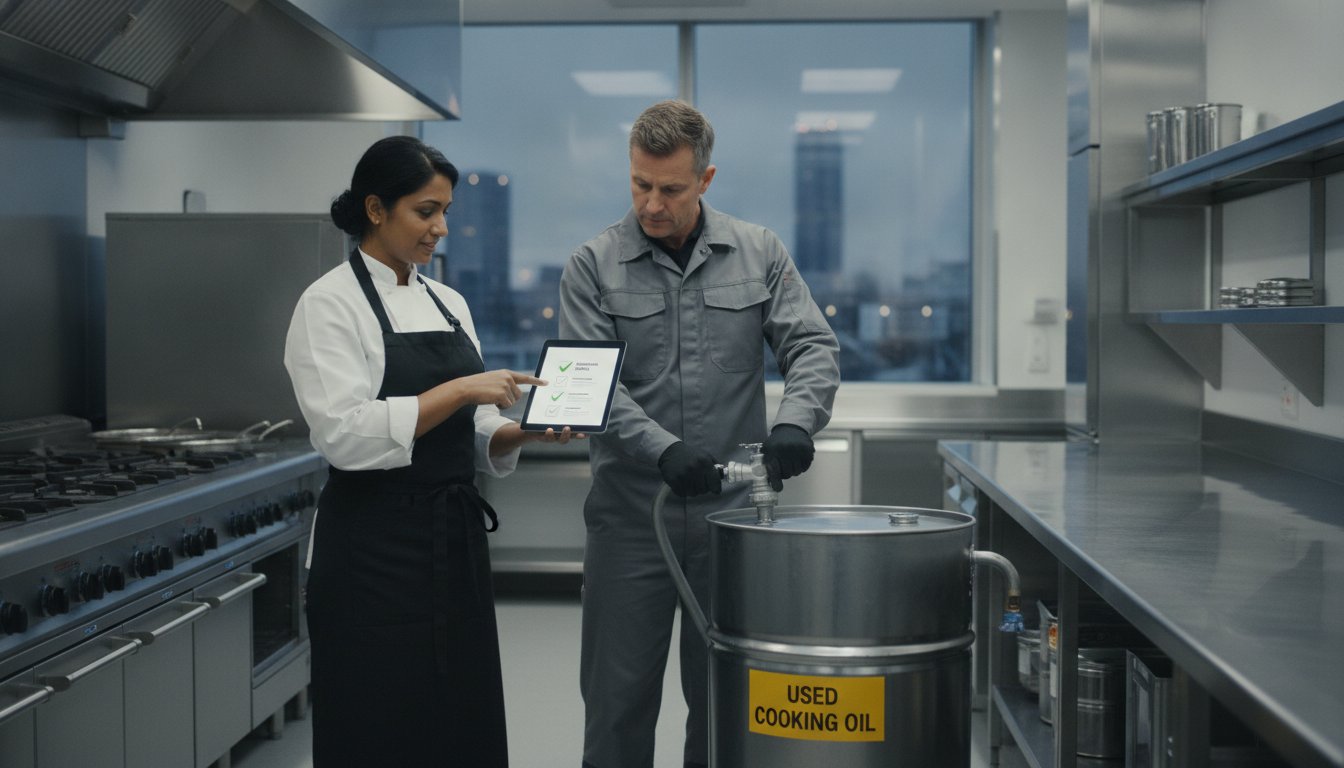
What if your restaurant’s biggest waste liabilities were actually hidden revenue streams waiting to be tapped? Running a busy kitchen in 2026 is a constant balancing act. You're likely feeling the squeeze from rising energy bills and the pressure of strict Environment Agency regulations. With mandatory food waste separation now in full effect for most businesses, it's easy to view sustainability as just another time-consuming cost centre. Your staff are already time-poor, and the last thing you need is a complex new process that slows down service.
We agree that staying compliant shouldn't break the bank or your workflow. This guide reveals how to implement a circular economy for restaurants UK to transform your operations from a linear "take-make-waste" model into a profitable, sustainable system. You'll discover how to navigate the 2026 waste laws, including the latest EPR packaging fees, whilst significantly lowering your operational overheads. We will walk through the exact steps to turn your kitchen waste into a brand-building asset that drives diner loyalty and generates immediate cash flow for your business.
Key Takeaways
- Understand how 2026 UK waste regulations have shifted the focus from optional green initiatives to mandatory operational efficiency.
- Apply a practical 5-step template to audit kitchen energy use, focusing on high-impact areas like refrigeration and ventilation to lower overheads.
- Implement a circular economy for restaurants UK to move beyond the "take-make-dispose" model and unlock value in your existing waste streams.
- Convert used cooking oil from a liability into immediate revenue with on-the-spot cash payments and guaranteed legal compliance.
- Protect your business from Environment Agency audits by ensuring every waste collection is backed by a valid Waste Transfer Note.
The 2026 Landscape: Why Sustainable Restaurant Practices are Mandatory
In 2026, sustainable restaurant practices aren't just about moral high ground; they're about business survival. The UK market has moved past the era of "optional eco-friendly" extras. Today, sustainability is synonymous with mandatory operational efficiency. If you aren't tightening your processes, you're losing money. Adopting a circular economy for restaurants UK means looking at your kitchen as a closed loop where every resource is squeezed for maximum value. This approach rests on three core pillars: energy efficiency, ethical sourcing, and rigorous waste management. By integrating these, you turn a cost-heavy operation into a lean, resilient machine.
The scale of the challenge is clear when you look at the data surrounding food waste in the United Kingdom. For a modern restaurateur, ignoring these figures isn't just bad for the planet; it's a direct threat to the bottom line. Waste disposal costs have climbed. Landfill taxes are up. Margins have thinned to the point where efficiency is now the only way to protect your profit. You can't afford to throw away potential revenue in an environment where every penny counts.
The Consumer Demand for Ethical Dining
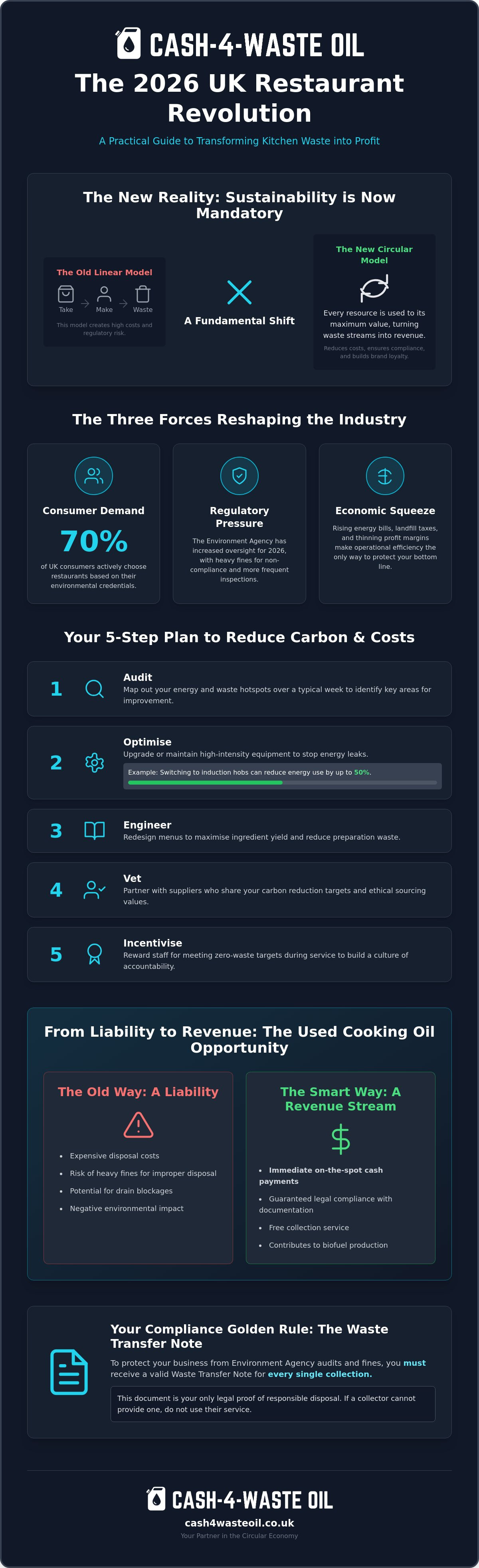
Diners have changed. 70% of UK consumers now actively choose restaurants based on their environmental credentials. They want to know where their food comes from and where the leftovers go. This shift has birthed the "Chop & Chat" trend. Chefs are no longer just cooks. They are sustainability influencers who use supply chain transparency to win trust. This isn't just about feeling good. It's about building long-term brand loyalty in a crowded market. Diners are caught between climate anxiety and the desire for ethical spending. They want their night out to align with their values. When they see you taking real action, they return.
Regulatory Compliance and the Environment Agency
The Environment Agency has ramped up its oversight for 2026. Commercial kitchens now face strict legal obligations regarding how they handle every waste stream. Fines for non-compliance are heavy. Inspections are more frequent than ever. You must ensure your team follows the latest commercial kitchen oil disposal standards to stay on the right side of the law. The most critical tool in your arsenal is the Waste Transfer Note. It's a simple document, but it's your only proof of legal disposal. If a collector can't provide one, walk away. Your business's reputation and bank account depend on that paper trail. Compliance is your insurance policy.
Reducing Your Restaurant Carbon Footprint: An Operational Template
Reducing your carbon footprint isn't a vague environmental goal; it's a series of measurable operational steps that protect your margins. Aligning your kitchen with the UK government's circular economy strategy ensures your business remains resilient against future policy shifts. A successful circular economy for restaurants UK relies on viewing every resource, from electricity to onion peelings, as an asset to be managed with precision. To help you transition, we've developed a 5-step template for auditing and reducing kitchen emissions:
- Audit: Map out your energy and waste hotspots over a typical week.
- Optimise: Upgrade or maintain high-intensity equipment to stop energy leaks.
- Engineer: Redesign menus to maximise ingredient yield and reduce prep waste.
- Vet: Partner with suppliers who share your carbon reduction targets.
- Incentivise: Reward staff for meeting zero-waste targets during service.
Building a zero-waste culture requires more than just new bins. It needs a shift in mindset where your team sees waste as lost profit. Training staff to spot inefficiencies, like leaving hobs on during prep or over-ordering perishables, creates a culture of accountability. When your team understands that sustainability makes their jobs easier and the business more secure, they'll drive the change themselves.
Step 1: The Energy Audit and Equipment Optimisation
Start with your most energy-intensive assets: refrigeration, hobs, and ventilation. Switching to induction hobs can reduce energy consumption by up to 50% compared to traditional gas burners, whilst also keeping the kitchen cooler. Regular maintenance of refrigeration units, such as cleaning coils and checking door seals, is a major sustainability win. A poorly maintained fridge works harder and uses more power, directly increasing your overheads. Simple swaps, like installing high-efficiency LED lighting in prep areas, offer quick returns on investment.
Step 2: Menu Engineering for Sustainability
Menu design is your most powerful tool for waste prevention. Adopting root-to-stem or nose-to-tail cooking ensures you're getting 100% value from every ingredient. Plant-forward menus generally have a significantly lower carbon impact than meat-heavy offerings, allowing you to appeal to eco-conscious diners whilst managing food costs. Accurate forecasting and portion control are essential; if you're consistently scraping plates into the bin, your portions or your menu mix need adjustment.
Step 3: Supply Chain Transparency
Look for suppliers who prioritise low-carbon logistics. In regions like Kent and Surrey, hyper-local sourcing isn't just a marketing gimmick; it's a logistical advantage that slashes food miles. Communicate these efforts clearly on your menus and social media to build trust. Transparency about your supply chain turns your sustainability efforts into a competitive advantage. For many kitchens, organising a professional waste oil collection is the easiest "quick win" to prove your commitment to circular operations whilst generating immediate cash flow.
Circular Economy in the Kitchen: Managing Waste Streams
Adopting a circular economy for restaurants UK requires a fundamental shift in how you view "rubbish". The traditional linear model of "take-make-dispose" is no longer viable in a high-cost, high-regulation market. Instead, you must transition to a system focused on "reuse-recycle-recover". This shift begins with the hierarchy of waste. Prevention is your first line of defence. If you can't prevent waste, you redistribute it. If redistribution isn't possible, you recycle or recover the energy from it. Disposal should be your absolute last resort, reserved only for materials that have zero remaining value.
Food waste management is the most visible part of this loop. For UK businesses, the choice usually sits between composting and anaerobic digestion. Whilst composting is excellent for small-scale herb gardens, anaerobic digestion is the professional standard for commercial volumes. It converts your organic scraps into renewable energy and bio-fertiliser. This process keeps methane-producing waste out of landfills and aligns perfectly with a broader sustainable waste oil disposal strategy. By treating every byproduct as a potential resource, you protect your business from rising disposal fees.
Eliminating Single-Use Plastics
Plastics are an operational drain. Replace cling film with reusable silicone lids or beeswax wraps for storage. For sous-vide or vacuum sealing, switch to certified compostable bags that meet UK standards. You should also demand better from your supply chain. Ask suppliers to deliver produce in reusable crates rather than single-use cardboard or plastic wrap. Switching to closed-loop beverage systems, such as draught wine or post-mix soft drinks, significantly reduces the volume of glass and aluminium your team has to process. These changes cut your waste disposal costs and simplify your back-of-house logistics.
Water Conservation Strategies
Water scarcity is a growing concern that directly impacts UK food supply chains and utility costs. You can reduce consumption immediately by installing low-flow taps and aerators on your sinks. These devices cut water use by up to 50% without affecting the pressure needed for rinsing. Implement a strict "full loads only" policy for dishwashers to maximise efficiency. A simple staff training hack is to enforce "dry scraping" of plates with a spatula before they reach the sink. This prevents heavy debris from entering the grease trap and saves thousands of litres of water every month. Smart water management is a quiet but effective way to boost your bottom line.
Turning Waste into Revenue: The Used Cooking Oil Opportunity
Managing used cooking oil (UCO) is often viewed as a messy chore. However, in a circular economy for restaurants UK, it is actually one of your most valuable assets. If mismanaged, UCO is a significant operational liability. If handled correctly, it becomes a consistent revenue stream. Instead of paying a waste management firm to haul it away, you can transform this byproduct into a cash rebate. This shift turns a necessary disposal task into a smart financial decision that supports your monthly cash flow.
Your waste oil doesn't just disappear; it fuels the UK’s green energy sector. Most collected UCO is processed into high-grade biodiesel. According to industry data, this renewable fuel can reduce greenhouse gas emissions by up to 89% compared to standard fossil diesel. By recycling your oil, you are providing the essential feedstock for this industry. To ensure your oil is suitable for this process, you must follow specific used cooking oil for biodiesel requirements. Contaminated or poor-quality oil is harder to process and often fetches a lower value.
The Legalities of Oil Disposal
Pouring oil down the sink is illegal and financially reckless. It leads to the formation of "fatbergs" in the sewer system. These blockages cost millions to clear and result in massive fines for the offending business. To stay compliant, you must use a licensed waste carrier registered with the Environment Agency. They provide the necessary Waste Transfer Notes to prove you have met your legal duty of care. Understanding the environmental impact of recycling cooking oil helps your team see why these regulations exist. It isn't just about avoiding fines; it's about preventing ecological damage and sewer overflows.
Maximising the Value of Your Waste Oil
To get the best return, you need to preserve the quality of your oil. Store it in a clean, lidded container to prevent rainwater or food debris from getting inside. Contamination reduces the price you'll receive and can even make the oil uncollectable. Opting for "Cash on the Spot" services is the most pragmatic choice for busy kitchens. It provides immediate liquidity and eliminates the need to chase invoices or wait for bank transfers. It turns a waste stream into a petty cash injection.
Regular collection schedules are essential for kitchen safety. Letting old oil sit for too long creates slip hazards and fire risks. It also attracts pests. A professional service takes this burden off your shoulders, keeping your prep areas clear and compliant. If you want to see how easy this transition can be, you can book a free waste oil collection today and start turning your waste into profit.
Implementation Strategy: Partnering with Cash 4 Waste Oil
Transitioning to a circular economy for restaurants UK is most effective when the changes are seamless. You don't need another complex system; you need a reliable partner to handle the logistics. Cash 4 Waste Oil acts as that partner for kitchens across the capital and the Midlands. Our service is designed for the fast-paced nature of the hospitality industry. We provide a no-nonsense collection process that is free, fast, and financially rewarding. By integrating our service into your cooking oil recycling London framework, you ensure your kitchen remains efficient and profitable.
We handle the heavy lifting so your team can focus on service. Your staff simply store the oil in a safe, accessible area and we do the rest. This isn't just about waste removal; it's about professional resource management. You get immediate cash payments and the peace of mind that comes with full regulatory compliance. It is a smart business decision that benefits both your bottom line and the environment. We turn a messy byproduct into a streamlined revenue stream without adding to your operational workload.
Coverage Areas: From London to the Midlands
We operate across London, Kent, Surrey, Birmingham, and Coventry. In these busy urban centres, speed and reliability are essential. A local, responsive collector prevents your storage areas from becoming cluttered with old containers. You can book a one-off collection to clear a backlog or set up a recurring schedule that matches your oil usage. This flexibility allows you to manage your back-of-house space effectively without worrying about overflow or hygiene issues. Our drivers are familiar with the unique access challenges of city-centre kitchens, ensuring a hassle-free experience every time we visit.
The Cash 4 Waste Oil Guarantee
Our service is built on transparency and legitimacy. As an Environment Agency registered waste carrier, we provide a valid Waste Transfer Note with every single collection. This document is your legal shield during inspections and proves your commitment to the circular economy for restaurants UK. We offer transparent pricing based on the current market value of biodiesel feedstock, ensuring you receive a fair cash rebate per litre on the spot. By partnering with us, you are directly powering the UK’s green energy future. We process your waste oil into high-grade biodiesel, closing the loop and proving that sustainability is a profitable asset for any commercial kitchen.
Future-Proof Your Kitchen for a Sustainable 2026
Implementing a circular economy for restaurants UK is the most effective way to protect your margins whilst meeting the strict environmental standards of 2026. You've seen how auditing energy use and redesigning menus can slash overheads. By treating waste streams as valuable resources rather than expensive liabilities, you stay ahead of Environment Agency regulations and build genuine loyalty with ethical diners. It's about making smart, pragmatic choices that benefit your bank account as much as the planet.
The quickest win for your bottom line is turning used cooking oil into immediate profit. Cash 4 Waste Oil offers a hassle-free solution that fits a busy service schedule. We're Environment Agency registered and provide legal Waste Transfer Notes with every visit to ensure your compliance. You get free collection across London, Kent, Surrey, and the Midlands, with cash paid on the spot. This simple switch removes a logistical headache and replaces it with a reliable revenue stream.
Ready to streamline your waste management and boost your cash flow? Get Cash for Your Waste Oil Today - Book a Free Collection. Taking action today ensures your restaurant remains resilient, compliant, and profitable for years to come.
Frequently Asked Questions
How can I reduce my restaurant carbon footprint without spending a fortune?
Focus on behavioural changes and equipment maintenance to see immediate results. Simple tasks like cleaning refrigeration coils, checking door seals, and ensuring hobs are switched off during prep hours require zero capital but significantly lower energy bills. Training your team to dry-scrape plates before washing also saves thousands of litres of water. These small, consistent adjustments create a more efficient kitchen and reduce your environmental impact without requiring a massive upfront investment.
Is used cooking oil worth money in the UK in 2026?
Yes, used cooking oil is a valuable commodity that generates a consistent revenue stream for your business. Instead of paying for disposal, you can receive cash payments per litre based on the volume you produce. This is a core component of a circular economy for restaurants UK, as it turns a messy byproduct into a liquid asset. Prices vary based on global demand for biodiesel feedstock, but it remains a reliable way to boost your monthly cash flow.
What is a Waste Transfer Note and why does my restaurant need one?
A Waste Transfer Note (WTN) is a legal document required by UK law for every load of commercial waste that leaves your premises. It tracks the waste from the producer to the final disposal point, ensuring it is handled responsibly by a licensed carrier. You must keep these records for at least two years. Without a valid WTN, your restaurant risks heavy fines from the Environment Agency during a routine inspection or compliance audit.
Can I pour small amounts of cooking oil down the kitchen sink?
No, you should never pour any amount of oil, fat, or grease down the sink. Even small quantities solidify in the pipes, leading to blockages and the formation of fatbergs. This practice is a major cause of sewer flooding and can result in significant repair costs and legal penalties for your business. Always scrape pans into a dedicated waste bin and store your used oil in a sealed container for professional collection and recycling.
How does recycling cooking oil into biodiesel help the environment?
Recycling oil diverts harmful waste from sewers and landfills, converting it into a renewable energy source. Biodiesel produced from used cooking oil has a much lower carbon intensity than traditional fossil diesel, significantly reducing greenhouse gas emissions in the transport sector. This process supports the circular economy for restaurants UK by ensuring that a single resource is reused for a secondary, high-value purpose rather than being discarded as a pollutant.
Which areas of the UK does Cash 4 Waste Oil cover for collections?
Cash 4 Waste Oil provides comprehensive coverage across London, Kent, Surrey, and the Midlands, including major hubs like Birmingham and Coventry. We specialise in serving fast-paced urban kitchens that require reliable and responsive service. If your restaurant is located within these regions, you can arrange for free collections and receive cash on the spot. This ensures your waste management is both legally compliant and financially beneficial for your operations.
What are the most effective sustainable restaurant practices for small cafes?
Small cafes should prioritise waste prevention and hyper-local sourcing to see the best returns. Reducing single-use packaging and implementing tight portion controls are highly effective ways to lower your environmental impact whilst protecting your margins. Partnering with local suppliers reduces food miles and supports the regional economy. Additionally, ensuring your used cooking oil is collected for recycling is a simple "quick win" that provides a revenue boost whilst meeting your legal obligations.
How do I ensure my kitchen waste disposal is Environment Agency compliant?
Compliance requires using a licensed waste carrier and maintaining a clear paper trail of Waste Transfer Notes for every collection. You must ensure that different waste streams, such as food scraps and packaging, are correctly separated according to the latest UK regulations. Regularly auditing your disposal partners to confirm they are Environment Agency registered is essential. This due diligence protects your business from the risk of heavy fines and ensures your waste is handled ethically.