In 2026, the Environment Agency doesn't just issue warnings. They issue unlimited fines that can cripple a commercial kitchen overnight. If you're still treating used oil as a nuisance rather than a regulated asset, you're risking heavy fines for improper cooking oil disposal UK. It's understandable to feel overwhelmed by the shifting landscape of environmental law and the "Duty of Care" principle. You want a clean kitchen and a simple way to stay legal without the paperwork headache.
This guide explains how to achieve total compliance while streamlining your waste management. You'll learn how to navigate the latest 2026 regulations, why the Waste Transfer Note is your primary defence, and how to turn waste oil into a reliable source of income. We'll show you how to secure your business with a system that's both legally compliant and financially rewarding. Following these steps ensures your kitchen remains efficient, your records stay up to date, and your waste starts paying for itself.
Key Takeaways
- Understand why 2026 regulations now allow the Environment Agency to issue unlimited penalties for liquid waste offences.
- Learn the two-step routine for safe oil storage that prevents kitchen accidents and maintains site hygiene.
- Protect your business from fines for improper cooking oil disposal UK by ensuring every collection includes a valid Waste Transfer Note.
- Discover how water companies trace "fatberg" blockages to specific premises and how to avoid these sewerage penalties.
- Maximise your profits by switching to a free collection service that provides immediate cash payments for your used oil.
Understanding Fines for Improper Cooking Oil Disposal in the UK (2026)
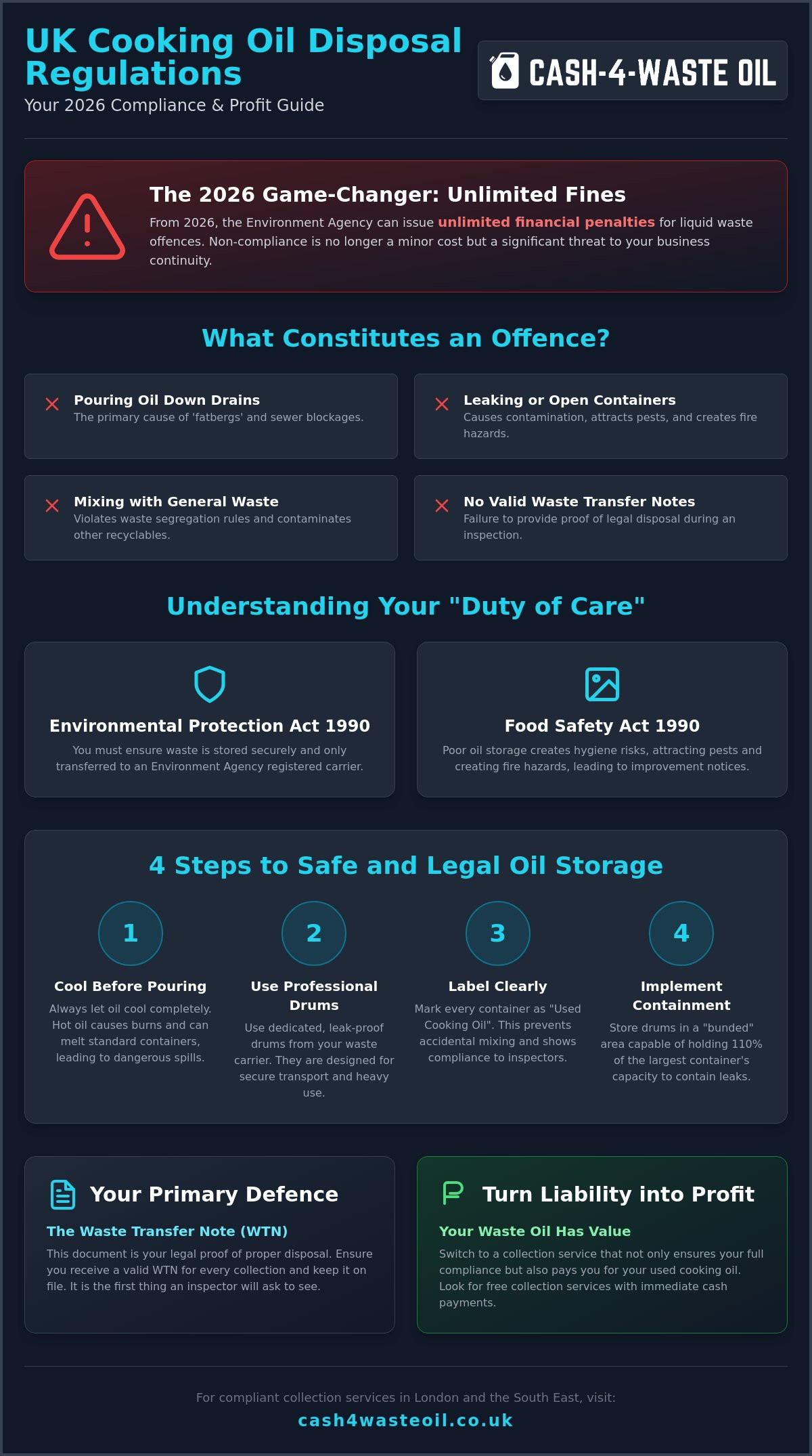
Disposing of used cooking oil incorrectly is no longer a minor oversight; it's a significant legal risk. In 2026, the threshold for "improper disposal" includes any action that allows oil to enter the public drainage system or involves handing waste to an unauthorised carrier. You face enforcement from two primary fronts. Local Water Authorities focus on sewer blockages and "fatbergs," whilst the Environment Agency monitors broader environmental pollution. For serious breaches, the cap on financial penalties has been removed. This means your business could face unlimited fines for improper cooking oil disposal UK if your waste management fails to meet statutory standards.
Improper disposal isn't limited to pouring oil down the sink. It also covers:
- Storing oil in leaking or open containers.
- Mixing cooking oil with general food waste.
- Using a sink macerator (banned in England since 2025).
- Failing to produce valid Waste Transfer Notes during an inspection.
Beyond the financial impact, local councils frequently publish the names of non-compliant businesses. This "naming and shaming" causes lasting reputational damage. In a digital age, a public record of environmental negligence can turn customers away faster than any health inspection grade.
The Food Safety Act and Environmental Protection Act
Compliance starts with Section 34 of the Environmental Protection Act 1990. This legislation establishes your "Duty of Care," requiring you to ensure waste is stored securely and only transferred to carriers registered with the Environment Agency. The Food Safety Act 1990 runs alongside this, focusing on kitchen hygiene. If oil is stored poorly, it attracts pests and creates a fire hazard, leading to immediate improvement notices. Your Duty of Care is a permanent legal obligation that stays with you from the moment the oil is used until it's safely recycled.
The Real Cost: Potential Financial Penalties in 2026
Minor administrative errors, such as missing records or incorrect labelling, often result in Fixed Penalty Notices (FPNs). These are immediate costs that eat into your weekly margins. However, the stakes rise for major incidents like oil spills or contributing to a What is a fatberg? blockage. In these cases, the Environment Agency can pursue criminal prosecution in Crown Court. You won't just pay a fine; you'll also be liable for "remediation" costs. This involves paying the full bill for professional sewer cleaning and environmental cleanup. When a business is found responsible for a major blockage, these costs can easily reach five or six figures, making fines for improper cooking oil disposal UK a genuine threat to business continuity.
How to Organise Legal Cooking Oil Storage in Your Kitchen
Compliance starts with your storage setup. If your containers leak or aren't secured, you risk environmental contamination and hefty fines for improper cooking oil disposal UK. Proper storage isn't just about tidiness; it's a legal requirement under your Duty of Care. Follow these four steps to secure your premises and protect your margins.
- Step 1: Cool before you pour. Always allow oil to cool completely before transferring it. Hot oil causes severe burns and melts standard plastic containers, leading to spills that are difficult and expensive to clean.
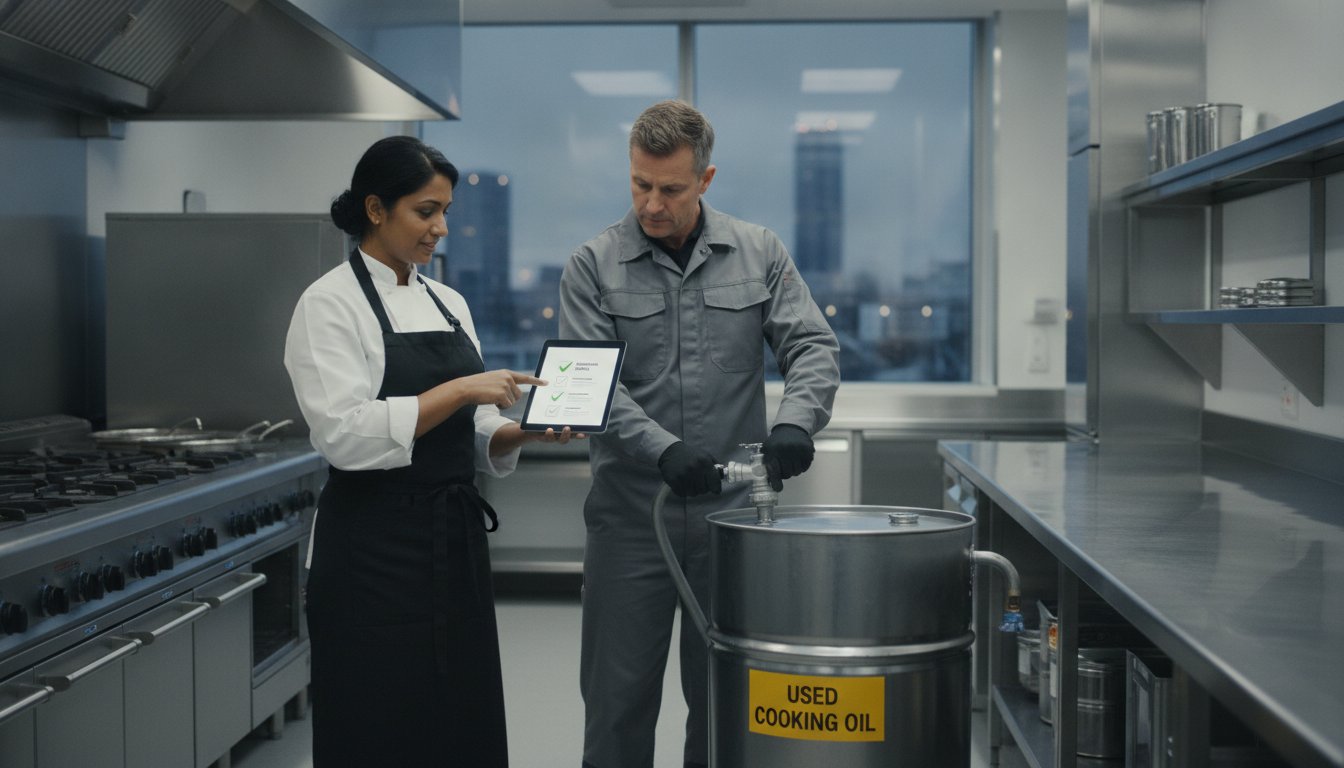
- Step 2: Use professional equipment. Relying on old vegetable oil tins is a mistake. Use dedicated, leak-proof drums supplied by a licensed waste carrier for cooking oil. These containers are designed for heavy use and secure transport.
- Step 3: Label clearly. Every drum must be marked as "Used Cooking Oil." This ensures staff don't mix waste streams and helps inspectors identify your compliance efforts immediately.
- Step 4: Implement secondary containment. Store your drums in a "bunded" area. A bund is essentially a tray or wall that can hold 110% of the largest container's capacity, preventing leaks from reaching the drains.
Choosing the Right Location for Oil Drums
Location is critical for both safety and security. If you store drums outdoors, keep them in a locked area to prevent theft and vandalism. Thieves often target used oil to sell to unregulated processors, leaving you without the necessary Waste Transfer Notes. Ensure your storage area is far from surface water drains. According to UK oil storage regulations, businesses storing large quantities must follow specific structural guidelines to prevent pollution. For indoor storage, prioritise fire-safe zones away from heat sources and food preparation areas to maintain hygiene standards.
Staff Training and Spill Prevention
Technology and equipment only work if your team knows how to use them. Implement a strict "Zero to Drain" policy. This means no oil, fat, or grease ever enters the sink, regardless of the volume. Provide a basic spill kit containing absorbent pads and sand to manage minor accidents instantly. Document all staff training sessions. This paper trail proves to inspectors that you've used "reasonable endeavours" to prevent fines for improper cooking oil disposal UK. If you need help setting up a compliant system, Cash 4 Waste Oil can provide the necessary drums and guidance to keep your kitchen running smoothly.
The Essential Paperwork: Waste Transfer Notes and Compliance
A Waste Transfer Note (WTN) is your only legal defence during an inspection. Without this document, you cannot prove where your waste went or who took it. If you fail to produce a valid WTN upon request, you are immediately vulnerable to fines for improper cooking oil disposal UK. It acts as a receipt of responsibility, shifting the legal liability from your kitchen to the waste carrier once the oil leaves your site.
Every WTN for used cooking oil must contain six mandatory fields to be legally binding:
- Description of the waste: Usually listed as "Used Cooking Oil" or the specific EWC code (20 01 25).
- Quantity and container type: The volume collected and whether it was in drums or a bulk tank.
- Standard Industrial Classification (SIC) code: The five-digit code identifying your specific business type.
- Transfer details: The exact date, time, and full address of the collection point.
- Carrier information: The name, address, and Environment Agency registration number of the collector.
- Signatures: Both you and the collector must sign to confirm the transfer was successful and legal.
In 2026, the UK has shifted toward mandatory digital waste tracking. This move simplifies record-keeping by providing a clear, tamper-proof audit trail. Digital systems ensure you never lose a physical slip of paper and make it easier to demonstrate compliance during a busy service. It is a smart business move to adopt digital systems now to avoid administrative errors that lead to penalties.
Environment Agency Inspections: What to Expect
Enforcement officers rarely visit at a convenient time. Inspections are often triggered by reports of sewer blockages in the local area or complaints about foul odours from outdoor storage. When an officer arrives, they will ask to see your waste records immediately. To satisfy them, you must present an organised file of your WTNs. Under the "Two-Year Rule," you are legally required to keep every Waste Transfer Note for at least 24 months. If your records are incomplete or missing, you risk an on-the-spot penalty.
Verifying Your Collector’s Licence
Handing your oil to an unaccredited "man with a van" is a fast track to legal trouble. If they fly-tip your oil, the Environment Agency will trace it back to you. Always check the Environment Agency public register to verify your carrier’s licence before they touch your drums. This simple check protects you from fines for improper cooking oil disposal UK and ensures your waste is handled by professionals. For more advice on choosing the right partner, read our Sustainable Waste Oil Disposal guide. Using a registered partner like Cash 4 Waste Oil guarantees you receive a legal WTN and a legitimate cash payment for every litre collected.
Preventing "Fatbergs" and Local Sewerage Penalties
Fatbergs are massive, solid blockages formed when fats, oils, and grease (FOG) combine with non-flushable items in the sewer system. Commercial kitchens are the primary contributors to these obstructions due to the sheer volume of liquid waste produced during daily service. Water companies no longer rely on guesswork to find the source. They now use advanced CCTV and AI-driven sensors to monitor flow rates and grease accumulation in real time. If a blockage occurs, they can trace the FOG trail directly back to your business's specific drain outlet.
The legal consequences are severe. Under the Water Industry Act 1991, it's a criminal offence to discharge any substance that interferes with the free flow of the public sewer. Violating this act leads to prosecution and massive fines for improper cooking oil disposal UK. Beyond the statutory penalty, you'll also be liable for "recharge" costs. This means you'll pay the full bill for the emergency excavation, high-pressure jetting, and specialist cleaning required to remove the blockage. These operational costs often far exceed the initial fine.
The Role of Grease Traps and Interceptors
A grease trap is a mandatory requirement for almost every commercial kitchen in the UK. However, simply installing one isn't enough to satisfy an inspector. You must maintain a rigorous cleaning schedule and keep detailed records of every service. If a water authority investigates your premises following a local blockage, these logs serve as vital evidence of responsible behaviour. They prove you've taken all reasonable steps to prevent grease from entering the network, which can be the difference between a warning and a court date.
Daily Best Practices for Fryer Management
Efficient kitchen management reduces the load on your interceptors and protects your drainage. Start by scraping all plates, pots, and trays directly into the food waste bin before they reach the sink. Implement the "dry-wipe" technique; use paper towels to remove the bulk of oily residue from pans and equipment before washing. Never use chemicals marketed to "dissolve" or "liquefy" grease. These products often just emulsify the oil, allowing it to pass through your trap only to re-solidify further down the sewer line. This actually increases your risk of being linked to a fatberg and facing fines for improper cooking oil disposal UK.
To ensure your waste oil never touches the drain and stays within the law, book a free collection with Cash 4 Waste Oil today. We provide the equipment and documentation you need to stay compliant.
Turning Liability into Profit: Professional Collection in London and the South East
Legal compliance doesn't have to be a drain on your resources. Whilst the threat of fines for improper cooking oil disposal UK is a serious concern for any kitchen manager, the solution is actually a revenue-generating opportunity. Cash 4 Waste Oil operates a model built on efficiency and mutual benefit. We provide free collection services across London, Kent, Surrey, and the Midlands, ensuring your used oil is handled by an Environment Agency registered carrier at zero cost to your business.
Instead of worrying about the unlimited penalties discussed in this guide, you can focus on your bottom line. We take your waste oil and transport it to specialist facilities where it is refined into sustainable biodiesel. This process supports the circular economy and significantly reduces the carbon footprint of the UK hospitality sector. By partnering with a professional service, you transform a messy liability into a clean, profitable asset that satisfies every regulatory requirement.
The "Cash on the Spot" Advantage
Small businesses often struggle with the mounting costs of waste management. Most contractors charge for the removal of liquid waste, but we believe your used oil has intrinsic value. We offer per-litre rebates for vegetable and sunflower oils, providing immediate cash payments at the time of collection. This "cash on the spot" model is designed to support your daily cash flow whilst removing any temptation to use unregulated disposal methods.
Transparent pricing is the foundation of a good waste partnership. You'll know exactly what you're earning based on the volume we pump from your drums. There are no hidden fees or administrative charges for the legal documentation we provide. This clarity helps you forecast your waste-related income and ensures you're getting a fair deal for your kitchen's byproducts. Our service makes it easier to avoid fines for improper cooking oil disposal UK by making the legal route the most profitable one.
Booking Your First Collection
We've made the logistics as simple as possible to suit the fast-paced nature of the service industry. You can schedule a one-off pickup or organise a recurring collection schedule via a quick phone call or WhatsApp message. Our teams understand the constraints of busy kitchens and work quickly to ensure minimal disruption to your service. On collection day, our process is straightforward:
- The Pump: Our driver pumps the oil directly from your storage drums into our specialised vehicle.
- The Payment: We verify the volume and provide your cash payment immediately.
- The Paperwork: You receive a professional Waste Transfer Note, which is your ultimate shield against enforcement officers.
It's a hassle-free process that keeps your kitchen clean, your records up to date, and your business profitable. To start earning from your waste, book your first collection with Cash 4 Waste Oil and secure your 2026 compliance today.
Securing Your Kitchen’s Future and Bottom Line
Compliance in 2026 is no longer about ticking boxes; it's about protecting your business from financial ruin. You've seen how the Environment Agency has shifted toward unlimited penalties and how digital tracking leaves no room for error. Staying safe requires a commitment to proper storage, rigorous staff training, and the meticulous filing of Waste Transfer Notes. These steps don't just prevent fines for improper cooking oil disposal UK; they create a cleaner, more professional kitchen environment that benefits everyone.
The most efficient way to manage this liability is to turn it into a resource. By choosing a partner that values your waste, you solve the compliance headache whilst boosting your cash flow. Cash 4 Waste Oil is an Environment Agency Registered Carrier dedicated to making this transition seamless. We provide fully compliant Waste Transfer Notes for every pickup and pay cash per litre on the spot. It's time to stop worrying about inspections and start getting paid for your waste.
Get a free collection and cash for your waste oil today and ensure your business stays ahead of the regulations. You've got the tools and the knowledge to succeed; now take the final step toward total compliance.
Frequently Asked Questions
What is the maximum fine for pouring cooking oil down the drain in the UK?
Fines for pouring cooking oil down the drain can be unlimited for serious environmental offences. Whilst minor breaches may result in a fixed penalty notice or a £5,000 summary fine, the Environment Agency now pursues uncapped penalties for major sewer blockages or persistent negligence. You'll also be liable for the full cost of clearing any blockages your business causes. This remediation cost often exceeds the statutory fine itself.
Do I need a Waste Transfer Note if the collection is free?
Yes, you must have a Waste Transfer Note even if the collection is free of charge. The document is your legal proof of Duty of Care compliance under the Environmental Protection Act 1990. It tracks the waste from your kitchen to its final destination. Without this paperwork, you risk fines for improper cooking oil disposal UK during a routine local council or Environment Agency inspection. Always ensure the collector signs the note.
Can I dispose of used cooking oil in my general waste bin?
No, you cannot dispose of liquid cooking oil in your general waste bin. Liquid waste has been banned from UK landfills since 2007. Mixing oil with general waste creates a significant pollution risk and attracts pests to your site. You must store oil in separate, leak-proof containers and arrange for collection by a licensed carrier to remain compliant with current environmental laws and keep your kitchen hygienic.
How do I know if my waste oil collector is legally registered?
You can verify a collector's status by checking the Environment Agency's public register of waste carriers. Every legitimate collector will have a unique registration number that you can search online. Don't take their word for it; verify the details yourself before allowing them to remove any waste. A registered partner will always provide a professional Waste Transfer Note that includes their full licence details and company address.
What happens if I lose my Waste Transfer Note records?
Losing your records puts you in breach of the Two-Year Rule, which requires businesses to keep all waste documentation for 24 months. If an enforcement officer visits and you can't produce these notes, you could face an immediate fixed penalty notice. To avoid this, switch to a digital tracking system or keep a dedicated, backed-up folder for all physical copies received at the time of collection. Consistency is key to compliance.
Is it illegal for a restaurant to sell its waste oil to an unlicensed person?
Yes, it is illegal to hand over or sell your waste oil to anyone who does not hold a valid waste carrier licence. Your Duty of Care means you are legally responsible for the waste until it reaches a registered processing facility. If an unlicensed collector fly-tips your oil, the authorities will trace it back to your kitchen, leading to prosecution and heavy fines for improper cooking oil disposal UK. Only use accredited partners.
Do these regulations apply to small takeaways as well as large hotels?
These regulations apply equally to every commercial food business, regardless of size or turnover. Whether you run a small local takeaway or a 500-room hotel, the law regarding liquid waste disposal is identical. Small businesses are often checked more frequently by local councils, so maintaining a clean record and proper documentation is essential for avoiding unexpected financial penalties. Compliance is a universal requirement for anyone producing controlled waste in a professional setting.
How often should a commercial kitchen have its waste oil collected?
Collection frequency depends on your kitchen's output, but you should never allow your storage drums to become overfilled. Most busy kitchens find that a fortnightly or monthly schedule works best to maintain hygiene and fire safety standards. Regular collections prevent the buildup of foul odours and reduce the risk of accidental spills that could lead to environmental contamination and subsequent enforcement action from your local water authority or the council.