
The most expensive waste oil contracts for restaurants aren't the ones with the lowest rebates; they're the ones that leave you with a backlog of drums and no legal paperwork when the inspector knocks. You need a reliable solution that keeps your kitchen clear and your books clean. In 2026, with the UK's expected transition to the Digital Waste Tracking Service, the margin for error regarding your waste disposal has completely vanished. Whether you operate in London, Kent, or Surrey, your focus should be on the pass, not the grease trap.
You're likely tired of chasing unreliable collectors or worrying about the heavy fines associated with missing Waste Transfer Notes. It's a common headache for busy hospitality professionals, but it shouldn't be your burden to carry. This guide reveals how to secure a waste oil agreement that ensures legal compliance whilst maximising your kitchen’s revenue. We'll explore the shift to digital tracking, explain why restrictive lock-in clauses are a thing of the past, and show you how to get paid cash on the spot for every litre you produce. We'll help you turn a messy chore into a streamlined profit centre while ensuring you meet the latest Environment Agency standards.
Key Takeaways
- Learn how to navigate the 2026 digital waste tracking requirements and ensure every collection is backed by a legal Waste Transfer Note.
- Understand the difference between restrictive waste oil contracts for restaurants and flexible collection models that prioritise your kitchen's cash flow.
- Discover how to secure transparent pricing and immediate cash payments for your used cooking oil instead of waiting for delayed rebates.
- Get a step-by-step plan to audit your oil usage and verify a collector’s Environment Agency licence to avoid regulatory fines.
- Find out why a no-fuss, local partnership in London, Kent, or Surrey often outperforms faceless national service agreements.
What are Waste Oil Contracts for Restaurants?
A waste oil agreement is a formalised arrangement between a food business and a licensed waste carrier. It outlines how, when, and where your used cooking oil is collected and processed. While industrial waste oil is defined as any petroleum-based or synthetic oil, the hospitality sector focuses on vegetable-based fats that must be diverted from sewers and into the circular economy. These waste oil contracts for restaurants act as a framework for both logistics and legal protection.
In 2026, these agreements have become essential due to the UK's transition to the Digital Waste Tracking Service. The government now requires a real-time electronic trail for all commercial waste. Relying on "man with a van" collectors who offer no paperwork is a fast track to a heavy fine. A professional contract ensures that your oil is handled by an Environment Agency registered carrier, protecting you from rogue operators who might dump your waste illegally.
The Legal Necessity: Waste Transfer Notes
Every single collection requires a Waste Transfer Note (WTN). This document is your proof that you have fulfilled your "Duty of Care" under UK environmental law. If an inspector visits your kitchen, they won't ask for a verbal promise; they will ask to see your records. In 2026, a valid WTN must contain specific details, including your Standard Industrial Classification (SIC) code, the volume of oil collected, and the carrier's full licence details. You must store these records, either digitally or in hard copy, for at least two years. Failing to produce them on demand can result in an immediate fixed penalty notice.
Commercial vs. Regulatory Requirements
It is vital to distinguish between what the law demands and what a provider tries to sell you. The law requires you to use a licensed carrier and keep records. It does not require you to sign a restrictive, multi-year deal with hidden service fees. Many national corporations use "contracts" as a way to lock independent restaurants into low rebates.
A smart business owner looks for an agreement that satisfies the Environment Agency whilst remaining commercially viable. This means knowing the current used cooking oil price per litre UK kitchens are achieving before you commit. You don't always need a 12-month commitment to stay compliant. You simply need a reliable, licensed partner who provides immediate documentation and fair payment. Transparency is the best indicator of a professional service.
Essential Features of a Professional Collection Agreement
A professional agreement should do more than just tick a regulatory box. It must actively support your kitchen's daily operations. When reviewing waste oil contracts for restaurants, look for explicit clauses regarding payment transparency and equipment maintenance. A vague promise of "market rates" often leads to disappointment. Instead, ensure you know the exact used cooking oil price per litre UK providers are offering before any oil leaves your site. This prevents disputes and ensures your business receives fair value for its waste.
Reliability is the second pillar of a functional agreement. An overflowing oil drum isn't just a nuisance; it's a health and safety hazard that can lead to slips or pest infestations. Your agreement should specify a collection frequency that matches your output. Whether you need a weekly lift or a fortnightly visit, the schedule must be set in stone. Professional collectors will also provide clean, leak-proof barrels as part of the service. This keeps your storage area tidy and compliant with local council inspections.
Finally, never overlook licensing. Every professional agreement must be backed by an Environment Agency waste carrier licence. Using an unlicensed collector makes you legally liable for where that oil ends up. The financial costs of improper UCO disposal can be devastating, often involving massive fines and clean-up charges that far outweigh any small saving from a "cheap" collector. Always verify their credentials before signing anything.
Payment Models: Cash vs. Credit
Many national providers prefer complex credit note systems. These often involve 30-day payment terms or credits against future fresh oil purchases. For independent restaurants, this creates an administrative burden. Choosing a "Cash on the Spot" model provides immediate liquidity for your petty cash tin. It’s a transparent, no-nonsense way to ensure you get paid for every drop collected without waiting for a head office to process an invoice. If you want a simpler way to manage your returns, consider switching to a cash-based collection service.
Service Reliability in High-Traffic Areas
Operating a kitchen in London, Surrey, or Kent presents unique logistical challenges. Congestion charges, low emission zones, and narrow high streets mean that national fleets often struggle with punctuality. A professional agreement in these areas requires local expertise. You need a collector who understands specific borough access times and can navigate city centre traffic without missing your window. Look for providers who offer "on-call" flexibility. This is vital during busy periods like the Christmas season or bank holiday weekends when your oil production might double unexpectedly.
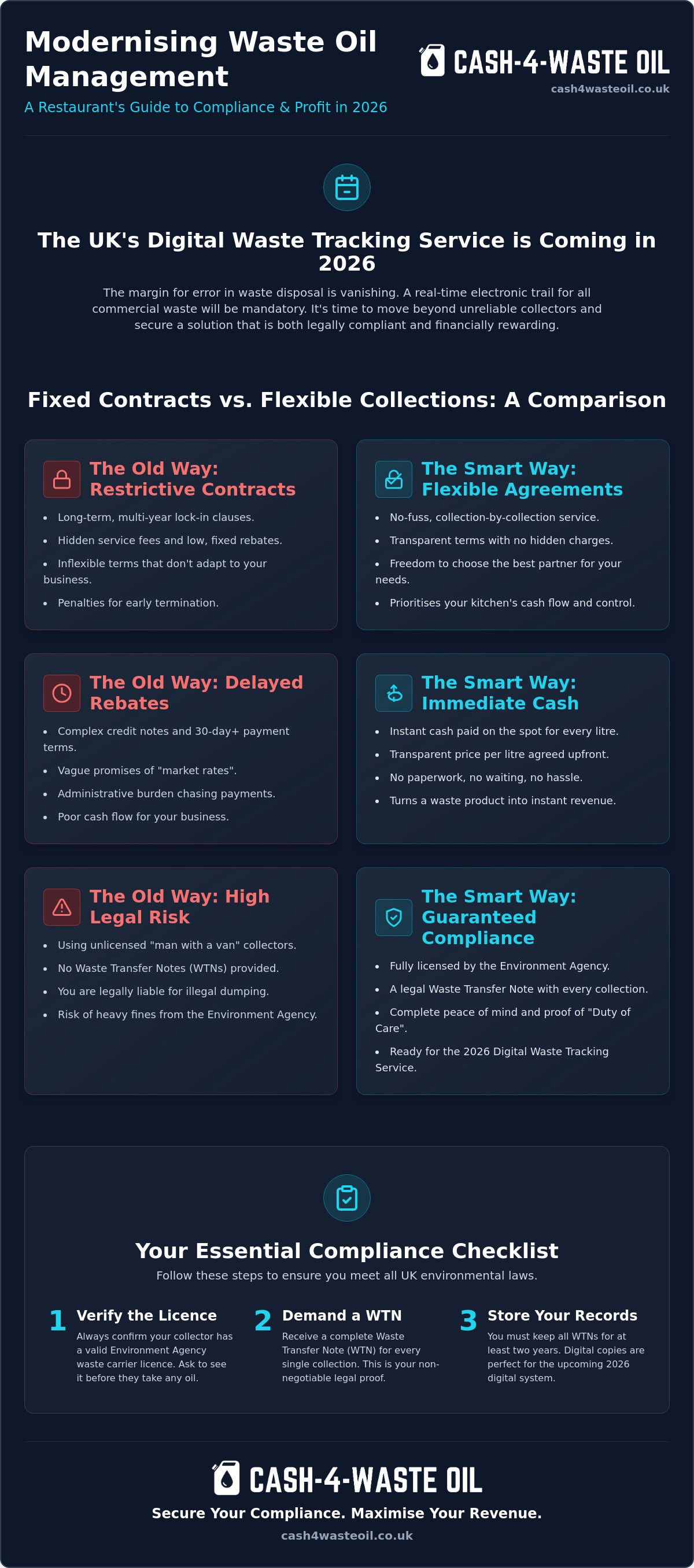
Fixed Contracts vs. Flexible Collections: A Comparison
Many national waste management firms push for multi-year waste oil contracts for restaurants, pitching them as a way to "lock in" rates and guarantee service. For a busy kitchen, the reality is often different. These rigid agreements frequently include auto-renewal clauses and hidden administrative fees that only surface when you try to leave. While a large corporation might value the predictability of a fixed term, independent eateries often find themselves trapped with unreliable collectors who know they face no repercussions for missed pickups.
The alternative is a flexible, service-led model. Instead of being bound by a legal "lock-in," you work with a provider on a rolling basis. This forces the collector to maintain high standards to keep your business. If the service slips or the rebates don't match market trends, you have the freedom to walk away. This approach mirrors the management standards found in international State Environmental Regulations, which prioritise the safe and efficient handling of waste over restrictive commercial ties. When you aren't tied down, you hold the power in the partnership.
The Pros and Cons of Long-Term Commitments
Fixed contracts can make sense for massive hotel chains or national franchises that require a single point of contact for dozens of sites. The consolidated billing and standardised reporting offer a level of administrative ease. However, the risks for a single-site operator are significant. If a national provider experiences fleet issues in your area, you're stuck at the bottom of their priority list with no legal recourse to switch. If you must sign a long-term deal, always insist on a robust exit clause. This should allow you to terminate the agreement without penalty if the provider misses more than two consecutive collections.
Why Flexibility Wins for Most UK Restaurants
Kitchen output is rarely constant. A seaside cafe in Kent will produce significantly more waste oil in July than in January. A flexible model allows you to adapt your collection frequency to match these seasonal peaks without paying for "ghost" visits or dealing with overflowing drums. It also ensures you can maintain sustainable waste oil disposal standards without being bogged down by the paperwork burden of a national contract.
Flexibility also means financial agility. If the market value for used cooking oil rises, a flexible provider is more likely to pass those gains on to you to ensure you don't switch to a competitor. In a fast-paced hospitality environment, your waste oil solution should adapt to your needs, not the other way around. Choosing a partner that values service over signatures ensures your oil is collected promptly, your kitchen remains compliant, and your rebates stay competitive.
How to Organise a New Waste Oil Collection Service
Setting up a new collection service should be a swift, administrative win for your business, not a logistical burden. Moving away from informal arrangements to structured waste oil contracts for restaurants ensures your kitchen remains tidy and your legal obligations are met. Follow these four steps to get your service running efficiently.
- Audit your usage: Calculate your weekly oil consumption to determine the storage capacity you require. Overestimating leads to wasted floor space; underestimating results in messy overflows.
- Verify the carrier’s licence: Check the Environment Agency’s public register to confirm your potential collector is a fully registered waste carrier. This is your primary defence against regulatory fines.
- Agree on a frequency: Set a schedule that reflects your busiest periods. Whether you need a weekly lift or an on-call service, consistency is key to preventing oil buildup.
- Finalise the paperwork: Confirm you will receive a Waste Transfer Note immediately upon collection. This document is essential for your 2026 digital waste tracking records.
Preparing Your Kitchen for First Collection
Proper storage is vital for maintaining the value of your waste. Keep your oil in a cool, dry area away from direct sunlight to prevent degradation. Most importantly, ensure no water or food debris enters the drums. Contaminated oil is harder to process into biodiesel and can lead to lower rebates. If your restaurant is tucked away in a narrow London alley or a busy Surrey high street, provide clear instructions on vehicle access. Knowing where the driver can safely park saves time and prevents missed windows during peak hours.
Switching Providers: A Seamless Transition
Transitioning to a better provider is simpler than it seems. If you have drums from a previous collector, notify them of your intent to cancel. Most reputable firms will collect their equipment within a few business days. To avoid a service gap, schedule your first pickup with your new provider for the day after your old agreement ends. This ensures you are never left with an accumulation of waste. Ensure your new Waste Transfer Notes are filed immediately to maintain your legal trail whilst you update your records. If you are ready for a cleaner, more profitable solution, book your first collection today with a licensed local expert.
Cash 4 Waste Oil: No-Fuss Compliance and Immediate Returns
We operate on a simple principle: high-quality service should keep a client, not a restrictive legal document. While many national providers insist on complex waste oil contracts for restaurants that lock you into long-term commitments, we choose a different path. Our no-contract model provides the ultimate flexibility for independent kitchens. We prioritise reliability and transparency, ensuring that you stay with us because you want to, not because a solicitor told you to. This approach removes the administrative stress of auto-renewals and hidden exit fees.
Our operations are deeply rooted in London, Kent, and Surrey. We understand the specific logistical hurdles of these regions, from navigating the ULEZ and Congestion Charge zones to meeting the strict waste disposal standards of local councils. By choosing a local partner, you benefit from a team that knows your streets and your specific business needs. We don't just collect your waste; we turn it into a resource. Every litre we pump is diverted into the circular economy, powering UK biodiesel production and reducing the environmental footprint of the hospitality sector.
The "Cash on the Spot" promise is at the heart of what we do. We don't believe in delayed rebates or complex credit notes that sit in your accounting software for months. Instead, we provide an immediate financial benefit for your kitchen. Our drivers pay you per litre at the point of collection, giving you instant liquidity for petty cash or operational expenses. It is a straightforward, honest transaction that rewards you for your environmental responsibility.
Professional Service with a Personal Touch
When you work with us, you get direct access to our team. We don't use frustrating call centres or automated queues that waste your time. Whether you run a small independent cafe or require hotel waste oil collection London wide, we tailor our frequency to your output. We handle all aspects of Environment Agency compliance during every visit. You receive a fully compliant Waste Transfer Note immediately, ensuring your digital records are always up to date and ready for inspection.
Start Earning from Your Waste Today
Organising your first collection takes less than two minutes. Once you book, our driver will arrive in a specialised vehicle, pump your oil efficiently, and leave your storage area clean. We provide fresh, clean barrels if needed, ensuring your kitchen remains tidy and compliant with health and safety regulations. Stop letting your used oil take up valuable space and start turning it into revenue. Get a free quote and book your collection now to experience a professional, no-nonsense waste solution.
Future-Proof Your Kitchen’s Waste Strategy
Navigating the legalities of 2026 doesn't have to mean signing away your freedom with restrictive waste oil contracts for restaurants. You've seen how a flexible, service-first approach provides the regulatory peace of mind you need whilst delivering the immediate financial returns your business deserves. By prioritising licensed carriers and immediate Waste Transfer Notes, you protect your kitchen from the risks of missing documentation and unreliable collection schedules. It is about making a smart business decision that benefits both your bottom line and the environment.
Choosing a local partner in London, Kent, or Surrey ensures your oil is collected promptly and processed sustainably into biodiesel. We are an Environment Agency Registered Waste Carrier that pays cash on every collection, providing immediate Waste Transfer Notes for your digital records. It is time to stop worrying about overflows and start benefiting from a transparent, no-nonsense service that values your time. Take control of your kitchen waste and let your oil work for your profit margins.
Turn your waste oil into cash – Book your London collection today
Your kitchen is busy enough; let us handle the grease whilst you focus on the food.
Frequently Asked Questions
Do I legally need a written contract for waste oil collection?
You don't legally require a long-term written contract, but you must have a "Duty of Care" agreement with a licensed waste carrier. The priority for the Environment Agency is that your waste is tracked and handled by a registered professional. Whilst some national firms insist on 12-month waste oil contracts for restaurants, a flexible service agreement that provides immediate documentation is perfectly legal and often more practical for independent kitchens.
How much cash can a restaurant expect per litre of waste oil?
The amount you receive depends on current market rates and the quality of your oil. Clean oil that is free from water and food debris typically fetches a higher rebate. Because we operate a "Cash on the Spot" model, we provide a fair market rate based on the volume collected at your premises. We recommend checking current trends to ensure you are getting a competitive return for your waste.
Is it legal for a collector to pay cash for used cooking oil?
Yes, it is entirely legal to receive cash payments for your used cooking oil, provided the transaction is documented correctly. The critical requirement is that a Waste Transfer Note is issued for the collection. This note proves the transfer of waste from your business to a licensed carrier. Cash payments offer immediate liquidity for your kitchen's petty cash without the administrative delays of bank transfers or credit notes.
What happens if I don’t have a Waste Transfer Note?
Failing to produce a valid Waste Transfer Note (WTN) during an inspection can result in a significant fixed penalty notice or prosecution. Under the 2026 digital waste tracking requirements, you must maintain a clear record of every collection for at least two years. Without this paperwork, you cannot prove that your oil was disposed of safely and legally, leaving your business vulnerable to heavy fines from the local council or Environment Agency.
Can I switch waste oil collectors if I am already in a contract?
Whether you can switch depends on the specific terms and exit clauses within your existing waste oil contracts for restaurants. Many national providers include auto-renewal periods or notice requirements, often 30 to 90 days. We recommend reviewing your current agreement for any "lock-in" clauses. If you are unhappy with your service, you can often terminate the agreement if the provider has failed to meet their stated collection frequency or service standards.
Do you provide the storage barrels for the waste oil?
Yes, we provide clean, leak-proof storage barrels as part of our collection service. Maintaining a tidy kitchen is essential for health and safety compliance, so we ensure you have the right equipment for your oil volume. When our driver arrives for a collection, they can swap your full drums for empty ones or pump directly from your existing tanks. This keeps your storage area organised and prevents messy spills.
What areas of London and Kent do you cover for restaurant collections?
We provide comprehensive coverage across all boroughs of London, as well as throughout Kent and Surrey. Our local knowledge allows us to navigate congested city centres and narrow high streets that national fleets often avoid. Whether you are based in the heart of the West End, a busy high street in Maidstone, or a rural pub in Surrey, we offer reliable, scheduled collections tailored to your location.
How is my restaurant’s waste oil recycled after collection?
Your used cooking oil is processed and refined into high-quality biodiesel. This sustainable fuel is used to power transport and heating systems across the UK, significantly reducing carbon emissions compared to traditional fossil fuels. By ensuring your oil is collected by a licensed professional, you are directly contributing to the circular economy. We take your kitchen waste and turn it into a valuable, renewable energy source.