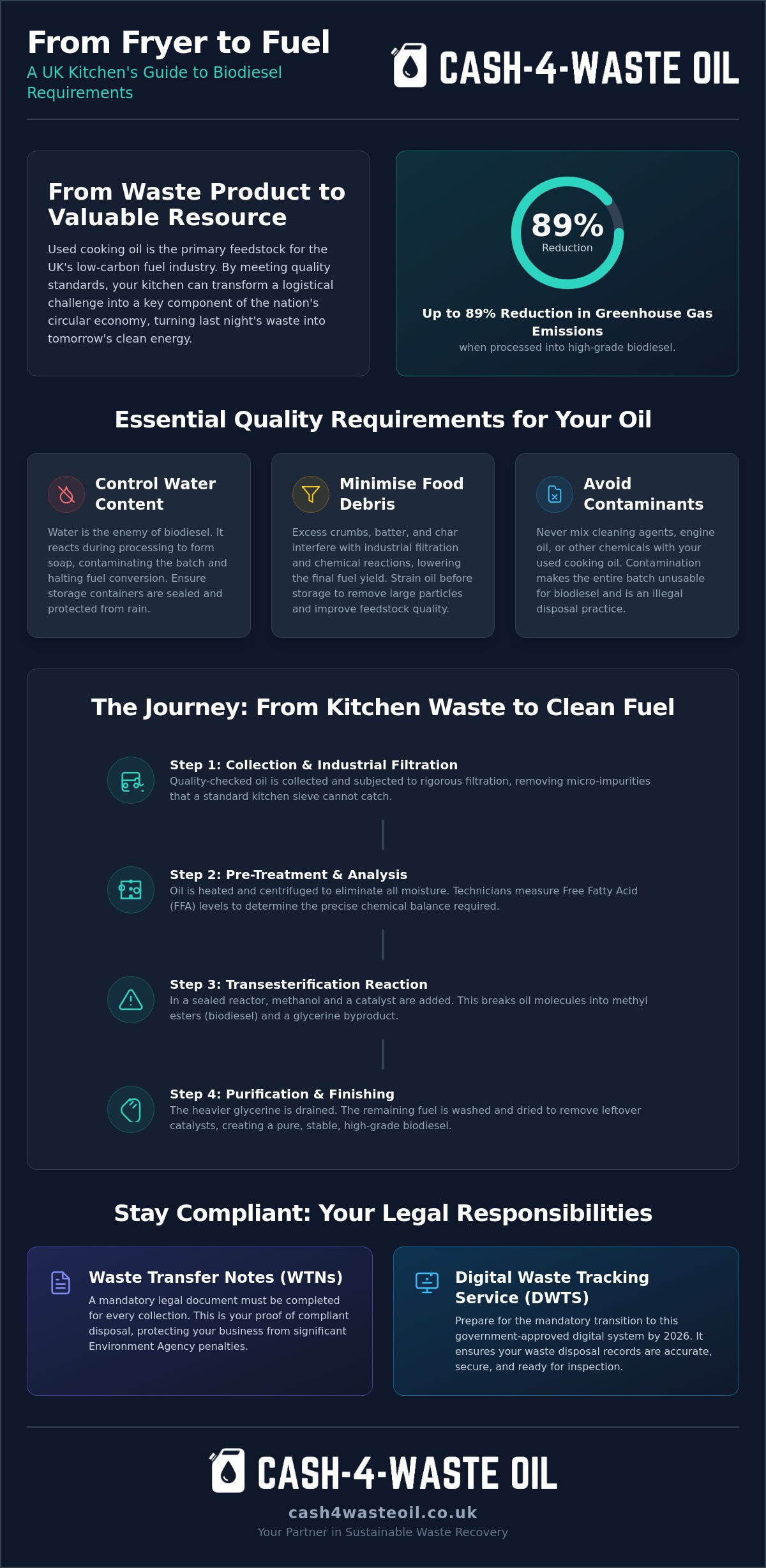
Did you know that the waste oil from your fryers can reduce greenhouse gas emissions by up to 89% when processed into high-grade biodiesel? It's a powerful environmental tool, but only if it meets the strict industry standards required for recovery. Understanding the specific used cooking oil for biodiesel requirements is no longer just a "nice to have"; it's a financial and legal necessity for any UK kitchen looking to claim cash rebates and stay compliant with the Environment Agency.
We know that managing waste oil often feels like a messy, secondary task compared to the heat of service. You likely worry if your oil is "clean enough" for collection or feel overwhelmed by the shifting landscape of Waste Transfer Notes. You need a process that's fast, professional, and entirely hassle-free. It's about turning a logistical headache into a streamlined part of your business model.
This guide provides a clear roadmap for 2026, outlining exactly how to prepare your oil to ensure it qualifies for high-grade production. We'll cover the essential EN 14214 quality specs, the mandatory rollout of the Digital Waste Tracking Service (DWTS) starting this October, and the simple storage habits that guarantee a seamless collection every time.
Key Takeaways
- Understand how to control water, food debris, and heat levels to ensure your kitchen meets the specific used cooking oil for biodiesel requirements for maximum rebate value.
- Stay legally compliant by securing mandatory Waste Transfer Notes for every collection, protecting your business from Environment Agency penalties.
- Prepare for the 2026 transition to the Digital Waste Tracking Service to ensure your disposal records are accurate and government-approved.
- Maximise your returns by turning waste into a revenue stream through "cash for oil" models that reward high-quality feedstock.
What is Waste Oil Recovery and Why Does it Matter in 2026?
Waste oil recovery is the systematic collection and processing of used cooking oil (UCO) into renewable energy. In 2026, this isn't just a cleaning task; it's the foundation of the UK's biodiesel industry. UCO serves as the primary feedstock for low-carbon fuels, helping the country meet the Renewable Transport Fuel Obligation (RTFO). By recovering this oil, kitchens divert harmful fats from sewers and reduce the need for virgin crops like rapeseed or palm oil. It’s the ultimate circular economy. A London pub’s waste oil from Friday night’s fish and chips can literally power a Kent delivery van by Monday morning. This process starts with your kitchen. By understanding the used cooking oil for biodiesel requirements, you ensure your waste is fit for purpose.
The Shift from Waste to Resource
"Disposal" is an outdated concept. In the modern hospitality sector, we talk about "recovery". As we hit the 2026 sustainability targets, your kitchen's output is viewed as a valuable commodity. Professionally managed recovery prevents the formation of "fatbergs" in London’s ageing Victorian sewer systems. These massive blockages cost millions to clear and cause significant environmental damage. By meeting specific quality standards, you ensure your waste becomes a resource rather than a pollutant. Industry professionals often refer to this filtered, high-quality UCO as Yellow grease, a key asset in the global renewable energy market. It's about moving away from a "throwaway" culture and into a model where every litre of oil is tracked and repurposed.
Economic Benefits for Commercial Kitchens
Efficiency drives profit. A professional recovery service doesn't just clear space; it creates a revenue stream. Through cash rebates, your waste oil pays you back. This "Cash for Oil" model turns a messy byproduct into a tangible financial asset. Beyond the direct payment, regular collection reduces the strain on your drainage systems. This lowers your long-term grease trap maintenance costs and prevents emergency plumbing call-outs. For businesses in the capital, choosing a specialist for cooking oil recycling London ensures you stay compliant whilst boosting your bottom line. It's a pragmatic business decision that aligns your financial goals with the UK's 2026 carbon-reduction mandates. When your oil is handled correctly, it stops being a cost and starts being a contribution to your kitchen’s profitability.
The Science: How Used Cooking Oil Becomes Biodiesel
Turning liquid fat into a high-performance fuel is a precise industrial feat. It isn't just about filtering out the breadcrumbs; it's a molecular transformation called transesterification. This process ensures that the used cooking oil for biodiesel requirements are met so the final product can safely power modern diesel engines. Without this chemical shift, the oil remains too viscous. Raw oil can't flow properly through modern fuel systems and would eventually cause catastrophic engine failure. By chemically altering the oil, we create a fuel that is chemically similar to petroleum diesel but with a significantly lower carbon footprint.
Before any chemical reactions occur, the oil undergoes rigorous mechanical filtration. This stage removes food debris, carbonised particles, and char that accumulate during the frying process. If these impurities remain, they interfere with the catalysts and lower the final fuel yield. This is why professional collection is superior to home-brewed methods. Industrial equipment can strip out micro-contaminants that a simple kitchen sieve would miss. Clean feedstock is the first step in protecting the expensive machinery used in the next stages of production.
The Transesterification Process
- Step 1: Pre-treatment. The oil is heated and centrifuged to remove every trace of moisture. Water is the enemy of high-quality fuel, as it can cause the oil to turn into soap during the reaction. At this stage, technicians also measure Free Fatty Acid (FFA) levels to determine the exact chemical balance needed.
- Step 2: Chemical reaction. A catalyst and an alcohol, usually methanol, are added to the oil in a sealed reactor. This breaks the oil molecules apart, creating two distinct substances: methyl esters (biodiesel) and glycerine.
- Step 3: Purification. The heavy glycerine settles at the bottom and is drained away. The remaining fuel is washed with water and dried to remove any leftover catalysts or alcohol. This ensures the fuel is stable and clear.
Standardising Fuel: The EN14214 Requirement
Every litre of biodiesel produced in the UK for road use must adhere to the EN14214 standard. This is a strict automotive-grade specification. It guarantees the fuel won't damage injectors or clog filters, even in freezing temperatures. Whilst some hobbyists attempt "backyard" biodiesel, these methods rarely meet legal waste cooking oil regulations or quality benchmarks. Professional recovery plants use advanced technology to guarantee the stability and performance required by modern vehicle manufacturers. Most reputable collectors also hold ISCC (International Sustainability and Carbon Certification), which proves the oil was sourced and processed responsibly. If you want to ensure your kitchen waste contributes to this high-standard fuel, you can book a collection to have your oil handled by experts.
Essential Quality Requirements for Recoverable Oil
Quality determines your rebate. Meeting the used cooking oil for biodiesel requirements depends on controlling three main factors: water, Free Fatty Acids (FFA), and food waste. We call these the "Big Three" enemies of oil recovery. If your oil is heavily contaminated with any of these, its value drops significantly. In some cases, it may even be rejected for collection. Refineries need a clean, stable feedstock to produce automotive-grade fuel that aligns with the official biodiesel quality protocol. By managing these impurities at the kitchen level, you protect your revenue stream and ensure your waste is fit for the circular economy.
Water is a silent profit-killer. When ice from frozen chips melts into the fryer, it triggers a chemical reaction called hydrolysis. This process breaks down the oil molecules and creates Free Fatty Acids. High FFA levels make the oil more acidic, which complicates the transesterification process we discussed earlier. Excessive heat is another culprit. Pushing your fryers above 180°C for long periods accelerates oil degradation. To keep your oil "recovery-ready" in a busy kitchen, follow this simple checklist:
- Shake excess ice off frozen products before they hit the oil.
- Maintain consistent frying temperatures and avoid overheating during quiet periods.
- Keep collection drums tightly sealed to prevent rainwater or cleaning chemicals from entering.
- Allow oil to cool slightly before transferring it to storage containers to prevent heat damage.
Managing Impurities and Filtration
Daily filtration is the most effective way to maintain oil health. By removing carbonised food bits every evening, you stop them from burning repeatedly and ruining the oil's chemical profile. It's also vital that you never mix vegetable oil with mineral oils or engine oil. Even a tiny amount of engine oil can cross-contaminate a whole batch, making it toxic and impossible to recycle into biodiesel. Store your used oil at ambient room temperatures in a dry area. This prevents the oil from going rancid or becoming too thick for our collection teams to pump efficiently.
Testing for Total Polar Materials (TPM)
Many modern kitchens now use digital testers to monitor oil health during service. These devices measure Total Polar Materials (TPM), which provides a clear picture of how much the oil has broken down. TPM is the chemical measure of oil degradation used by refineries to assess feedstock value. Regular testing ensures you aren't throwing away "good" oil too early, but it also alerts you when the oil is too spent to meet used cooking oil for biodiesel requirements. Keeping your TPM levels within the 24% to 27% range ensures your food stays crisp whilst your waste oil remains a high-value asset for biodiesel production.
Legal Compliance: Waste Transfer Notes and Regulations
Legal compliance is the bedrock of professional kitchen management. Every time used cooking oil leaves your premises, you must hold a valid Waste Transfer Note (WTN). This isn't a suggestion; it's a mandatory requirement enforced by the Environment Agency. The legal "Duty of Care" rests squarely on your shoulders as the waste producer. This means you are responsible for ensuring your oil is handled by a licensed carrier until it reaches its final destination. Handing your oil over to an unlicensed "cowboy" collector might save a few seconds, but it carries massive risk. If that oil is fly-tipped or disposed of illegally, the authorities will trace it back to your kitchen.
Beyond simple disposal, meeting the used cooking oil for biodiesel requirements requires a transparent, documented chain of custody. A licensed collector ensures your oil is tracked from your back door to the refinery. This paper trail is essential for any business that values its reputation and wants to avoid the legal pitfalls of the shadow waste market. Professional recovery turns a potential liability into a fully compliant asset. Without these documents, you cannot prove that your waste has been handled in accordance with UK environmental law.
The Anatomy of a Waste Transfer Note
A valid WTN must contain specific data points to be legally binding. It must include the European Waste Catalogue (EWC) code, which is typically 20 01 25 for used cooking oil. You also need to record the exact volume collected, the date, and the full names and signatures of both the producer and the collector. You are legally required to keep these records for at least 2 years. Failure to produce them during an inspection can lead to immediate fines. For more targeted compliance advice in the hospitality sector, check out our guide on hotel waste oil collection London.
Environment Agency Registered Collectors
Never take a collector's word at face value. You can easily verify a waste carrier licence on the official government register. Legitimate collectors will always provide their registration number upfront. Operating outside this system puts your business at risk of unlimited fines or even criminal prosecution for illegal oil dumping. By partnering with a registered expert, you guarantee a 100% legal paper trail that protects your business during any local authority audit. It is the only way to ensure your oil is truly being recycled into renewable fuel. To get started with a fully compliant service, request your waste oil collection now.
Maximising Value: Partnering with a Local Recovery Expert
Choosing the right partner transforms a messy chore into a streamlined profit centre. For kitchens in London, Kent, and Surrey, a local recovery specialist offers advantages that national conglomerates simply can't match. We act as the professional bridge between your kitchen and the refinery, ensuring your output meets every used cooking oil for biodiesel requirements whilst putting money back into your pocket. Our "Cash for Oil" model is designed for the fast-paced hospitality sector. It turns a logistical headache into a predictable revenue stream. By opting for scheduled collections rather than waiting for an on-call service, you keep your storage areas clear and your operations lean. Reliability is key in a busy kitchen; you need to know your oil will be gone before the next delivery arrives.
A professional recovery service does more than just haul away liquid waste. It provides the data you need to monitor your kitchen's efficiency. When you see exactly how much oil you're recovering each week, you can better manage your procurement and frying habits. This transparency is a byproduct of a smart business decision. It aligns your financial goals with your environmental responsibilities without adding to your daily workload. We handle the compliance, the logistics, and the heavy lifting, leaving you to focus on running your business.
Why Local Knowledge Matters
Operating in the capital requires more than just a van. We understand how to navigate London’s ULEZ zones and complex traffic constraints to ensure your collection happens on time, every time. This regional expertise extends into Kent and Surrey, where we support the local economy through regional partnerships. You aren't dealing with a distant corporate entity; you're working with a team that understands the specific pressures of your local hospitality sector. This proximity allows for a more personalised service and faster response times when your volumes unexpectedly spike during peak seasons or local events.
Getting Started with Professional Recovery
Starting your recovery journey is straightforward. We offer a hassle-free process that minimises disruption to your service. When you organise your first free collection, our team handles the transition from your current disposal method. On collection day, you can expect a transparent, three-step process:
- Weighing: We accurately measure your oil on-site using calibrated equipment so you know exactly what you've produced.
- Payment: We provide immediate cash payments or rebates based on the current market value and the quality of your feedstock.
- Paperwork: We issue a fully compliant Waste Transfer Note on the spot, fulfilling your legal "Duty of Care" instantly.
By following the quality tips outlined in this guide, you ensure your oil is always "refinery-ready". This maximises your rebate and ensures your business remains a key contributor to the UK's renewable energy targets. Ready to streamline your kitchen? Turn your waste oil into cash today with our professional London collection service.
Future-Proof Your Kitchen with Professional Oil Recovery
Managing your waste shouldn't be a burden. By mastering the used cooking oil for biodiesel requirements, you protect your business from legal risks whilst creating a reliable new revenue stream. Clean filtration and proper storage ensure your oil is always ready for the refinery, turning a messy byproduct into a valuable commercial asset. It's about making a pragmatic decision that benefits both your bottom line and the environment without adding to your daily workload.
Don't leave your compliance to chance or trust your waste to unlicensed collectors. We provide the professional bridge you need to stay ahead of the 2026 regulations. As an Environment Agency Registered Waste Carrier, we guarantee a 100% legal paper trail with every collection. We're fully licensed and offer instant cash payments for commercial kitchens across London, Kent, and Surrey. Our team understands the fast-paced nature of the service industry and provides a seamless, stress-free experience from start to finish.
Book your free waste oil collection and get paid cash today. It's the easiest way to streamline your kitchen operations and do your bit for the planet at the same time. Let's turn your waste problem into a profit today.
Frequently Asked Questions
What are the main requirements for used cooking oil to be used for biodiesel?
The primary used cooking oil for biodiesel requirements focus on the chemical stability and purity of the feedstock. Oil must be vegetable-based, have a low moisture content, and contain minimal Free Fatty Acids (FFA). Refineries require oil that hasn't been excessively degraded by high heat, as this ensures a higher yield of automotive-grade fuel that meets EN14214 standards.
Can I mix different types of vegetable oil for recovery?
Yes, you can mix various vegetable oils, including rapeseed, sunflower, and soy, within the same storage container. These oils are chemically compatible for the transesterification process used to create biodiesel. You should avoid mixing them with any mineral oils or synthetic lubricants, as this renders the entire batch unrecoverable and potentially hazardous.
How much water is allowed in waste cooking oil for biodiesel feedstock?
To meet the necessary standards, water content should be kept as low as possible, typically below 2%. Excessive water causes the oil to break down into soap during processing, which reduces the efficiency of the biodiesel conversion. Keeping your storage drums indoors or under cover helps prevent rainwater from contaminating your supply and lowering its rebate value.
Why do I need a Waste Transfer Note for my cooking oil?
A Waste Transfer Note (WTN) is a mandatory legal document that tracks the movement of waste from your kitchen to the disposal site. It's your proof of compliance with the Environment Agency's "Duty of Care" regulations. If an inspector visits your premises, you must be able to produce these notes for every collection made in the last two years to avoid heavy fines.
Does the oil need to be filtered before the collection team arrives?
You don't need to perform professional filtration, but removing large food debris with a basic sieve is highly recommended. This prevents carbonised particles from further degrading the oil whilst it sits in storage. Clean oil is more valuable for recovery and ensures a faster, cleaner transfer during the collection process without clogging the pumping equipment.
What happens if my waste oil is contaminated with animal fats or engine oil?
Engine oil is a critical contaminant that turns vegetable oil into hazardous waste, making it impossible to recycle into fuel. Animal fats like lard or dripping are often accepted but should be declared, as they have different chemical properties and a higher melting point than liquid vegetable oils. Pure vegetable oil remains the preferred feedstock for producing high-grade, automotive-standard biodiesel.
How often should a restaurant schedule a waste oil recovery collection?
The ideal frequency depends on your kitchen's output, but most restaurants benefit from a weekly or fortnightly collection. Regular pickups prevent the accumulation of old oil, which can attract pests and create unpleasant odours in your storage area. A consistent schedule also ensures you always have empty drums ready for your next oil change, keeping your kitchen operationally lean.
Is there a minimum volume requirement for free oil collection in London?
We provide free collection services for commercial volumes of used cooking oil throughout London and the Home Counties. Because we operate locally, we can provide flexible pickups that suit your business size and volume. There's no hidden charge for the collection itself, and we provide instant cash payments for all qualifying waste oil that meets recovery standards.