
Is your used oil taking up more than just floor space in your premium London kitchen? Managing waste shouldn't be a source of stress, yet many chefs struggle with messy storage and the constant fear of heavy fines for improper disposal. We know that unreliable collectors who fail to show up on time can disrupt your entire service. You need a dependable partner for cooking oil recycling London who understands that in the hospitality industry, every square metre and every minute counts.
This guide reveals how to turn your kitchen waste into a consistent revenue stream whilst ensuring 100% legal compliance with the 2026 "Simpler Recycling" regulations. You can achieve a cleaner workspace and total peace of mind by securing the correct Waste Transfer Notes for every collection. We'll walk you through the essential legalities, the "cash for oil" process, and how to choose a licensed collector who actually turns up when they say they will. Discover how to streamline your operations and put extra cash back into your business today.
Key Takeaways
- Understand your legal "Duty of Care" and why businesses must avoid residential recycling centres to remain compliant with UK law.
- Maximise your kitchen’s profitability by turning used fryer fat into a consistent revenue stream through professional cooking oil recycling London.
- Solve storage issues in cramped commercial spaces by correctly assessing your weekly oil output and choosing the right container size.
- Protect London’s infrastructure by ensuring your waste is refined into high-grade biodiesel rather than clogging Victorian sewer systems.
- Improve your business cash flow with immediate "cash on the spot" payments that provide instant value for every litre of oil collected.
What is Commercial Cooking Oil Recycling and Why Does London Need It?
Commercial cooking oil recycling is the systematic collection of used vegetable and seed oils, which are then refined into high-grade biodiesel. For a busy London kitchen, this process is more than just a waste management task; it's a vital contribution to the city's infrastructure. In industrial contexts, this used cooking oil is often classified as Yellow grease, a valuable commodity that serves as a primary feedstock for sustainable energy. It is important to distinguish these food-grade oils from industrial mineral oils. Whilst mineral oils are used for machinery and engines, cooking oil recycling London focuses exclusively on the vegetable fats, sunflower oils, and rapeseed oils that power our fryers.
London produces thousands of tonnes of waste oil every year. Without a robust recycling system, this waste would end up in our waterways or landfill. By choosing to recycle, you ensure that your kitchen's byproducts are put to productive use rather than becoming an environmental liability. It’s a pragmatic business decision that aligns your operations with the capital's wider sustainability goals.
The Role of Biodiesel in London’s Circular Economy
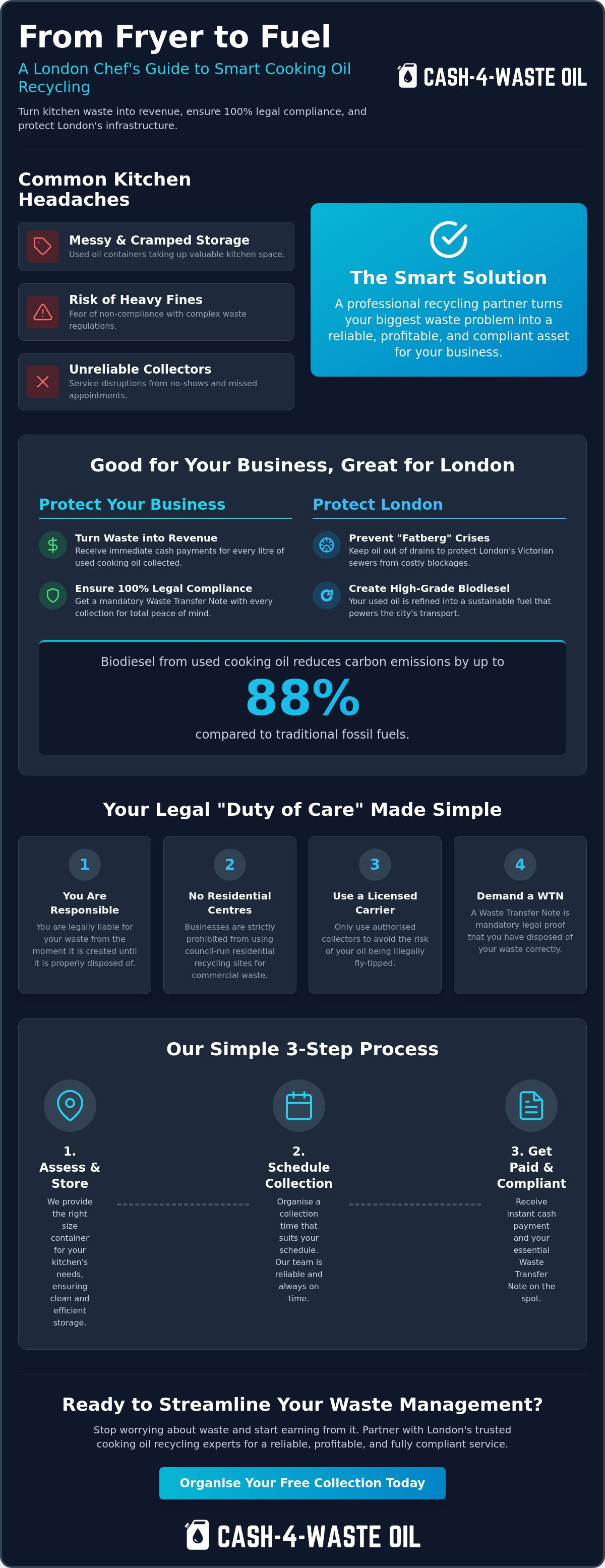
Used cooking oil (UCO) is the most efficient feedstock for biodiesel production in the UK. According to industry data, biodiesel derived from UCO can reduce carbon emissions by as much as 88% compared to traditional fossil fuels. This fuel doesn't just disappear into the atmosphere; it powers the capital’s greener transport links, including many of London's iconic red buses. In the context of London hospitality, a circular economy means transforming your kitchen's waste stream into a renewable fuel source that powers the very city your business serves. It turns a disposal problem into a resource-rich solution.
Avoiding the "Fatberg" Crisis in Greater London
London’s Victorian sewer system was never designed to handle the volume of fats, oils, and grease (FOG) produced by modern commercial kitchens. When oil is poured down the drain, it solidifies and binds with other waste to create "fatbergs." These massive blockages cost the city millions of pounds to clear every year. Don't be fooled by "biodegradable" labels on certain oils; they still solidify in cold underground pipes. Under the Environmental Protection Act 1990, businesses found responsible for sewer blockages face severe legal repercussions and heavy fines. Proper recycling isn't just about being green; it’s about protecting your business from the financial and legal fallout of a local sewer crisis.
Commercial vs Domestic: Understanding London’s Legal Requirements
London’s local councils provide Reuse and Recycling Centres (RRCs) for residents to dispose of small quantities of household waste. However, these sites are strictly off-limits for businesses. If you run a commercial kitchen, you cannot legally drop your used oil at a local tip. The law draws a clear line between domestic waste and commercial output. Businesses are required to arrange private collections through authorised specialists to ensure their waste is handled safely and transparently. Attempting to bypass this by using residential facilities can lead to significant fines and a tarnished reputation with your local borough.
Adhering to oil storage regulations is the first step in meeting your "Duty of Care." This legal concept, established under the Environmental Protection Act 1990, means you're responsible for your waste from the moment it’s produced until it’s finally disposed of or recycled. Even after the oil leaves your premises, you remain liable if it is dumped illegally. This is why choosing a reputable partner for cooking oil recycling London is a critical business decision rather than a simple chore. It ensures your liability is managed correctly at every stage of the journey.
Handing your waste to an unlicensed "man with a van" is a gamble that rarely pays off. These collectors often lack the necessary permits and may engage in illegal tipping to avoid processing costs. If your oil is found fly-tipped in a London alleyway, investigators will trace it back to your kitchen. You'll face the legal consequences, regardless of whether you paid for the collection. Stick to professional services that provide full transparency and legal protection.
The Essential Waste Transfer Note for London Businesses
A Waste Transfer Note (WTN) is a mandatory legal document that must accompany every single oil collection. It acts as proof that you've handed your waste to an authorised carrier. Your WTN must include the date, the quantity of oil, the names of both parties, and their signatures. London businesses are legally required to store these records for a minimum of two years. During a routine council inspection, failing to produce these notes can result in immediate penalties. Always insist on a digital or physical copy before the collector leaves your site.
Environment Agency Registered Collectors
Every legitimate collector must hold a valid waste carrier licence issued by the Environment Agency. You can easily verify this by checking the public register online. A registered professional will always be happy to provide their licence number. Working with an expert in cooking oil recycling London guarantees that your oil is refined into biofuel in a controlled, legal environment. This protects the city’s environment from toxic spills and ensures your kitchen stays on the right side of the law. Using a registered service is the only way to achieve total peace of mind for your business.
Cash for Oil: Turning Waste into a London Revenue Stream
Your used fryer oil is more than just a byproduct; it's a valuable industrial commodity. In the world of cooking oil recycling London, your waste serves as a vital raw material for the global biofuel market. Because this oil has intrinsic value, professional collectors offer a rebate or cash payment for every litre they take away. This effectively turns a disposal cost into a legitimate revenue stream for your business. It’s a simple way to offset other waste management expenses.
London’s hospitality sector operates on tight margins and high overheads. For many cash-flow-heavy pubs and independent eateries, the "cash on the spot" model is often more attractive than waiting for a monthly rebate. It provides immediate liquidity that goes straight back into the daily till. Larger operations might prefer a structured rebate system, but the core principle remains the same: your waste should pay for itself. You aren't just cleaning your kitchen; you're boosting your bottom line.
The price you receive depends on several variables. Market rates for biodiesel fluctuate, but the volume and quality of your oil are the factors you can control. Large-scale collections are more efficient for the carrier, which often leads to better rates for the kitchen. Consistency is key. If you provide a reliable volume of high-quality oil, you're in a much stronger position to negotiate the best possible price.
Transparent Pricing and Immediate Compensation
Transparency is the foundation of a good recycling partnership. You should always know exactly what you're being paid per litre before the oil leaves your site. A reputable collector will provide clear, upfront pricing without hiding costs behind "collection fees" or "container rentals." For small to medium London eateries, getting paid immediately for a 60-litre or 100-litre collection simplifies bookkeeping. It ensures you're seeing the value of your recycling efforts in real-time without chasing invoices.
Contamination Control: Protecting Your Rebate
To get the best price, your oil must remain as pure as possible. High-grade feedstock is what refineries want. If your oil is mixed with water, food debris, or cleaning chemicals, its value drops significantly. In extreme cases, contaminated oil cannot be recycled into fuel at all. This results in lost revenue and potential disposal charges.
Managing your oil correctly is a key part of your duty of care as a food business operator. Simple kitchen habits make a big difference. Ensure lids are kept tight on storage drums to prevent rainwater from entering. Train staff to filter out large food particles before pouring used oil into the collection bin. Most importantly, never mix vegetable oil with mineral or engine oils. Even a small amount of industrial oil can ruin an entire batch. Keeping your waste stream clean protects both the environment and your profit margins.
How to Organise Your London Oil Collection Service
Setting up an efficient system for cooking oil recycling London requires a pragmatic approach to logistics and space management. You first need to assess your weekly oil output. Overestimating your needs leads to wasted space; underestimating leads to messy overflows. Most medium-sized London kitchens find that a fortnightly or monthly pickup works best, provided they have the right containers. Track your usage for two weeks to determine your ideal frequency.
Once you know your volume, you must integrate the collection into your daily operations. This means scheduling pickups that don't clash with your main food deliveries or the dreaded lunch rush. London's strict traffic enforcement and congestion charges mean your collector needs a clear window to operate. Efficiency here prevents delays and ensures your kitchen stays clear of clutter when you're at your busiest.
Storage Solutions for Small London Spaces
Space is a premium commodity in the capital. Many Soho or City basements simply cannot accommodate a standard 200L steel drum. In these instances, 60L plastic barrels are often the superior choice. They are easier for staff to manoeuvre through narrow corridors and can be tucked under prep tables. Regardless of size, your containers must be:
- Leak-proof: Spills in a London basement are a nightmare to clean and a major slip hazard.
- Sealed: Tight lids are essential to prevent pest issues, particularly in older buildings.
- Secure: If storing oil in an alleyway, ensure containers are locked or screened to prevent theft or tampering.
Navigating Soho, Camden, and the City Centre
Operating a kitchen in pedestrianised zones like Camden or restricted-access areas in Soho presents unique challenges. You need a collector with deep local knowledge of London’s one-way systems and Red Routes. They should understand the specific loading restrictions of your borough to avoid unnecessary fines. We recommend scheduling "out-of-hours" or early morning pickups. This avoids disrupting your dinner service and ensures the collection vehicle isn't blocked by heavy traffic or delivery vans. If you're ready to clear your space, book your first collection with a team that knows your neighbourhood.
Safety must remain your priority during the transfer process. Ensure your staff wait for the oil to cool completely before pouring it into storage containers. Hot oil causes severe burns and can melt certain plastic barrels. Once the collector arrives, your final task is the paperwork. Never let a vehicle depart without verifying the Waste Transfer Note. Check that the volume listed matches what was taken and that all signatures are present. This document is your only legal shield if the local council requests proof of your recycling activities.
Why Cash 4 Waste Oil is London’s Trusted Recycling Partner
Choosing a partner for cooking oil recycling London shouldn't be a gamble for your business. We operate as a dedicated, local expert serving the unique needs of commercial kitchens across London, Kent, and Surrey. Our team understands that the capital's hospitality sector moves fast. You don't have time to chase unreliable collectors or deal with complicated paperwork. We've built our reputation on being a hassle-free problem solver that takes the burden of waste management off your shoulders. It's a professional, no-nonsense approach designed for busy operators.
Our "Cash on the Spot" promise is a core part of our pragmatic business model. Whilst other companies might make you wait weeks for a rebate or bury your profits in administrative fees, we provide immediate value. We pay you directly for every litre of used oil we collect from your site. This injection of cash helps with daily overheads and ensures your recycling efforts provide a tangible, financial reward. It’s a smart business decision that benefits both your bottom line and the environment simultaneously.
Compliance is never optional in a regulated city like London. We provide an Environment Agency-compliant Waste Transfer Note with every single collection. This ensures your business meets its legal "Duty of Care" without you having to manage complex regulatory filings yourself. By partnering with us, you're also supporting the UK’s sustainable energy sector. We maintain direct refinery partnerships, ensuring your used oil is refined into high-grade biodiesel that powers the country’s transport network. We treat your waste as a valuable resource, not a nuisance.
Hassle-Free Collections Across Greater London
Our fleet is specifically equipped to handle the logistical challenges of the city. Whether you run an independent takeaway in Islington or a large-scale hotel kitchen in Mayfair, we can reach you. We navigate London's toughest access routes, one-way systems, and restricted loading zones with professional precision. Local landlords and head chefs trust our service because we turn up on time and work around their busy schedules. We respect your service windows and ensure our presence never disrupts your staff or your customers during peak hours.
Get Started with Cash 4 Waste Oil Today
We believe in transparency and simplicity. That’s why we offer the no-contract flexibility that London’s fast-paced hospitality sector demands. You aren't locked into long-term agreements; we earn your business with every collection we make. Booking your first free collection takes under two minutes through our streamlined online system. Join the growing number of London businesses that have stopped paying for disposal and started getting paid for their waste. Efficiency, reliability, and immediate payment are just one click away.
Book your free London oil collection and get paid today
Streamline Your Kitchen’s Waste and Boost Your Bottom Line
Managing a commercial kitchen in the capital is demanding enough without the added stress of waste logistics. You now understand that staying compliant with modern recycling regulations isn't just about avoiding fines; it's about running an efficient, profitable business. Professional cooking oil recycling London transforms a messy disposal problem into a reliable revenue stream. Whether you're navigating the narrow streets of Soho or operating a large hotel in Mayfair, the right collection partner ensures your "Duty of Care" is handled automatically.
We take the hassle out of the process as a Licensed Waste Carrier and Environment Agency Registered specialist. Our team provides full legal documentation and cash paid on the spot for every litre collected. Serving London, Kent, and Surrey, we're the dependable ally your business needs to stay clean and compliant. Don't let used oil clutter your premium floor space or risk your legal standing. Take the first step toward a more efficient kitchen today.
Get a free collection and cash for your oil now
Frequently Asked Questions
Is cooking oil recycling free for London businesses?
Yes, professional collection services are typically free of charge for commercial quantities of waste oil. We don't charge for the pickup or the provision of storage containers. Instead, the process is designed to be a revenue generator where we pay you for the oil we collect. It turns a necessary waste management task into a profitable part of your operation.
How much cash can I get for my used cooking oil in London?
The payment you receive depends on the current biodiesel market rates and the volume of oil you provide. Whilst market prices fluctuate, we always offer competitive rates paid on the spot during the collection. Larger volumes generally qualify for better pricing, so it's beneficial to assess your output and consolidate your waste where space allows.
What happens if I don’t have a Waste Transfer Note for my oil?
Failing to produce a Waste Transfer Note during a council inspection can lead to heavy fines and legal prosecution. Under the Environmental Protection Act 1990, you must have proof that your waste was handled by a licensed carrier. We provide these mandatory documents with every collection to ensure your kitchen remains 100% compliant with UK law.
Can I recycle oil that has been mixed with animal fats?
No, we only collect vegetable-based oils for refinement into biodiesel. Animal fats like lard or dripping have a different chemical profile and can contaminate the recycling stream, making the batch unsuitable for fuel production. To protect your rebate, keep your vegetable and seed oils in a separate container away from animal fats and food debris.
How often should a London restaurant have its oil collected?
Collection frequency depends entirely on your weekly oil output and available storage space. Most busy eateries find that a fortnightly or monthly cooking oil recycling London schedule prevents cluttered kitchens and storage overflows. We can help you determine the most efficient collection rhythm after your first pickup to ensure your workspace stays clear and safe.
Do you collect waste oil from domestic households in London?
No, our service is exclusively for commercial kitchens, pubs, and food businesses. London residents should dispose of small quantities of household oil at their local council’s Reuse and Recycling Centre. These facilities are specifically designed for domestic waste, whereas our fleet is equipped to handle bulk commercial volumes and industrial-scale recycling.
What areas of London do you cover for oil collection?
We provide comprehensive coverage across all 32 London boroughs and the City of London. Our drivers are experienced in navigating the capital's complex traffic zones, from the restricted-access streets of Soho to the industrial estates of the outer boroughs. No matter your location, we can arrange a reliable collection that fits your service window.
Can I get a regular scheduled collection for my pub in Kent or Surrey?
Yes, we offer regular, scheduled collections for businesses throughout Kent and Surrey as well as Greater London. We provide the same professional service and immediate cash payments to pubs and restaurants outside the M25. You can easily set up a recurring pickup schedule that ensures your waste is managed without you having to call us every time.