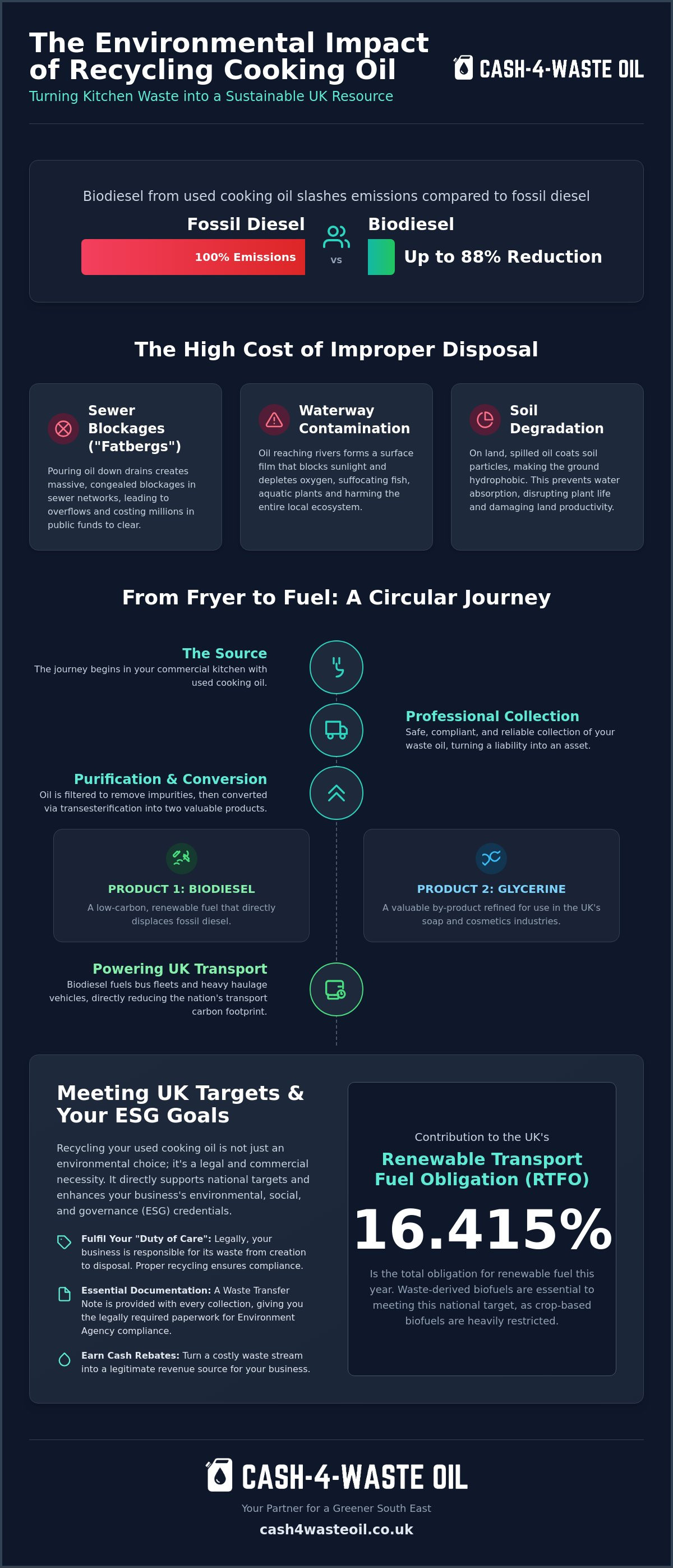
Did you know that biodiesel produced from your used cooking oil can slash greenhouse gas emissions by up to 88% compared to standard fossil diesel? For any UK business, understanding the environmental impact of recycling cooking oil is now a commercial necessity rather than a choice. With the UK’s renewable fuel obligation hitting 16.415% this year, your kitchen waste has become a vital resource for the national energy transition. You’re likely already feeling the pressure of rising disposal costs and the new digital waste tracking mandates that come into force this October.
We're here to help you turn these regulatory hurdles into a strategic advantage for your brand. This article outlines how recycling your oil protects the UK environment and supports the growing circular economy. We will preview the specific carbon savings you can achieve, the essential role of the Waste Transfer Note in your legal compliance, and the straightforward process of turning your waste into a legitimate revenue stream.
Key Takeaways
- Discover the positive environmental impact of recycling cooking oil, including how it prevents toxic soil degradation and diverts tonnes of waste from UK landfills.
- See how waste oil is converted into low-carbon biodiesel to help the UK transport sector meet its 2026 carbon reduction targets.
- Learn why keeping fats out of waterways is crucial for reducing freshwater eutrophication and protecting the local ecosystem.
- Understand your legal "Duty of Care" and why a Waste Transfer Note is essential for Environment Agency compliance.
- Find out how to secure a legitimate cash rebate for your used oil whilst ensuring your business meets its ESG goals.
What is the Environmental Impact of Recycling Cooking Oil?
The environmental impact of recycling cooking oil is a dual-benefit of pollution prevention and renewable fuel creation. By capturing this waste at the source, UK businesses prevent thousands of tonnes of grease from entering landfill sites every year. This isn't merely a waste management task. It's a high-yield carbon reduction strategy that turns a messy byproduct into a vital resource. Every litre of oil you recycle is diverted from potentially damaging ecosystems and instead used to create a sustainable feedstock for low-carbon biodiesel. This process is essential for meeting the 2026 UK renewable transport fuel obligation of 16.415%.
The Problem: Why Improper Disposal is a Modern Crisis
Traditional disposal methods are no longer sustainable or legal. Pouring oil down the sink leads to the formation of "fatbergs", particularly in London's ageing sewer networks. These massive, congealed blockages cause sewer overflows and cost the taxpayer millions to clear. The damage doesn't stop at the infrastructure. When oil reaches natural waterways, it forms a thin surface film that blocks sunlight and depletes oxygen levels. This layer effectively suffocates fish and aquatic plants. On land, oil spills cause soil degradation by coating particles and making the ground hydrophobic. This prevents plants from absorbing water, disrupting local biodiversity and damaging the land's productive capacity.
The Solution: The Power of Valorisation
Valorisation is the tactical process of turning waste into higher-value products. It's the core engine of a circular economy. Unlike mineral-based industrial oils that persist for decades, used cooking oil is 100% biodegradable. This organic nature makes it the perfect candidate for conversion into Vegetable oil fuel. By understanding the positive environmental impact of recycling cooking oil, businesses can move away from old disposal habits. Recycling ensures these fats stay within a closed-loop system rather than becoming a pollutant. This model keeps resources in use for longer and reduces the need for virgin oil production. For the modern UK kitchen, your waste becomes a valuable asset that supports national sustainability targets whilst simplifying your own logistics.
From Fryer to Fuel: The Lifecycle of Recycled Biodiesel
Decarbonising the UK transport sector is a massive challenge, but your kitchen waste is a primary solution. Biodiesel produced from used cooking oil can reduce greenhouse gas emissions by up to 88% compared to standard fossil diesel. This is a staggering figure for any business looking to hit its ESG targets. The environmental impact of recycling cooking oil goes beyond just cleaning up local drains. It represents a direct displacement of fossil fuels. Every litre of waste oil you recycle is a litre of crude oil that stays in the ground. This shift also reduces the global pressure to produce virgin vegetable oils, such as palm oil, which often drives deforestation in sensitive tropical regions.
The Biodiesel Transformation Process
The journey from a commercial deep fryer to a fuel tank is a precise industrial process. It starts with filtration and decontamination. This stage removes food particles, carbonised residues, and water that would otherwise degrade the fuel. Once cleaned, the oil undergoes transesterification. This is a chemical reaction where the oil reacts with an alcohol to create fatty acid methyl esters (biodiesel) and glycerine. Nothing in this process is wasted. The glycerine by-products are refined and sold into the UK's soap and cosmetics industries. This ensures the entire lifecycle of your waste oil remains within a productive, circular economy.
Reducing the Carbon Footprint of UK Transport
The UK transport sector relies heavily on waste-derived fuels to meet its 2026 carbon targets. Under the Renewable Transport Fuel Obligation (RTFO), the total obligation for renewable fuel is 16.415% this year. Much of this is met by "Second Generation" biofuels, which are derived from waste rather than food crops. In 2026, the cap for crop-derived biofuels is restricted to just 3.00%. This makes your used oil more valuable than ever. These waste-based fuels currently power London’s bus fleets and heavy haulage vehicles across the South East. Following the used cooking oil for biodiesel requirements ensures that your waste meets the strict quality standards needed for modern engines.
By opting for a reliable waste oil collection, you're directly supporting this green energy transition. It's a simple operational change that delivers a measurable reduction in your business's carbon footprint whilst supporting the UK's move away from fossil fuel dependency.
Combatting the Climate Crisis through a Circular Economy
A circular economy is about more than just reducing waste. It's about maximising the value of every resource we use. A primary environmental impact of recycling cooking oil is the significant reduction in Global Warming Potential (GWP) through methane avoidance. When organic waste like oil ends up in landfill sites, it decomposes anaerobically. This process releases methane, a greenhouse gas with a warming potential far higher than carbon dioxide. By diverting your kitchen waste to a licensed recycling stream, you eliminate this methane production entirely. This is an immediate, high-impact action that supports the UK’s 2050 Net Zero goals.
Recycling also delivers an impressive energy-positive return. The energy required to collect, filter, and refine used oil is a small fraction of the energy output provided by the resulting fuel. It's far more efficient than the resource-intensive process of growing, harvesting, and transporting virgin oil crops. This high energy return on investment makes oil recycling one of the most effective tools for sustainable commercial kitchen management. It allows your business to contribute to national energy security whilst reducing its own ecological footprint.
Mitigating the "Fatberg" Phenomenon
Improper disposal doesn't just hurt the atmosphere; it cripples our national infrastructure. Fatbergs currently cost UK water companies over £100 million every year to clear. These massive, congealed blockages are a direct result of poor kitchen behaviour and inadequate grease management. When fats, oils, and grease (FOG) enter the sewer, they solidify and trap other debris. For the hospitality sector in Kent and Surrey, responsible oil management is essential for protecting local river health. Keeping oil out of the drains prevents sewage overflows that lead to freshwater eutrophication. This process causes algal blooms that deplete oxygen and devastate local fish populations.
Resource Efficiency and Waste Hierarchy
The UK Waste Hierarchy is a legal framework that prioritises "recovery" over "disposal." Recycling your oil ensures it stays at the top of this hierarchy. It also helps build a more resilient domestic energy market. By processing oil within the UK, we reduce our reliance on imported energy and virgin oils. This domestic cycle is a boost for the green economy, supporting local green-tech jobs and refineries across the South East. The environmental impact of recycling cooking oil includes these vital socio-economic benefits. It turns a local waste problem into a national resource, ensuring that your business remains both compliant and environmentally responsible.
Regulatory Compliance and ESG Goals for UK Kitchens
The environmental impact of recycling cooking oil is no longer just a metric for your marketing; it's a core component of UK law. Under the Environmental Protection Act 1990, every commercial kitchen has a legal "Duty of Care" to manage waste responsibly. This means you are personally responsible for your oil until it reaches a licensed facility. Failing to meet these standards can result in unlimited fines or criminal prosecution. By using a registered collector, you ensure your waste contributes to the UK's renewable energy targets rather than becoming a liability for your business or the local ecosystem.
Understanding Your Duty of Care
The most critical document in your kitchen's administration is the Waste Transfer Note (WTN). This is your legal proof that you've handed your oil to a legitimate, Environment Agency-registered carrier. You must keep these records for at least two years to satisfy local authority inspections. From October 1st, 2026, the new national digital waste tracking service becomes mandatory across England and Wales. This will create a real-time digital record of every oil movement, making transparency non-negotiable. You must verify that your collector holds a valid waste carrier licence before any oil leaves your premises. For a step-by-step breakdown of these requirements, refer to our cooking oil recycling London guide.
Storage Best Practices for Maximum Impact
How you store your oil directly affects its value and the efficiency of the recycling process. Contaminated oil is harder to refine and may even be rejected by the processing plant. Follow these simple rules to maintain quality:
- Use blue barrels: These are the industry standard for preventing leaks and containing odours in busy kitchen environments.
- Prevent contamination: Never mix used oil with water, chemicals, or general food waste. Pure oil yields the highest quality biodiesel.
- Keep it accessible: Organise your kitchen layout so that full barrels can be swapped quickly during a collection without disrupting your service.
Beyond basic compliance, recycling data is a powerful tool for your ESG (Environmental, Social, and Governance) reporting. Modern investors and customers demand transparency. By tracking the exact volume of oil you recycle, you can calculate your direct contribution to carbon savings. This data improves your brand’s sustainability score and proves your commitment to the circular economy. The environmental impact of recycling cooking oil is now a measurable asset that adds value to your business's reputation.
Ready to streamline your compliance? You can book a licensed waste oil collection today to ensure you receive a valid WTN and a cash rebate for your waste.
Partnering for a Greener South East: The Cash 4 Waste Oil Advantage
We understand that busy kitchens don't have time for complex logistics. You need a solution that works as hard as your chefs. By choosing Cash 4 Waste Oil, you're not just clearing space in your storage area. You're making a direct contribution to the environmental impact of recycling cooking oil across the South East. We ensure that 100% of the oil we collect from your venue is processed for the UK biodiesel industry. This turns your kitchen waste into a high-performance fuel that powers local transport. It's a pragmatic way to close the loop on your carbon emissions whilst boosting your bottom line with an immediate cash rebate.
Supporting Local Kitchens in London and Kent
Reliability is the backbone of our service. We provide free, licensed collections for commercial venues throughout London, Kent, and Surrey. Our team understands the fast-paced nature of the hospitality sector. We don't leave you waiting with full barrels that cause odours or safety hazards. At every collection, we provide the mandatory Waste Transfer Note. This document is your shield against Environment Agency fines. It's your official proof of "Duty of Care" compliance. As a key player in the South East’s regional sustainability network, we help local businesses meet their ESG targets without the administrative headache. We've built our reputation on being a trusted, local partner that understands your specific operational challenges.
Join the Circular Economy Today
Joining the circular economy should be the easiest task on your to-do list. Our process is designed for maximum efficiency. A simple phone call triggers a prompt collection and an on-the-spot cash payment. Choosing a local partner like us also reduces the "collection miles" associated with your waste. This further lowers the total environmental impact of recycling cooking oil by minimising the transport emissions of the collection vehicle itself. It's a smart business decision that benefits the local Kent and Surrey ecosystems by ensuring no oil ever reaches our rivers. Your kitchen becomes a centre for sustainability, proving that green initiatives can be both ethically sound and commercially profitable. We take the burden of logistics off your shoulders so you can focus on running a successful business. Contact us today to see how your kitchen can start turning waste into wealth.
Secure Your Kitchen’s Sustainable Future
Recycling your kitchen waste is a smart business move that delivers immediate results. You've seen how the environmental impact of recycling cooking oil extends from preventing local fatbergs to powering the UK's green transport transition. By choosing a responsible collection partner, you ensure full compliance with Environment Agency requirements whilst hitting your own ESG targets. It's about turning a messy logistical burden into a reliable revenue stream for your business.
We make the process completely hassle-free. As an Environment Agency Registered Collector, we provide the mandatory Waste Transfer Note at every visit to keep your records spotless. We serve commercial venues across London, Kent, and Surrey with free collections and pay cash on the spot for every litre we take. Don't let your waste oil sit in storage when it could be funding your operations and protecting the planet.
Turn your waste oil into cash and support the environment today. Let's work together to build a cleaner, more efficient South East.
Frequently Asked Questions
Is recycling cooking oil actually good for the environment?
Yes, it is one of the most effective ways for a commercial kitchen to reduce its ecological footprint. The environmental impact of recycling cooking oil includes diverting organic waste from landfills where it would otherwise decompose and produce methane. It also provides a sustainable alternative to fossil fuels, supporting the UK’s shift toward a circular economy and national net-zero targets.
What happens to the oil after it is collected from my restaurant?
Your waste oil undergoes a multi-stage refining process to become high-quality biodiesel. First, industrial filters remove food debris and water. A chemical process called transesterification then converts the oil into fuel. This recycled biodiesel is used to power bus fleets and heavy haulage vehicles across the UK, which significantly reduces national carbon emissions and dependency on imported crude oil.
Can I get a fine for pouring cooking oil down the drain in the UK?
Yes, businesses can face unlimited fines and even criminal prosecution for improper oil disposal. Under the Environmental Protection Act 1990, you have a legal "Duty of Care" to ensure your waste doesn't cause pollution or blockages. Local authorities and water companies actively monitor sewer health and can trace fatbergs back to the specific commercial kitchen responsible for the discharge.
How much carbon does recycling cooking oil save compared to fossil fuels?
Biodiesel produced from used cooking oil saves up to 88% in greenhouse gas emissions compared to standard fossil diesel. This makes it a "Second Generation" biofuel, which is much more sustainable than crop-based alternatives. By recycling your oil, you help the UK transport sector meet its 2026 carbon targets whilst ensuring that more fossil fuel remains in the ground.
What is a Waste Transfer Note and why do I need one for my oil?
A Waste Transfer Note (WTN) is a legal document that proves you've disposed of your waste oil responsibly. You must keep these records for at least two years. With the new national digital waste tracking service becoming mandatory in October 2026, having accurate, accessible documentation is more important than ever for satisfying Environment Agency inspections and avoiding heavy fines for non-compliance.
Does recycling cooking oil help prevent fatbergs in London?
Yes, consistent recycling is the primary way to stop fatbergs from forming in London's sewer network. When oils and fats are poured down the drain, they congeal and trap other waste, creating massive blockages. These fatbergs cost UK water companies over £100 million annually to clear. Proper collection ensures these fats never enter the infrastructure and instead become a productive resource.
Can all types of vegetable oil be recycled into biodiesel?
Most common commercial vegetable oils, including rapeseed, sunflower, and corn oil, are perfectly suited for biodiesel production. Even heavily used oil can be refined if it hasn't been contaminated with water or chemicals. Understanding the environmental impact of recycling cooking oil helps kitchen staff appreciate why keeping waste oil pure is vital for producing high-quality, sustainable fuel for the transport sector.
How much money can I get for recycling my waste cooking oil?
The amount you receive depends on the current market value of used cooking oil and the total volume you produce. We provide a competitive cash rebate on the spot for every litre collected from your premises. This turns your environmental responsibility into a direct revenue stream, helping to offset other operational costs whilst ensuring your business remains fully compliant with UK waste regulations.