
That sticky drum of used fat in your yard is either a ticking legal time bomb or a consistent source of revenue. With the Environment Agency increasing site inspections throughout 2026, a messy storage area is no longer just an eyesore; it is a direct financial risk. You likely already know that managing a catering company waste oil collection is a logistical headache that involves more than just pouring liquid into a vat. Between the fear of heavy fines and the complexity of Waste Transfer Notes, it is often tempting to let the oil stagnate and hope for the best.
We promise that by following this 2026 essential compliance checklist, you will transform your disposal process from a burden into a streamlined profit centre. You will learn exactly how to maintain a spotless kitchen whilst meeting every legal requirement for your next audit. This guide provides a methodical breakdown of the latest storage regulations, the documentation you must keep on file, and the simple steps to ensure you receive a financial rebate for every litre of waste you produce.
Key Takeaways
- Master the legal requirements of the Environmental Protection Act 1990 to shield your kitchen from costly Environment Agency fines and inspections.
- Streamline your daily operations with a professional cooling and filtering checklist that ensures safe storage and a cleaner workspace.
- Identify the essential criteria for a catering company waste oil collection partner, including the necessity of official Waste Transfer Notes.
- Protect your financial rebates by avoiding common contamination pitfalls, such as food debris and water ingress, that ruin oil recycling value.
- Convert your used cooking oil into immediate reinvestment capital through efficient, cash-based collection services tailored for local businesses.
What is Commercial Kitchen Oil Disposal and Why is it Regulated?
Commercial kitchen oil disposal is the professional, regulated removal of used cooking fats and vegetable oils from a food business. It isn't merely a cleaning task; it's a strict legal obligation. Under the Environmental Protection Act 1990, every food service operator has a "Duty of Care" to ensure their waste doesn't harm the environment. The Environment Agency actively monitors how businesses handle their liquid waste to prevent pollution and infrastructure damage. If your kitchen is caught disposing of oil incorrectly, the consequences are severe. You face unlimited fines, potential criminal prosecution, and the risk of immediate business closure.
Properly managing your catering company waste oil collection turns a potential liability into a streamlined process. The industry often refers to this used commodity as "yellow grease." Understanding what is yellow grease helps you see your waste as a commodity rather than rubbish. This material is a primary feedstock for the biofuel industry, meaning your old frying oil has a second life as sustainable fuel. However, you can only tap into this value if you follow the strict legal framework that governs its collection and transport.
The Legal Duty of Care for Catering Businesses
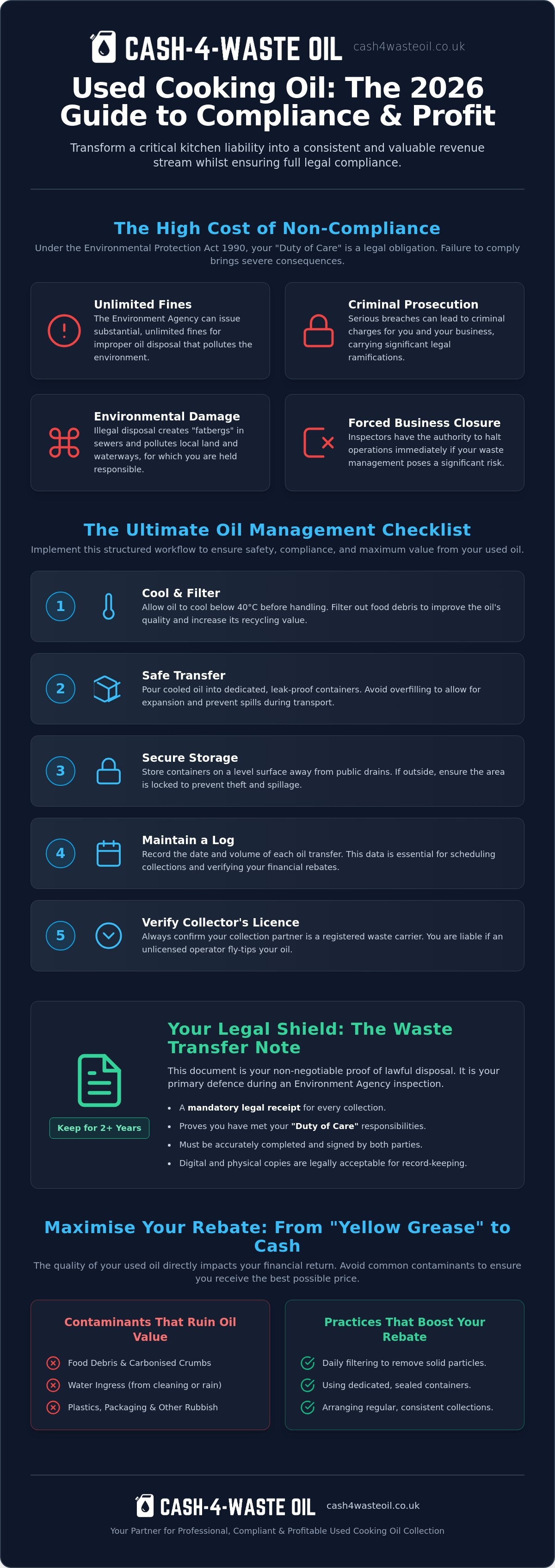
The Duty of Care principle means you are legally responsible for your waste until it reaches a licensed disposal point. This responsibility covers all types of kitchen fats, including vegetable oil, sunflower oil, and solid shortenings. You must verify that your collector is a registered waste carrier with a valid licence. A Waste Transfer Note is the mandatory legal receipt you must keep for at least two years to prove your compliance during an official inspection.
Why Traditional Disposal Methods Fail
Pouring used oil down the drain is a criminal offence that leads to "fatbergs" in the sewage system. These massive blockages cause backups that can flood your own kitchen with raw sewage. Never use unlicensed collectors who might fly-tip your oil in a local field. If they do, the Environment Agency will prosecute you as the original producer. Additionally, leaking containers ruin kitchen hygiene and attract vermin. A professional catering company waste oil collection service eliminates these risks by providing secure, leak-proof containers and documented disposal routes.
The Ultimate Kitchen Oil Management Checklist
A clean kitchen is a profitable kitchen. Without a structured system, used cooking oil becomes a slip hazard and a compliance nightmare. Use this checklist to standardise your workflow and protect your business from the risks of improper disposal.
- Step 1: Cool and Filter. Allow oil to drop below 40°C before handling. Filtering removes breadcrumbs and carbonised debris that lower the oil's quality. High-quality oil fetches a better rebate because it's a superior feedstock for biodiesel production.
- Step 2: Safe Transfer. Move cooled oil into dedicated, leak-proof containers. Use wide-neck drums to avoid splashes and don't fill them to the absolute brim. Leave space for thermal expansion and safe transport.
- Step 3: Secure Storage. Keep drums on a level, non-slip surface away from external gullies. If you store oil outside, ensure the area is locked to prevent theft. Oil must never be stored where a spill could reach a public drain.
- Step 4: Maintain a Log. Record the volume transferred and the date of each change. This data is vital for predicting when you'll next need a catering company waste oil collection and helps you verify your financial rebates.
- Step 5: Verify Registration. Ask for a copy of the collector's waste carrier licence. Under UK law, you are liable if an unlicensed collector fly-tips your waste. Always check their Environment Agency credentials before they leave the site.
Daily and Weekly Oil Handling Procedures
Daily filtering extends the life of your oil, directly reducing your weekly overheads. Train your team to handle fats with heat-resistant gloves and aprons to prevent kitchen accidents. A weekly deep clean of the storage area prevents pest infestations and keeps health inspectors satisfied. If your storage area smells or feels greasy underfoot, your current process is failing. Clean areas are easier to manage and present a professional image to anyone auditing your site.
Documentation and Record Keeping
Waste Transfer Notes (WTNs) are your primary defence against fines. Organise them chronologically in a dedicated folder or a secure digital drive. Whilst the Environment Agency increasingly accepts digital records in 2026, they must be instantly accessible during a spot check. You must keep every WTN for at least two years. These receipts prove that you've fulfilled your legal Duty of Care and that the oil has entered a legitimate recycling stream.
Organising a regular catering company waste oil collection ensures your drums never overflow and your kitchen remains compliant. You can arrange a pick-up today to keep your operations running smoothly and safely.
Choosing a Catering Company Waste Oil Collection Partner
Choosing a partner for your catering company waste oil collection requires more than a quick search for the cheapest option. You need a provider that treats your waste as a commodity whilst respecting the tight margins and fast pace of the hospitality sector. National corporations often provide a "one size fits all" service that fails to account for the specific pressures of local businesses. In contrast, an agile local specialist understands the logistical hurdles of operating across London, Kent, and Surrey. They know how to navigate ULEZ requirements, congestion zones, and peak traffic times to ensure your kitchen remains clear and compliant without disruption.
The rebate model is a fundamental part of a smart business partnership. Your used oil is collected, filtered, and sold as feedstock for the growing biofuel industry. High demand for sustainable aviation fuel and renewable diesel means your waste has a tangible market value. A reliable partner provides transparent pricing based on the volume of oil collected, which effectively turns your disposal process into a consistent revenue stream. This financial return can then be reinvested directly into your kitchen operations or staff training; for instance, you can learn more about Operational Chef Consultant to find professional staffing solutions that elevate your service standards.
Verifying Environment Agency Registration
Always check the Environment Agency's public register before signing any contract. A legitimate collector will proudly display their waste carrier licence and provide it upon request. Be wary of any individual who refuses to provide a Waste Transfer Note or suggests "off-the-books" collections for a lower fee. These are major red flags. If your oil is eventually fly-tipped, the legal liability stays with you as the original producer. A licensed partner is your primary insurance policy against Environment Agency fines and criminal prosecution.
Service Frequency and Reliability
Your collection schedule must match your kitchen's actual output. For smaller cafes, on-call collections might suffice, but larger operations usually benefit from scheduled weekly pickups to prevent storage overflows. Reliability also means "clean" collections. You don't want a partner who leaves oily residue or spills in your yard; this creates slip hazards and attracts pests. For larger establishments with high-volume requirements, consider a specialised Hotel Waste Oil Collection London service to ensure consistent, large-scale removal and maximum rebates. A professional catering company waste oil collection service should be invisible, efficient, and financially rewarding.
Avoiding Common Pitfalls in Commercial Oil Disposal
Busy kitchens are chaotic environments where mistakes happen quickly. Contamination is the silent profit killer in your waste management strategy. If your team allows food debris, wash water, or cleaning chemicals to enter your storage drums, the recycling value of the oil plummets. Refiners require clean feedstock to produce high-quality biodiesel; heavily contaminated oil may even be rejected by your collector. This doesn't just lose you a rebate; it can lead to additional disposal charges for "difficult" waste. Treat your used oil as a product, not a rubbish bin.
Water ingress is another frequent error that ruins your financial return. Rainwater entering an unsealed barrel causes hydrolysis, which increases the free fatty acid content and makes the oil unstable for processing. Always keep lids tightly secured and store containers under cover whenever possible. Many businesses also fall for the myth of "free" collection. In 2026, used cooking oil is a valuable commodity. If you are currently paying for a catering company waste oil collection or receiving no rebate, you are effectively giving away part of your profit margin. Professional collectors should pay you for your waste, reflecting its market value as a renewable energy source.
Preventing Drain Blockages and Fines
Never confuse bulk oil disposal with grease trap management. Whilst a catering company waste oil collection handles your fryer fats, your grease trap catches the residual oils from pot washing and plate scraping. Neglecting either leads to "fatbergs" in the local sewer system. Local councils and water authorities can trace blockages back to your kitchen using CCTV and dye testing. Even if the blockage occurs "downstream," you are legally liable for the repair costs and environmental fines. Implement a strict "No Oil Down Drains" rule for all staff, from the head chef to the newest commis, to ensure total compliance.
Managing Storage in Small London Kitchens
Space is a luxury in Soho or Camden basements. If you lack the footprint for large drums, increase your collection frequency rather than overfilling small containers. Overfilled vats are a major fire risk; stored vegetable oil acts as a significant fuel source if a kitchen fire breaks out. Ensure your storage area is well-ventilated and kept clear of flammable packaging. For kitchens with restricted access, agile local collectors can provide smaller, more manageable containers that fit through narrow doorways without compromising safety or hygiene standards.
Stop losing money on your kitchen waste and start getting paid for your compliance. Get a quote for your waste oil and turn your used fats into immediate cash for your business.
Maximising Value with Cash 4 Waste Oil
Cash 4 Waste Oil simplifies the catering company waste oil collection process by removing the administrative and logistical hurdles that typically slow down a busy kitchen. Whilst national competitors often hide behind complex invoicing cycles and vague "best price" promises, we operate on a direct "Cash on the Spot" model. This immediate payment provides a tangible advantage for independent businesses, allowing you to reinvest liquid capital back into your stock or equipment the very same day. You no longer have to wait weeks for a rebate to clear your bank account; the value of your waste is realised the moment the drums are loaded onto our vehicle.
Compliance is handled with the same level of efficiency. We issue your mandatory Waste Transfer Note instantly upon collection, ensuring your digital or paper records are always audit-ready for an Environment Agency inspection. This transparent approach satisfies your legal Duty of Care without adding to your daily paperwork. By choosing a specialist partner, you also contribute directly to the UK's circular economy. Every litre of oil we collect is diverted from landfills and sewers, then transported to specialised facilities to be converted into high-grade UK biodiesel. This process turns a hazardous waste product into a sustainable energy source that powers transport and reduces carbon emissions across the country.
Our Service Area: London, Kent, and Surrey
We provide a rapid response service across Greater London and the Home Counties, including Kent and Surrey. Our local focus is a strategic choice; it allows us to navigate the specific traffic and zoning challenges of the region more effectively than national firms. This proximity also minimises the carbon footprint of the recycling process by reducing transport distances. Whether you manage a local pub, a busy high-street takeaway, or a large-scale catering firm, our local knowledge ensures a seamless, punctual experience that respects your kitchen's operational hours.
How to Book Your First Collection
Booking a collection is designed to be as fast as the service itself. We follow a methodical three-step process that places the caterer's needs first:
- Step 1: Call. Reach out to schedule a collection at a time that minimises disruption to your service.
- Step 2: Collect. our team arrives, handles the transfer safely, and issues your legal compliance documentation on-site.
- Step 3: Get Paid. Receive your cash payment immediately based on the volume of oil collected.
We don't believe in restrictive long-term contracts or hidden service fees. You enjoy total flexibility and a reliable partner that values your time and your waste. Get cash for your waste oil today and transform your disposal routine into a predictable revenue stream for your business.
Secure Your Compliance and Profits Today
Effective oil management is the difference between a compliant, profitable kitchen and one facing crippling Environment Agency fines. By following the 2026 checklist, you ensure your storage remains clean, your staff stay safe, and your legal paperwork is always up to date. A professional catering company waste oil collection shouldn't be a cost; it is a seamless transaction that puts money back into your business. We have explored why local expertise in London and the Home Counties matters and how avoiding simple contamination errors protects your rebate.
Now is the time to clear your storage area and boost your cash flow. We are fully Environment Agency Registered and provide mandatory Waste Transfer Notes with every collection to keep you protected. Book your free waste oil collection and get paid cash today with our guaranteed cash on the spot service. Streamlining your waste disposal has never been simpler or more rewarding for your bottom line.
Frequently Asked Questions
Is it illegal to put cooking oil in the bin in the UK?
It is illegal to dispose of liquid used cooking oil in your standard general waste bins or down the sink. UK regulations categorise liquid fat as a controlled waste stream that requires specialised handling to prevent environmental contamination. If liquid oil leaks into a landfill, it can cause significant damage to soil and water sources. You must use a professional catering company waste oil collection service to ensure your waste is processed at a licensed facility.
Do I need a Waste Transfer Note for every oil collection?
You must receive a Waste Transfer Note (WTN) for every single collection of used cooking oil from your premises. This document is your legal proof that you have transferred your waste to a registered carrier. You are required by law to keep these notes for at least two years. Failure to produce them during an Environment Agency inspection can result in heavy fines or legal action against your business.
How much cash can I get for my used cooking oil?
The amount of cash you receive depends on the volume and quality of the oil you provide. Clean, filtered oil that is free from food debris and water ingress typically commands a higher rebate. We provide transparent, market-linked payments that reflect the current value of used cooking oil as a renewable energy feedstock. This turns your waste into a direct source of reinvestment for your kitchen's daily operations.
How should I store waste oil before it is collected?
Store your used oil in secure, leak-proof drums provided by your collection partner. These containers should be kept in a cool, dry area that is inaccessible to the public to prevent theft or tampering. It's vital to keep the storage site away from external drains or gullies. This prevents accidental spills from entering the water system, which could lead to severe penalties from your local water authority.
Can I mix different types of cooking oil in one barrel?
You can generally mix various types of vegetable-based cooking oils, such as sunflower, rapeseed, and palm oil, in the same collection barrel. However, you must never mix cooking oil with engine oil, solvents, or cleaning chemicals. Contaminating your vegetable oil with non-food substances ruins its recycling value. It may also lead to a refusal of collection or additional disposal fees to cover the cost of hazardous waste processing.
What happens to the waste oil after it is collected from my kitchen?
After your catering company waste oil collection is complete, the oil is transported to a specialised processing facility. It undergoes a rigorous filtration and refining process to remove impurities and water. The final product is used as a sustainable feedstock for the production of biodiesel. This renewable fuel significantly reduces carbon emissions compared to traditional fossil fuels, supporting a cleaner environment and a modern circular economy.
How do I know if a waste oil collector is legitimate?
You can verify a collector's legitimacy by checking the Environment Agency's public register of waste carriers. A legitimate business will always have a valid waste carrier licence and will provide a Waste Transfer Note at the point of collection. Be cautious of any individual who offers to take your oil without providing official documentation. If they fly-tip your waste, the legal liability remains with you as the original producer.
Do you collect waste oil from residential properties?
No, we do not provide residential oil collection services. Our operations are strictly focused on the commercial sector, serving restaurants, hotels, takeaways, and professional catering companies. If you are a householder with used cooking oil, you should contact your local council. They can direct you to the nearest household waste recycling centre that is equipped to accept and process liquid fats from domestic sources.