
Your Waste Transfer Note is more than just a legal hurdle to clear before a surprise inspection; it is a professional receipt that proves your kitchen is contributing to the circular economy. If you are worried about the heavy Environment Agency fines that come with poor record-keeping, you aren't alone. Knowing exactly how to get a waste transfer note for cooking oil is the simplest way to protect your business from untrustworthy collectors who disappear when the regulators start asking questions.
It's understandable if you find the jargon around EWC codes and the 2026 digital tracking mandates confusing. You want a kitchen that runs like clockwork, not a desk buried in manual paperwork. This guide promises to simplify the entire compliance process for you. We will show you how to secure a valid WTN instantly, keep your records audit-ready for the required two-year period, and ensure you receive a fair cash rebate for every litre you recycle. From understanding your duty of care to spotting a licensed carrier, here is your 2026 checklist for a compliant, profitable kitchen.
Key Takeaways
- Understand your legal 'Duty of Care' to avoid heavy Environment Agency fines and ensure your kitchen remains fully compliant with 2026 regulations.
- Learn exactly how to get a waste transfer note for cooking oil by partnering with a registered carrier that provides instant, valid paperwork on-site.
- Verify that your documentation includes the mandatory EWC code 20 01 25 and keep your records organised for the required two-year retention period.
- Reduce weekly admin by opting for annual 'Season Ticket' notes for regular collections instead of signing a new form every time.
- Maximise your profits by securing immediate cash payments for your waste oil whilst fulfilling your legal obligations.
The Legal Necessity of a Waste Transfer Note for Cooking Oil
A Waste Transfer Note (WTN) is a mandatory document that records the movement of non-hazardous waste from your premises to a collector. For a commercial kitchen, it acts as the only valid proof that your used cooking oil has been handled by a legitimate, licensed carrier. Relying on a handshake or a verbal agreement with a collector is illegal. Without a physical or digital note, you remain legally liable for where that oil ends up. If a collector dumps your waste in a field or down a drain, the Environment Agency will look to your business for answers.
Your legal obligations are rooted in the "Duty of Care" established by the Environmental Protection Act 1990. This legislation dictates that as a waste producer, you must ensure your waste is managed responsibly. You cannot simply hand it over and forget about it. You must verify that the person taking it is authorised to do so. This is why understanding how to get a waste transfer note for cooking oil is a fundamental skill for any restaurant manager or head chef. The Environment Agency monitors these transactions to prevent environmental damage and ensure waste enters the circular economy correctly.
Why Commercial Kitchens are High-Priority for Inspections
Kitchens are under constant scrutiny because of the damage fats, oils, and grease (FOG) cause to the UK’s sewage infrastructure. When oil is poured down the sink, it solidifies into "fatbergs" that cause massive blockages and local flooding. Under the Food Safety Act 1990, businesses must maintain a clean and safe environment, which includes proper waste management. Local councils frequently use routine health and safety or hygiene inspections to check your waste documentation. If you cannot produce a WTN for your last six months of collections during a doorstep check, you are already in breach of the law.
The Cost of Non-Compliance: Fines and Penalties
The financial risks of cutting corners are significant. Failing to produce a WTN on demand can lead to an immediate Fixed Penalty Notice (FPN). These are on-the-spot fines designed to punish administrative negligence. However, if your waste is linked to a serious pollution incident or fly-tipping, the penalties escalate quickly. UK courts have the power to issue unlimited fines for serious waste offences. For a detailed breakdown of what you might face, see our guide on fines for improper cooking oil disposal UK. Compliance is always cheaper than a court date.
Essential Checklist: What Must Appear on Your Cooking Oil WTN?
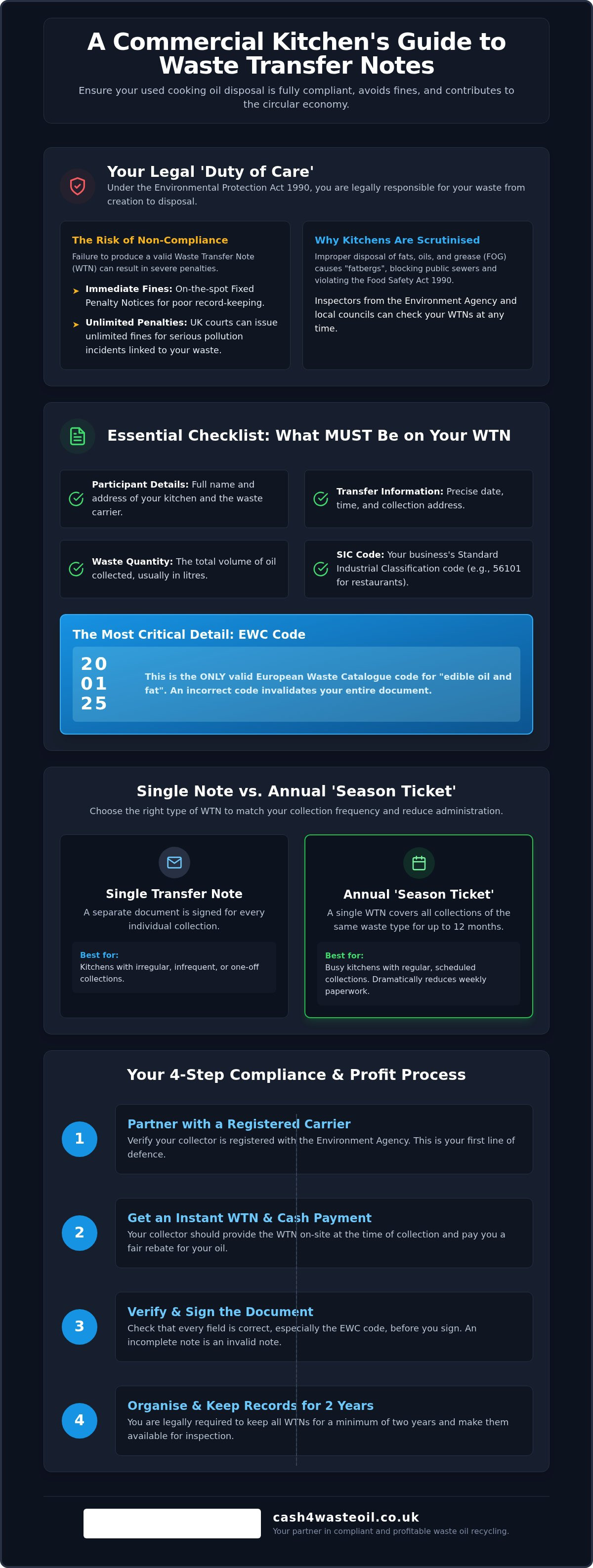
A valid Waste Transfer Note isn't just a receipt; it is a legal safeguard for your business. To ensure your paperwork stands up to scrutiny from the Environment Agency or local council inspectors, it must contain specific, non-negotiable details. Missing even a single field can render the entire document invalid, leaving you exposed to fines. Knowing how to get a waste transfer note for cooking oil is only half the battle; you also need to know what a valid one looks like before you sign it.
Each note must accurately record several key pieces of information to be considered legally binding:
- Participant Details: The full name and business address of both the waste producer (your kitchen) and the waste carrier.
- Transfer Information: The exact date, time, and location where the oil was handed over.
- Waste Description: A clear description of the waste, which must include the correct classification code.
- Quantity: The total volume of oil collected, typically recorded in litres for commercial kitchens.
- SIC Code: Your business's five-digit Standard Industrial Classification code. For most restaurants, this is usually 56101.
- Waste Hierarchy Declaration: A signed statement confirming you have followed the waste hierarchy, prioritising recycling into biodiesel over general disposal.
Understanding EWC Code 20 01 25
The European Waste Catalogue (EWC) serves as the UK's standardised waste language. It uses a six-digit coding system to ensure every type of waste is classified correctly. For used cooking oil, the only code you should see on your paperwork is 20 01 25. This code specifically identifies "edible oil and fat" and distinguishes it from hazardous mineral oils or general food waste. Using the wrong code is a major red flag for inspectors and can invalidate your compliance status immediately. Understanding The Legal Necessity of a Waste Transfer Note requires you to be vigilant about these technical classifications.
Verification of the Licensed Waste Carrier
Handing your waste to an unlicenced collector is a gamble you don't need to take. You have a legal duty to verify that your collector is an Environment Agency registered carrier. Always ask for their registration number and cross-reference it with the Environment Agency's public register before any oil leaves your site. A legitimate licensed waste carrier for cooking oil will always carry a copy of their licence and will be happy to show it to you. If you are struggling with how to get a waste transfer note for cooking oil that guarantees full compliance, you can organise a professional collection with a carrier that provides immediate, valid documentation on the spot.
Comparing Single Transfer Notes vs. Annual Season Tickets
Managing a fast-paced commercial kitchen is a logistical challenge. Adding a weekly ritual of filling out and signing paperwork for oil collection can feel like a drain on your resources. When you are researching how to get a waste transfer note for cooking oil, you will find two primary options: the single transfer note and the annual season ticket. Choosing the right one depends on your collection frequency and how much you value your administrative time.
A single Waste Transfer Note (WTN) documents one specific transfer of waste. If your oil is collected every week, you would technically need to sign and file 52 individual notes every year. This creates a heavy paper trail that you must organise and store for at least two years. In contrast, an annual "Season Ticket" is a single document that covers all transfers of the same waste between the same two parties for up to 12 months. It effectively replaces the need for individual notes for every visit, provided the waste type and the carrier remain unchanged.
When to Opt for a Single Waste Transfer Note
Single notes remain a practical choice in specific scenarios. If you are a new business and still testing a collection partner, a single note allows you to trial their service without committing to a long-term arrangement. They are also mandatory for one-off bulk removals. For example, if you have just completed a major deep clean or hosted a seasonal event that generated an unusual amount of waste, a single note accurately reflects that specific volume. Use a single note when your oil output is unpredictable or if you are clearing out a large quantity of old oil that isn't part of your regular collection cycle.
The Efficiency of the Annual Waste Transfer Note
For established kitchens in high-volume hubs like London, Birmingham, or Kent, the annual season ticket is the efficiency gold standard. It slashes your paperwork whilst ensuring you stay fully covered during a surprise inspection. To be valid, your season ticket must be supported by a "schedule" or a log of collections. This log proves exactly when each pickup occurred and the volume of oil removed. This ensures your records match the Essential Checklist for Your WTN requirements for transparency.
If you produce significant amounts of waste, you should also refer to the DEFRA cooking oil waste guidance to ensure your annual volumes align with the latest 2026 commercial standards. Moving to an annual system simplifies your filing and lets you focus on your customers instead of your filing cabinet. It is the most logical step for any kitchen looking to streamline its compliance without sacrificing legal protection.
Step-by-Step: How to Obtain and Organise Your Compliance Paperwork
Securing your paperwork doesn't have to be a headache. Learning how to get a waste transfer note for cooking oil is a vital first step for any kitchen manager who wants to avoid legal trouble. Once you have a system in place, the process becomes a repeatable part of your weekly routine. Follow these five steps to ensure your kitchen remains fully protected and audit-ready.
- Book your collection: Contact an Environment Agency registered carrier. Verify their licence number before they arrive at your premises.
- Prepare your oil: Ensure all used oil is safely stored in sealed, leak-proof containers. This prevents environmental contamination and allows the carrier to measure the volume accurately.
- Review the documentation: Check the WTN at the point of collection. Ensure it lists the correct EWC code (20 01 25) and the exact quantity of oil being removed.
- Sign and receive: Once you are satisfied with the details, sign the note. You should receive your copy immediately, either as a physical carbon copy or a digital PDF sent to your email.
- File your records: Move the note straight into your 'Duty of Care' folder. Organising them chronologically is the most effective way to manage your paper trail.
Best Practices for Record Keeping: The 2-Year Rule
UK law requires you to keep all Waste Transfer Notes for a minimum of two years. Whilst physical folders are traditional, digital filing is often more reliable during a surprise inspection. A digital folder allows you to search for specific dates or volumes in seconds, which immediately puts an inspector at ease. If you prefer paper, use a dedicated lever-arch file with monthly dividers. This level of organisation proves you take your environmental responsibilities seriously and reduces the time spent on admin during a busy shift.
What to Do if You Lose a Waste Transfer Note
Losing a note is a common issue, but it's one you must fix quickly. If a document goes missing, contact your waste carrier immediately to request a duplicate. Most professional carriers keep digital backups of every transaction and can resend a copy via email. It's important to remember that the legal liability for proving proper disposal sits with you, the waste producer. Even if your carrier loses their copy, you are still responsible for your records. Maintaining your own backup digital copies is a vital business safeguard that prevents gaps in your compliance history. If you want to skip the admin and get paid on the spot, book your oil collection today and receive your paperwork instantly.
Securing Your WTN and Cash Rebate with Cash 4 Waste Oil
Compliance doesn't have to be a cost centre for your kitchen. At Cash 4 Waste Oil, we have built a "Compliance + Cash" model that simplifies the process of how to get a waste transfer note for cooking oil whilst putting money back into your business. We operate as an Environment Agency registered carrier across London, Surrey, Kent, and the Midlands. We provide immediate, legally valid WTNs the moment we collect your oil. This ensures you have total peace of mind during surprise inspections. You can prove your contribution to the circular economy instantly, as every drop we collect is repurposed into sustainable biodiesel.
Our service is designed to be a seamless, professional experience for busy hospitality managers. We understand that your time is best spent on the floor or in the kitchen, not chasing paperwork or dealing with "cowboy" collectors. By choosing a licensed partner, you eliminate the risk of fines and ensure your waste is handled with the highest environmental standards. We take the burden of logistics off your shoulders, providing the documentation you need to stay on the right side of the law.
Turning a Legal Burden into a Revenue Stream
Most waste management services charge you for the privilege of removing your refuse. We take the opposite approach. We recognise the commercial value of used cooking oil and pass that value back to you through our per-litre rebate system. Our "Cash on the Spot" policy is a favourite amongst independent pubs, restaurants, and takeaways because it provides an immediate injection of funds. There's no waiting for bank transfers or complicated invoicing. You receive your cash and your compliance paperwork in one single visit. For the latest market rates and details on how we calculate your payment, check our guide on how to get paid for used cooking oil London.
Reliable Local Collections in Your Area
We pride ourselves on being a trusted local partner with deep regional expertise. We operate across major hubs including London, Birmingham, Coventry, and Wolverhampton. Using a local carrier means we understand specific regional council requirements and can provide a prompt, reliable service that fits your schedule. Whether you need a one-off bulk removal or a regular weekly pickup, we provide the same high level of transparency and professionalism. Don't leave your kitchen's compliance to chance. Book your collection and get your Waste Transfer Note today to start turning your waste into a reliable revenue stream.
Future-Proof Your Kitchen Compliance Today
You now have a clear, actionable roadmap for handling your used cooking oil. By moving away from informal collections and mastering how to get a waste transfer note for cooking oil, you protect your business from the unlimited fines and legal scrutiny that define the 2026 regulatory landscape. Remember to verify EWC code 20 01 25 on every document and consider an annual season ticket to slash your weekly admin time. These simple steps ensure your kitchen remains audit-ready whilst contributing to a greener, circular economy.
Compliance shouldn't be a headache; it's an opportunity to streamline your operations and boost your bottom line. At Cash 4 Waste Oil, we make the process effortless. As an Environment Agency Registered Carrier, we provide fully compliant documentation every time whilst paying cash on the spot for your waste. Stop worrying about surprise inspections and start getting rewarded for your recycling efforts. Get your legal Waste Transfer Note and cash for your oil—Book now. Turning your waste into a reliable revenue stream is a smart business move that benefits your profit margins and the planet.
Frequently Asked Questions
What is a Waste Transfer Note and why does my restaurant need one?
A Waste Transfer Note is a legal document that records the transfer of waste from your premises to a collector. Your restaurant needs one to prove compliance with the Environmental Protection Act 1990. It acts as your only valid evidence that your oil was handled by a licensed carrier. Without this paperwork, you remain legally liable if your waste is later fly-tipped or disposed of incorrectly.
How long do I need to keep my cooking oil waste transfer notes?
You must keep your Waste Transfer Notes for a minimum of two years from the date of the collection. This is a strict legal requirement under the UK's Duty of Care regulations. Storing them in a chronological folder, either digitally or physically, ensures you can produce them instantly if an Environment Agency officer or local council inspector visits your kitchen for a spot check.
Can I use an annual waste transfer note for my cooking oil?
Yes, you can use an annual note, often called a "Season Ticket," to cover multiple transfers of the same waste over a 12-month period. This is the most efficient method for kitchens looking at how to get a waste transfer note for cooking oil whilst reducing weekly paperwork. You must simply maintain a schedule of collections to prove when each individual pickup occurred and the volume removed.
Is it illegal to dispose of cooking oil without a waste transfer note?
Yes, it is illegal for a commercial business to dispose of used cooking oil without a valid Waste Transfer Note. Handing your oil to an unlicensed collector or failing to document the transfer is a direct breach of your Duty of Care. This negligence can result in immediate Fixed Penalty Notices or unlimited fines if the Environment Agency decides to take the matter to court.
What is the EWC code for used cooking oil on a WTN?
The correct European Waste Catalogue (EWC) code for used cooking oil is 20 01 25. This specific code identifies the waste as "edible oil and fat" and is the only classification you should use for kitchen oil. You must ensure this exact code appears on your documentation. Using the wrong code can invalidate your compliance status and lead to problems during a formal health and safety audit.
How do I check if my waste oil collector is legally licensed?
You should check the Environment Agency's public register of waste carriers using the company's registration number. A legitimate, professional collector will always be happy to provide their licence details before any oil leaves your site. Always verify this information yourself to ensure you aren't dealing with an untrustworthy collector who could leave your business vulnerable to legal action or heavy environmental fines.
Can I get a waste transfer note for free?
Yes, professional collectors like Cash 4 Waste Oil provide the Waste Transfer Note at no cost as part of the service. We provide immediate paperwork whilst paying you cash on the spot for every litre collected. This approach simplifies the process of how to get a waste transfer note for cooking oil and ensures you remain fully compliant without paying extra for mandatory legal documentation.
What happens if I lose my waste transfer note before an inspection?
You must contact your waste carrier immediately to request a digital or physical duplicate if you lose a note. Most licensed carriers maintain their own digital records for at least two years and can resend the documentation via email. It is vital to replace missing notes quickly. The legal responsibility to produce valid records during an inspection rests entirely with you, the waste producer.