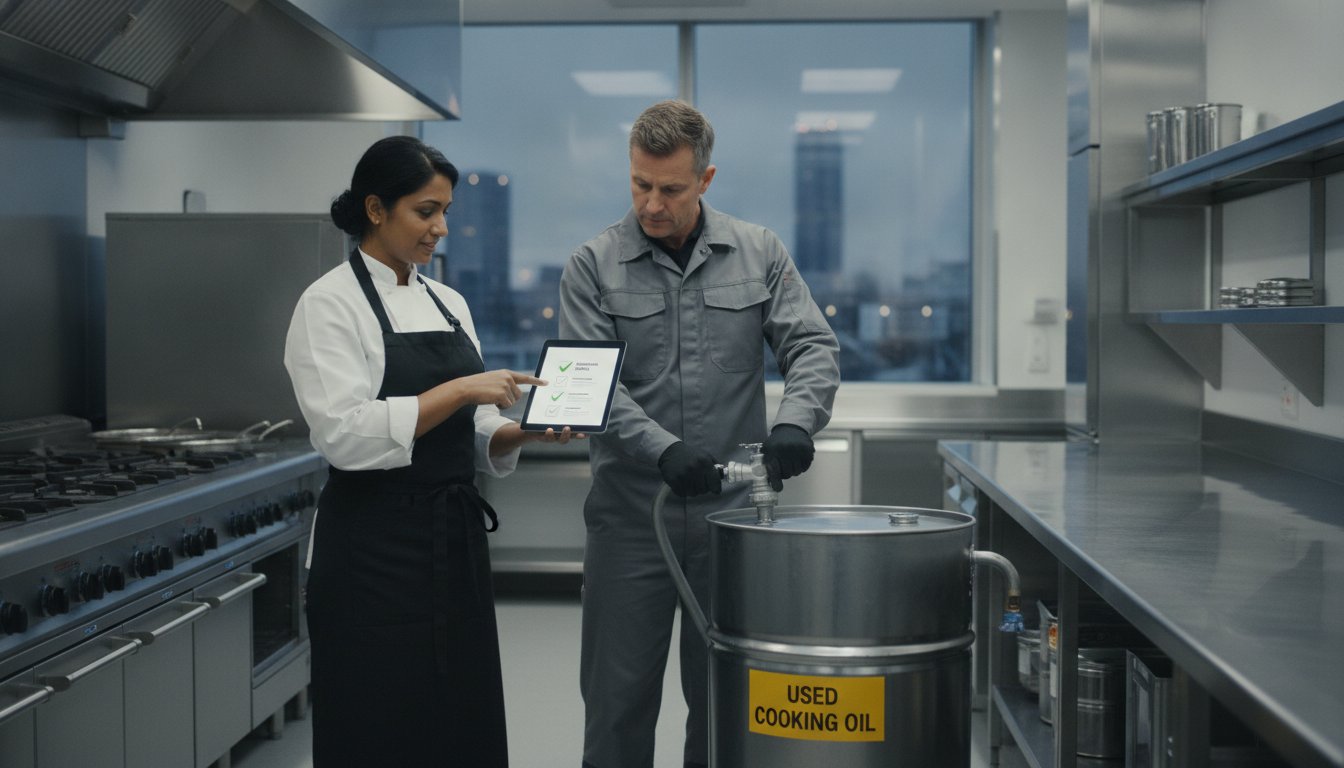
Could your kitchen's waste oil be the difference between a £5,000 fine and a fresh stream of revenue? You're likely already managing cramped storage and the daily pressure of a high-speed service. Keeping up with the latest DEFRA cooking oil waste guidance often feels like an administrative burden you simply don't have time for. It's understandable to feel frustrated by the prospect of Environment Agency inspections or the new digital tracking mandates when you're busy running a business.
We'll help you master the 2026 compliance rules to ensure your kitchen remains legal whilst turning your waste oil into a genuine financial asset. By following this guide, you can eliminate the fear of heavy fines and replace messy, unorganised storage with a streamlined system that pays you back. We will walk you through the October 2026 Digital Waste Tracking transition, the essential requirements for Waste Transfer Notes, and how to stay ahead of the Environment Agency's stricter oversight. You'll learn exactly how to transform your duty of care from a legal headache into a clean, profitable, and hassle-free operation.
Key Takeaways
- Understand why used cooking oil is classified as "controlled waste" and how the latest DEFRA cooking oil waste guidance sets the standard for commercial kitchens in 2026.
- Learn how to fulfil your "Duty of Care" under the Environmental Protection Act 1990 by ensuring your waste is only handled by authorised, licensed carriers.
- Discover the specific storage requirements needed to prevent environmental contamination and avoid local authority fines of up to £5,000.
- Master the transition from paper Waste Transfer Notes to the mandatory Digital Waste Tracking system arriving in October 2026.
- Find out how professional collection services can streamline your compliance whilst providing immediate cash payments for your waste oil.
Understanding DEFRA Cooking Oil Waste Guidance for 2026
In the eyes of the law, your used frying oil isn't just a kitchen byproduct. It's classified as "controlled waste" under the Environmental Protection Act 1990. This means you have a legal obligation to manage it from the moment it leaves the fryer until its final disposal. The Department for Environment, Food & Rural Affairs (DEFRA) establishes the policy framework that dictates how this waste must be handled. Their goal is clear: move the UK towards a circular economy where waste becomes a resource. By following the DEFRA cooking oil waste guidance, you're not just staying legal; you're contributing to a system that turns old fats into low-carbon biodiesel.
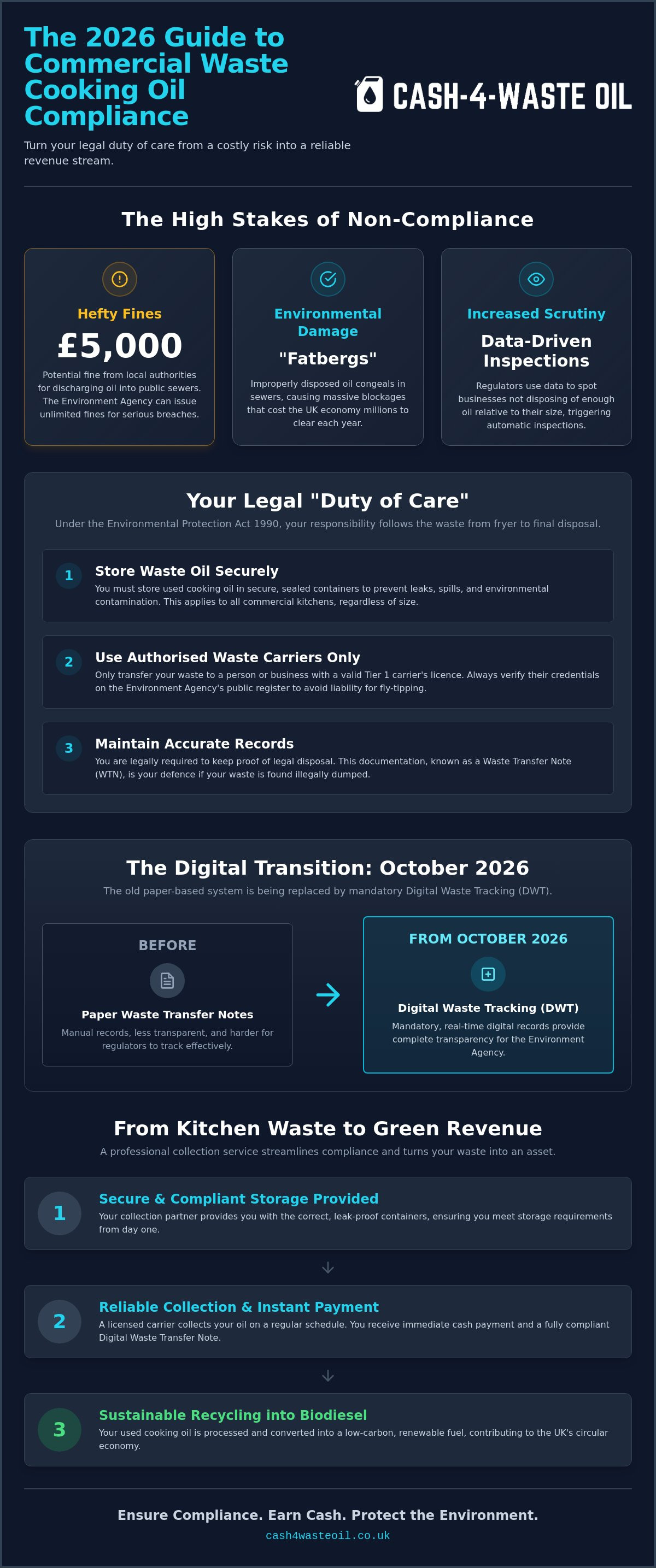
Pouring oil down the sink remains a serious criminal offence in 2026. It's not just about local blockages. The regulatory framework for UK waste cooking oil collection ensures that every litre is tracked to prevent environmental damage. When oil enters the sewer system, it congeals with other debris to form "fatbergs," which cost the UK economy millions to clear every year. Regulators are increasingly using data from the new Digital Waste Tracking service to spot businesses that aren't disposing of enough waste oil relative to their size, making it harder than ever to hide improper practices.
Who Does the Guidance Apply To?
The rules don't distinguish between a Michelin-starred restaurant and a small local takeaway. If you produce food for profit, these regulations apply to you. Many small business owners mistakenly believe that low volumes of oil exempt them from strict oversight. That's a dangerous assumption. Even if you only fill one 20-litre drum a month, you still fall under the "Duty of Care" requirements. You must keep records, store the oil securely, and only use licensed carriers for collection. There's no "domestic" loophole for commercial premises; if it's a business, it's controlled waste.
The Consequences of Non-Compliance
Ignoring DEFRA cooking oil waste guidance carries heavy penalties. The Environment Agency has the power to issue unlimited fines and pursue criminal prosecutions for serious breaches of waste law. Beyond the courtrooms, local water authorities can levy fines of up to £5,000 if they find you're discharging oil into public sewers. You can read more about the specific fines for improper cooking oil disposal UK kitchens face in our detailed compliance guide. Perhaps worse than the financial hit is the reputational damage. Being publicly linked to a sewer collapse or a local fatberg can destroy customer trust overnight.
Your Legal Duty of Care: The Environmental Protection Act 1990
Your responsibility for used cooking oil doesn't stop at the kitchen door. Under the Environmental Protection Act 1990, every business has a "Duty of Care" regarding the waste it produces. This isn't a one-off task; it's a lifelong responsibility that follows the waste from production to final disposal. If your oil is found dumped in a field or poured down a drain, the authorities will trace it back to you. You're legally required to take all reasonable steps to keep the waste safe and ensure it's managed correctly at every stage.
In 2026, the emphasis has shifted heavily towards digital traceability. The Environment Agency (EA) now uses sophisticated data to monitor waste streams and identify gaps in commercial compliance. By October 2026, the mandatory Digital Waste Tracking (DWT) service will be fully operational for all licensed waste sites in England. This system allows regulators to see exactly who is collecting your oil and where it ends up in real time. If your kitchen produces high volumes of fried food but has no recorded waste collections, you'll likely trigger an automatic inspection. Staying aligned with DEFRA cooking oil waste guidance is the only way to avoid these red flags.
Verifying Your Waste Carrier
You must ensure your waste is only handled by authorised persons. Always check the Environment Agency's public register to confirm a collector has a valid Tier 1 carrier's licence. Rogue collectors often offer "free" disposal but might fly-tip your oil to avoid processing costs. If they do, you remain legally liable for the cleanup and any resulting fines. A licensed waste carrier for cooking oil acts as your legal shield, providing the necessary documentation to prove you've met your obligations. To ensure you're meeting these standards without the stress, consider booking a collection with an Environment Agency registered oil collector who handles the paperwork for you.
The Hierarchy of Waste
Following DEFRA cooking oil waste guidance means adhering to the "Waste Hierarchy." This five-step framework prioritises how waste should be managed: Prevention, Re-use, Recycling, Recovery, and finally, Disposal. For commercial kitchens, converting used oil into biodiesel is the gold standard of recycling. It keeps carbon-heavy waste out of landfills and sewers whilst contributing to the UK's renewable energy goals. In 2026, sending liquid vegetable oils to landfill is no longer a legal option for commercial entities. Recycling isn't just the "green" choice; it's the only compliant one.
Compliant Storage and Handling: Preventing Fines and Blockages
Storing your used oil correctly is about more than just hygiene; it's a core part of DEFRA cooking oil waste guidance. In high-density areas like London and Kent, kitchen space is often at a premium. This leads to containers being left in cramped alleyways or near back doors where they risk being knocked over or leaking. To remain compliant, your storage must be "secure." This means using robust, leak-proof drums that are kept in a bunded area or away from high-traffic zones where spills could occur. If oil seeps into the ground, it can contaminate the soil and lead to an Environment Agency investigation.
A critical rule is keeping your oil containers far from surface water drains. If a leak occurs, oil can quickly enter the environment, leading to severe penalties. The UK government guidance on cooking oil waste specifies that businesses must prevent any oil from reaching the drainage system. Clear labelling on every drum helps staff and collectors identify the contents immediately. This reduces the risk of accidental contamination or incorrect handling during a busy shift. Proper labelling also ensures that your waste remains "identifiable" as part of your legal duty of care.
Best Practices for Kitchen Staff
Your team is the first line of defence against compliance failures. Establish a clear protocol for cooling oil before it's moved. Transferring boiling oil into plastic drums is a major safety hazard and can melt the container, causing a massive spill. Once cooled, ensure the oil isn't mixed with water, chemicals, or food waste. Contaminated oil is harder to process into biodiesel and may even be rejected by collectors. Regular training on using spill kits is also essential. Staff should know exactly how to contain a leak before it reaches a drain, keeping your kitchen safe and legal.
Avoiding Drain and Sewer Issues
Used oil might look liquid when it's warm, but it solidifies rapidly once it hits the cool environment of a sewer pipe. Over time, these layers build up, catching other debris and creating massive blockages. Whilst many kitchens use grease traps, these are not a "set and forget" solution. Grease traps only catch a portion of the fats and require regular maintenance. They don't replace the need for professional collection. Legally, you are prohibited from allowing any oil to enter the public sewer system. Proper storage and a reliable collection schedule are the only ways to ensure your business doesn't contribute to local fatbergs.
The Waste Transfer Note (WTN): Your Proof of Legal Disposal
A Waste Transfer Note (WTN) is your only definitive proof that you've handled your oil according to DEFRA cooking oil waste guidance. It's a mandatory legal document required for every single load of waste that leaves your premises. Without it, you have no way to prove you didn't fly-tip the oil or dispose of it illegally. During a local authority or Environment Agency inspection, these notes are the first thing an officer will ask to see. They serve as your legal protection; they document the moment the responsibility for the waste shifts from your kitchen to the licensed carrier.
Under the 2026 regulations, you must keep copies of all your WTNs for at least two years. This applies whether you use a traditional paper filing system or a modern digital archive. If you can't produce a note for a collection that took place eighteen months ago, you're technically in breach of the law. Keeping these records organised isn't just about avoiding fines. It's about maintaining a transparent audit trail that protects your business's reputation and operational licence. If you're ever questioned about a local environmental issue, a complete set of WTNs proves you've acted responsibly.
What Should Be on Your WTN?
A compliant WTN must contain specific data points to be valid. If any of these are missing, the document won't protect you during an audit. Ensure every note includes:
- The correct European Waste Catalogue (EWC) code: for edible oil, this is always 20 01 25.
- A clear description of the waste and the exact quantity (in litres) collected.
- Your business details and the collector's Environment Agency carrier licence number.
- The specific date, time, and location of the transfer.
- Signatures from both your kitchen representative and the licensed carrier.
Digital vs Paper Records
The landscape is changing. By October 2026, the new Digital Waste Tracking (DWT) service becomes mandatory for waste receiving sites in England. Whilst you might still receive paper notes during this transition, moving to digital records now is a smart business decision. Digital WTNs are harder to lose and much easier to search if you're managing multiple sites across London or the Midlands. If an Environment Agency officer visits, being able to pull up a clear, timestamped digital record on a tablet or computer demonstrates a high level of professional compliance. To simplify your record-keeping, you can get a legal Waste Transfer Note with every collection and ensure you're always ready for an inspection.
Professional Collection: Staying Compliant Whilst Earning Cash
Adhering to DEFRA cooking oil waste guidance doesn't have to be a drain on your time or your budget. Whilst the regulations for 2026 are strict, a professional collection service transforms these legal obligations into a streamlined, profitable part of your business. Instead of worrying about inspections or paperwork, you can rely on a licensed carrier to manage the entire process. This approach ensures you meet your duty of care requirements whilst generating immediate revenue from a product that would otherwise be a liability. It's a pragmatic solution for busy kitchens that value both efficiency and transparency.
We provide a reliable, hassle-free service for commercial kitchens across London, Kent, Surrey, and the Midlands, including Birmingham. By choosing a professional collector, you remove the risk of accidental non-compliance. You don't need to navigate the complexities of waste tracking systems alone. A registered carrier ensures your oil is handled safely, stored correctly during transport, and processed at authorised facilities. Most importantly, it turns your waste oil into "cash on the spot," helping to offset the rising operational costs faced by the hospitality sector in 2026.
How the Cash 4 Waste Oil Process Works
Our collection process is designed to be as fast and unobtrusive as possible. We understand the fast-paced nature of the service industry and aim to provide a seamless experience that fits your schedule. Here is how we keep your kitchen compliant and profitable:
- Step 1: Flexible Collection. Arrange an on-call pickup or set up a regular schedule that suits your oil production volume. We collect directly from your commercial premises in London, Kent, Surrey, or Birmingham.
- Step 2: Immediate Payment. We weigh your used cooking oil on-site using trade-approved equipment. You receive an immediate cash payment based on the total volume collected.
- Step 3: Legal Documentation. We provide the mandatory Waste Transfer Note instantly. This document contains all the required EWC codes and carrier details to keep you fully compliant with Environment Agency audits.
The Circular Economy in Action
When you recycle your oil through a professional service, you're participating in a modern circular economy. The journey of your oil doesn't end at the kitchen door; it's transported to specialised plants where it's refined into sustainable biodiesel. This process significantly reduces the carbon footprint of your restaurant or pub. Biodiesel produced from used cooking oil can reduce greenhouse gas emissions by up to 88% compared to standard fossil diesel. It's a bold way to prove your commitment to environmental responsibility without added costs. Book your free waste oil collection and get paid today to ensure your business stays ahead of the 2026 regulations.
Future-Proof Your Kitchen Compliance for 2026
Compliance isn't just a legal hurdle. It's an opportunity to streamline your operations and contribute to a greener UK. As the 2026 regulations take hold, the shift toward digital tracking and stricter drain protection makes professional oversight essential. You've seen how secure storage and accurate Waste Transfer Notes are your best defence against legal scrutiny. By following the DEFRA cooking oil waste guidance, you protect your business from the risk of unlimited fines whilst ensuring every drop of oil is recycled into sustainable biodiesel.
Ready to clear your storage and boost your bottom line? We make compliance effortless by acting as your Environment Agency Registered Carrier. We provide mandatory Waste Transfer Notes with every pickup and pay cash on the spot for your used oil. Get a free collection and cash for your waste oil today. It's the simplest way to turn a messy byproduct into a clean, profitable resource. Let's get your kitchen ready for the future.
Frequently Asked Questions
What is the specific DEFRA guidance for commercial cooking oil?
DEFRA classifies used cooking oil as "controlled waste," meaning you're legally responsible for its safe management from production to final disposal. The DEFRA cooking oil waste guidance requires you to store it securely, prevent any leaks into the drainage system, and ensure only authorised carriers collect it. This policy framework supports the UK's circular economy by prioritising the recycling of fats into renewable fuels rather than allowing them to enter the sewer system.
Do I legally need a Waste Transfer Note for every oil collection?
Yes, you legally require a Waste Transfer Note (WTN) for every single collection that leaves your premises. This document is your primary evidence of compliance, detailing the waste type, quantity, and the carrier's licence number. Without a WTN, you have no proof that you've fulfilled your duty of care. By October 2026, most of these records will transition to the mandatory Digital Waste Tracking service for better transparency and easier auditing.
Can I dispose of used cooking oil in my general waste bin?
No, you cannot put liquid cooking oil in your general waste bin. Commercial vegetable oil is classified as controlled waste and must be handled separately from other refuse. Disposing of liquids in general bins can lead to leaks, environmental contamination, and the rejection of your entire waste skip by the collector. It also violates the waste hierarchy, which requires you to recycle oil into biodiesel whenever possible.
How long do I need to keep my waste oil records in the UK?
You must keep all waste oil records, including Waste Transfer Notes, for a minimum of two years. These can be stored as physical paper copies or in a digital format, provided they are easily accessible for inspection. Regulators or local authority officers can request these documents at any time to verify that your kitchen follows the latest DEFRA cooking oil waste guidance and legal disposal protocols.
Is it illegal to pour cooking oil down the sink in a restaurant?
Yes, pouring cooking oil down a commercial sink is a criminal offence. It leads to the formation of fatbergs and severe blockages in the public sewer network. Local water authorities can issue fines of up to £5,000 for illegal discharges. Beyond the financial penalty, you may also be held liable for the costs of clearing any blockages or repairing damage to the infrastructure caused by your waste oil.
How do I check if my oil collector is Environment Agency registered?
You can verify a collector's status by searching the Environment Agency's public register of waste carriers, brokers, and dealers. Simply enter their company name or registration number to confirm they hold a valid Tier 1 licence. Always ask to see their physical or digital licence during their first visit. Using an unregistered collector is a breach of your duty of care and leaves you liable for any fly-tipping.
Can I get paid for my used cooking oil whilst staying compliant?
Yes, you can receive cash payments for your used cooking oil whilst remaining fully compliant with all UK regulations. Professional collectors often pay a rebate per litre because used oil is a valuable feedstock for biodiesel production. This commercial arrangement is perfectly legal as long as the collector is Environment Agency registered and provides you with the mandatory Waste Transfer Note for every transaction.
What happens if I cannot produce a Waste Transfer Note during an inspection?
Failing to produce a Waste Transfer Note during an inspection is a serious breach of the Environmental Protection Act 1990. Officers may issue a Fixed Penalty Notice or pursue a formal prosecution, which can result in unlimited fines. It signals to regulators that your waste management chain is untraceable. Keeping organised, timestamped records is the only way to prove you aren't responsible for illegal waste activity in your area.