
Could a single missing piece of paper cost your restaurant a heavy Environment Agency fine? In 2026, a Waste Transfer Note (WTN) isn't just a receipt; it's your primary defence against strict Duty of Care penalties that can reach thousands of pounds. You already manage enough complexity in a busy kitchen, and the fear of falling foul of waste regulations shouldn't be added to your plate. Knowing exactly what should be on a waste transfer note for cooking oil is the difference between a seamless inspection and a legal nightmare.
We understand that deciphering EWC codes and legal terminology feels like a time-consuming chore when you'd rather focus on your customers. This guide masters the legal requirements to protect your restaurant whilst ensuring your kitchen operation remains efficient and profitable. We'll preview the essential details your documentation must include, from accurate waste descriptions to carrier license numbers, and show you how to find a collector who manages the entire process for you. By the end of this article, you'll have a clear roadmap for record-keeping that satisfies every inspector.
Key Takeaways
- Understand your 'Duty of Care' and why a Waste Transfer Note is a non-negotiable legal requirement for every commercial kitchen in the UK.
- Learn exactly what should be on a waste transfer note for cooking oil to ensure your documentation stands up to Environment Agency scrutiny.
- Discover how to use 'Season Tickets' to streamline your paperwork for regular oil collections whilst remaining fully compliant.
- Identify the correct EWC code (20 01 25) and other mandatory details needed to maintain a flawless waste audit trail.
- Find out how to turn compliance into profit by partnering with a licensed carrier that handles the paperwork and pays cash on the spot.
What is a Waste Transfer Note for Restaurants?
A Waste Transfer Note (WTN) is a mandatory legal document that records the transfer of waste from one party to another. For a commercial kitchen, this document tracks used cooking oil from the moment it leaves your storage drums until it reaches a licensed processing facility. It's not a optional receipt; it's a legal requirement established under the Environmental Protection Act 1990. This legislation ensures that every litre of waste produced by your business is accounted for and handled by authorised professionals.
In the fast-paced environment of a professional kitchen, it's easy to mistake a simple collection receipt or a cash voucher for a valid legal document. However, a standard till receipt is entirely insufficient for an Environment Agency inspection. Inspectors look for specific regulatory data that proves you've met your legal obligations. Understanding exactly what should be on a waste transfer note for cooking oil is the only way to guarantee your paperwork will stand up to scrutiny during a spot check. The process defines a clear relationship between your restaurant, known as the "producer," and the oil collection company, known as the "carrier."
Why the Duty of Care Matters in 2026
The "Duty of Care" is a permanent legal responsibility. It creates a chain of accountability that follows the waste from your kitchen to its final destination. In 2026, as the UK focuses on a circular economy, tracking how used oil is converted into sustainable biofuel has become a priority for regulators. For businesses amongst the competitive London and Midlands hospitality sectors, a valid WTN is your proof of professional conduct. It demonstrates that you've taken all reasonable steps to ensure your waste is disposed of safely and legally, protecting both the environment and your business reputation.
The Consequences of Missing Paperwork
Operating without proper documentation carries significant risks. If you cannot produce a valid WTN upon request from a local council or the Environment Agency, you face immediate fixed penalty notices. The law is strict; if your oil is found fly-tipped by an unscrupulous collector, you remain legally liable for the cleanup and potential prosecution unless you have a valid transfer note to prove you handed it to a registered carrier. You can read more about the specific fines for improper cooking oil disposal UK to see how missing paperwork can impact your bottom line. Using a professional service ensures you stay on the right side of the law without the administrative headache.
Legal Requirements for Commercial Kitchen Oil Waste
Compliance isn't just about having a piece of paper; it's about the specific data that paper contains. To meet the official government code of practice, your documentation must be precise. A valid WTN serves as a legal contract between the producer and the carrier. If any field is left blank or contains incorrect information, the document becomes invalid, leaving your business exposed to penalties. You can't rely on guesswork here. Every detail must be accurate to ensure the chain of custody remains unbroken.
The document must clearly identify three key parties: the waste producer (your restaurant), the waste carrier (the collector), and the final disposal site where the oil will be processed. Without these three pillars, the Environment Agency considers the transfer undocumented. You must also include a clear description of the waste, stating it is "used cooking oil" and detailing how it is contained, such as in 20-litre drums or a bulk tank. Before any oil leaves your premises, both you and the collector must sign the document. This signature confirms the transfer happened legally and that both parties accept their respective responsibilities.
Mandatory Information for Kitchen Compliance
When reviewing what should be on a waste transfer note for cooking oil, several technical details are non-negotiable. You must include your business's Standard Industrial Classification (SIC) code, which identifies your industry sector. Additionally, the carrier's registration number must be clearly visible. This number proves they are authorised by the Environment Agency to transport waste. Don't overlook the quantity; always ensure the oil is recorded in litres rather than "drums" or "tanks," as volume is the standard metric for environmental audits. Precise dating and timing of the collection further strengthen your audit trail, making it easy to cross-reference with your kitchen logs if required.
The Two-Year Storage Rule
Your legal obligation doesn't end when the collector drives away. The law requires you to keep every Waste Transfer Note for a minimum of two years. This applies to both physical copies and digital records. Inspecting officers won't wait for you to dig through old boxes; they expect records to be organised and accessible. Many modern kitchens now prefer digital storage to save space and ensure quick retrieval. A well-organised filing system can prevent a routine inspection from turning into a lengthy, stressful audit. If you want a hassle-free way to stay compliant, choosing a professional used cooking oil collection service ensures your paperwork is handled correctly every time.
Season Tickets vs Single Waste Transfer Notes
Managing paperwork for every single collection can be a drain on your resources. If your restaurant has a regular collection schedule, the Environment Agency allows for a more efficient system called a "Season Ticket" or Annual Waste Transfer Note. This single document covers multiple transfers over a period of up to 12 months. It's a practical solution for busy kitchens in London and Surrey that want to stay compliant without drowning in files. It streamlines your admin whilst ensuring you meet every legal standard.
To use a Season Ticket, the details of each transfer must remain identical. This means the waste producer, the waste carrier, and the description of the waste cannot change. If you switch oil types or change your collector, your annual note becomes invalid immediately. When setting up this agreement, you must still be meticulous about what should be on a waste transfer note for cooking oil. Referencing the UK guidance on completing a Waste Transfer Note will help you get the initial setup right so your long-term compliance is guaranteed. It ensures that the EWC codes and business details are perfectly captured for the year ahead.
When to Organise a Season Ticket
Season Tickets are ideal for sites with a predictable rhythm, such as weekly or fortnightly fryer oil collections. They are particularly beneficial for multi-site restaurant groups. By using one document per site for the entire year, you centralise your Duty of Care and make it easier for area managers to monitor compliance. Just remember that these notes have a strict expiry date. You must renew them every 12 months to avoid a gap in your legal records. It's a simple process that saves hours of manual data entry over the course of a year. It's about working smarter, not harder.
Managing Ad-hoc Collections
Even with an annual agreement in place, certain situations require a separate, Single WTN. If you're doing a kitchen "spring clean" or dealing with an unexpected surge in oil volume during festive periods, a one-off collection is the best approach. These ad-hoc services fall outside the scope of a standard Season Ticket because the volume or timing differs from your regular schedule. If you find yourself in a situation where your drums are overflowing, you might need an emergency waste oil collection Kent. In these cases, ensure you receive a dedicated Single WTN to cover that specific transfer. This keeps your primary annual record clean and your audit trail transparent.
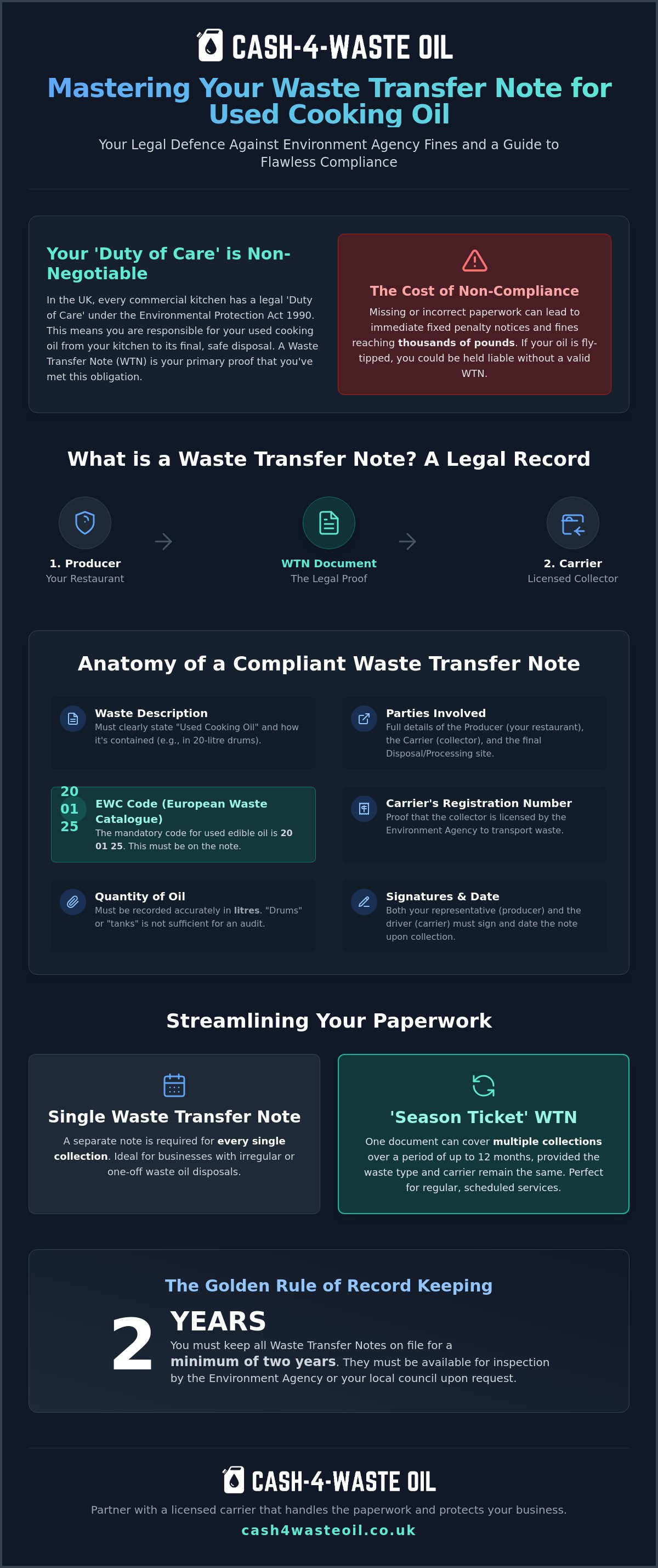
Checklist: What Every Restaurant WTN Must Include
When the collector arrives, don't just sign the first clipboard put in front of you. You are legally responsible for the accuracy of that document. A quick, systematic check ensures your kitchen remains compliant and audit-ready. Use this verification list to confirm exactly what should be on a waste transfer note for cooking oil before the driver leaves your site. If any of these details are missing, the document is legally worthless during an Environment Agency inspection.
- Producer Details: Your restaurant's full name, address, and SIC code.
- Carrier Details: The collection company's name, address, and their Environment Agency registration number.
- Waste Description: The oil must be described as "Used Cooking Oil" or "Edible Oil."
- EWC Code: This must be clearly stated as 20 01 25.
- Quantity: The total volume collected, recorded accurately in litres.
- Destination: The name and address of the authorised facility where the oil is being taken.
- Signatures: Both the driver and a member of your kitchen staff must sign and date the note.
Correct EWC Codes for Cooking Oil
The European Waste Catalogue (EWC) uses specific codes to categorise waste types. Using the wrong code can invalidate your compliance and trigger a more detailed audit of your waste management practices. European Waste Catalogue code 20 01 25 is the specific legal identifier for edible oil and fat waste from commercial kitchens. It's vital to differentiate this from grease trap waste, which often carries a different code. Ensuring 20 01 25 is on your note proves you've correctly identified the material being transferred.
Spotting a Fraudulent Waste Carrier
Rogue collectors often target busy restaurants with promises of quick removal. These "white van" operators frequently lack the necessary licences and may fly-tip your oil to avoid disposal fees. If a collector refuses to provide a WTN, lacks a visible carrier registration number, or cannot name the final disposal site, turn them away. You remain legally liable for where your waste ends up. Partnering with a licensed waste carrier for cooking oil is the only way to guarantee your Duty of Care is fulfilled. Don't risk a heavy fine for the sake of a quick collection. If you want to ensure total compliance and get paid for your waste, book your collection today with a registered professional.
Ensuring Compliance and Profit with Professional Oil Collection
Compliance doesn't have to be a cost centre for your business. Most waste removal services charge for collection and documentation, but we take a different approach. Cash 4 Waste Oil provides a complete solution that combines mandatory legal compliance with immediate financial rewards. We handle the technical side of what should be on a waste transfer note for cooking oil, ensuring every document is fully populated with the required EWC codes and carrier details before we leave your site. You get the legal protection you need without the administrative burden or the service fees.
Our service is designed for the fast-paced hospitality industry. We don't just take your waste; we pay you for it. By providing cash on the spot for every litre of used oil, we turn a logistical chore into a profitable revenue stream. This free collection service is available across London, Surrey, Kent, and the Midlands, delivered by local teams who understand the importance of reliability and promptness. We arrive, we measure, we pay, and we provide the paperwork. It's a seamless transaction that respects your time and your bottom line.
Why Cash 4 Waste Oil is the Safe Choice
Choosing a collector is a decision that impacts your legal standing. We are an Environment Agency registered waste carrier (CBDU244837), giving you total peace of mind that your waste is being handled by authorised experts. Every visit includes the provision of a valid Waste Transfer Note as standard. We don't just dispose of your oil; we ensure it enters the circular economy. Your waste is processed into high-quality, sustainable biodiesel. This process reduces reliance on fossil fuels and gives your kitchen waste a second life as a greener energy source. It's a smart business decision that also supports your environmental goals.
Getting Your Paperwork Right Today
If you're currently using an unreliable collector or struggling with messy paperwork, it's time to switch to a professional service. We've simplified the process so you don't have to worry about the fine details of what should be on a waste transfer note for cooking oil. Our teams arrive on time, measure your oil accurately, pay you in cash, and provide the necessary documentation instantly. For more detailed insights into national standards and how they affect your site, check out our DEFRA cooking oil waste guidance. Booking your first collection is straightforward; just contact our team to arrange a visit that fits your kitchen's schedule. Stop paying for disposal and start getting paid for compliance.
Secure Your Kitchen's Legal Compliance
Mastering your Duty of Care doesn't have to be a burden on your daily operations. By ensuring you have a clear grasp of what should be on a waste transfer note for cooking oil, you protect your business from hefty Environment Agency fines whilst maintaining a transparent audit trail. Remember to verify EWC code 20 01 25 and keep your records for at least two years to stay on the right side of the law. Proper documentation is your best defence against unexpected inspections.
You don't have to handle the complex paperwork alone. As an Environment Agency Registered Carrier, we provide full legal documentation with every visit, taking the administrative weight off your shoulders. We turn your waste into a revenue stream by offering instant cash payments on-site across London, the Home Counties, and the Midlands. It's a pragmatic solution that benefits both your bottom line and the environment.
Book your free collection and get paid cash for your waste oil today. It's time to turn a mandatory chore into a seamless, profitable part of your kitchen's routine.
Frequently Asked Questions
What is a waste transfer note for a restaurant?
A waste transfer note (WTN) is a mandatory legal record that tracks the movement of waste from your premises to a disposal or recycling site. It serves as official proof that you've handed over your used cooking oil to a registered carrier. This document is a core part of your business's legal audit trail and is required for every single load of waste that leaves your restaurant.
Is a waste transfer note a legal requirement for cooking oil?
Yes, it's a strict legal requirement under the UK's Duty of Care legislation. Every time a collector removes oil from your kitchen, a note must be generated, signed, and exchanged. Failing to produce these documents during an Environment Agency inspection can lead to heavy fixed penalty notices or even prosecution against your restaurant. You must never let oil leave your site without one.
How long must a restaurant keep waste transfer notes?
You must keep all waste transfer notes for a minimum of two years from the date of the transfer. These records can be stored physically in a folder or digitally on your computer, provided they're easily accessible for inspectors. Maintaining a well-organised filing system prevents stressful delays during routine compliance checks and proves you take your environmental responsibilities seriously.
What is the EWC code for used cooking oil?
The correct European Waste Catalogue (EWC) code for used cooking oil is 20 01 25. This specific code identifies the waste as edible oil and fat, separating it from other kitchen wastes like grease trap sludge. Ensuring this code is clearly listed is a vital part of what should be on a waste transfer note for cooking oil to ensure the document stands up to legal scrutiny.
Can I use a season ticket for my restaurant's oil collections?
You can use a season ticket if you have regular, predictable collections with the same carrier and the waste type remains identical. These annual notes cover all transfers for up to 12 months, which significantly reduces your administrative workload. It's a pragmatic choice for busy kitchens that want to remain fully compliant whilst avoiding the hassle of managing individual notes for every weekly visit.
Does it cost money to get a waste transfer note?
It shouldn't cost you anything when you partner with a professional and reputable collection service. We provide full legal documentation for free as a standard part of our cash-paying collection process. You get the necessary paperwork whilst receiving instant payment for your waste oil on-site. This approach turns a mandatory legal requirement into a profitable transaction for your restaurant business.
What happens if I do not have a waste transfer note during an inspection?
Failing to produce a valid WTN can result in an immediate fixed penalty notice from the Environment Agency or your local authority. In more serious cases, especially if your waste is later found fly-tipped, it can lead to prosecution and unlimited court-ordered fines. It's your permanent responsibility to prove that every litre of waste oil was handled by a licensed and registered professional carrier.
Who is responsible for filling out the waste transfer note?
Both the restaurant manager and the waste collector share the legal responsibility for the document's accuracy. The carrier usually provides the form, but you must verify what should be on a waste transfer note for cooking oil before adding your signature. Both parties must sign the note to confirm the transfer was handled safely, legally, and in full accordance with UK waste regulations.