
Your used cooking oil isn't a waste product; it's an untapped revenue stream that's likely sitting in a drum taking up valuable kitchen space right now. If you're tired of chasing collectors who miss pick-ups or paying for disposal that should be free, you're not alone. Most hospitality managers feel the same frustration whilst trying to get paid for used cooking oil London wide. It's a common struggle to find a partner who values your time as much as your oil and keeps your Environment Agency paperwork in order.
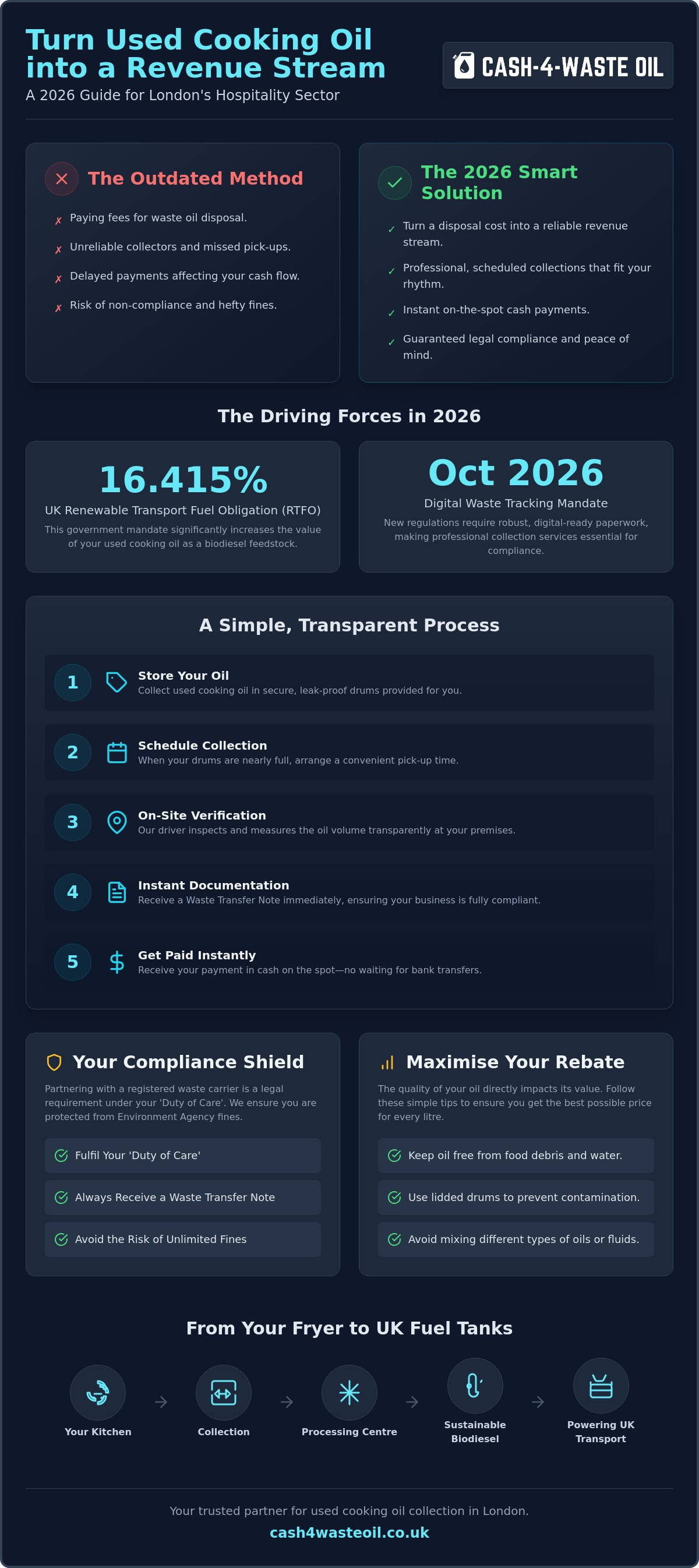
This 2026 guide reveals how you can turn that kitchen waste into immediate cash whilst ensuring your business remains fully compliant with the latest regulations. We'll provide a clear path through the new digital waste tracking mandates coming in October 2026 and explain why the 16.415% RTFO target makes your oil more valuable than ever. You'll learn how to secure your Waste Transfer Notes, avoid the risk of unlimited fines, and establish a reliable collection schedule that actually works for your kitchen's busy rhythm.
Key Takeaways
- Turn your waste disposal costs into a reliable revenue stream by learning how to get paid for used cooking oil London kitchens generate every day.
- Understand the legal necessity of Waste Transfer Notes and how they act as a shield against Environment Agency fines and 'Duty of Care' inspections.
- Maximise your financial rebate by following professional storage tips that prevent oil contamination and maintain high product quality.
- Discover why on-the-spot cash payments offer a significant cash-flow advantage over traditional bank transfer systems for hospitality businesses.
- Learn how to set up a professional, scheduled collection service that ensures your kitchen stays clean whilst remaining fully compliant with 2026 regulations.
Why Your London Kitchen Should Get Paid for Used Cooking Oil
Stop viewing your spent fryer oil as a messy byproduct. In the modern circular economy, that liquid is a valuable commodity. Many London business owners are still stuck in an outdated mindset where they pay waste management companies to haul this away. In 2026, that's effectively throwing money down the drain. You should be looking to get paid for used cooking oil London wide, turning a recurring expense into a predictable rebate that stays in your pocket.
Commercial vs. Residential Disposal in London
It's vital to distinguish between domestic recycling and commercial requirements. Whilst residents can drop off small amounts at local council centres, these facilities are strictly off-limits for businesses. Commercial kitchens operate under a legal "Duty of Care" that mandates the use of a registered waste carrier. Handing your oil to an unlicensed collector or trying to use residential channels isn't just inefficient; it's illegal. Professional collection services remove the burden from your team. Instead of staff wasting hours lugging heavy drums or dealing with spills, a scheduled service handles the logistics safely and provides the necessary documentation. What is used cooking oil (yellow grease)? Understanding this term helps clarify why the biofuel industry is so eager to buy your waste; it's a high-energy feedstock that powers everything from trucks to aeroplanes.
Turning Waste into a Revenue Stream
London's hospitality density is your biggest advantage. Because the city has such a high concentration of pubs and restaurants, collection routes are highly efficient. This efficiency translates directly into better rebates for you. With the UK's Renewable Transport Fuel Obligation (RTFO) set at 16.415% for 2026, demand for your waste oil is at an all-time high. This government mandate drives the need for sustainable feedstock, meaning your kitchen's waste is a critical part of the national energy mix.
Consider the cumulative impact on your bottom line. If your kitchen produces several hundred litres a month, the annual income from rebates can offset other rising operational costs. We've moved beyond simple waste management. We're now in the era of resource recovery. By partnering with a service that pays cash on the spot, you improve your weekly cash flow immediately. You aren't just cleaning your kitchen; you're harvesting a resource that the global market is desperate to acquire. It's a pragmatic business decision that turns a logistical headache into a financial win.
How the 'Cash for Oil' Model Works in 2026
Moving from a cost-centre to a profit-centre is straightforward and efficient. You store your waste oil in secure, leak-proof drums within your kitchen or storage area. When these are nearing capacity, you simply request a collection. Our driver arrives in a specialised vehicle, inspects the oil for contaminants, and measures the volume using calibrated equipment right in front of you. This transparent verification ensures you know exactly how much you'll get paid for used cooking oil London kitchens generate. There's no guesswork, no estimated volumes, and no waiting for a head office statement to arrive in the post.
The Instant Payment Advantage
Most national waste firms operate on a credit system. They collect your oil and promise a rebate weeks or even months later. For a busy London pub or takeaway, this lag is a cash flow killer. The 'cash on the spot' model fixes this. You receive your payment immediately, which simplifies your weekly bookkeeping and provides instant funds for petty cash or kitchen sundries. It's a clean, honest transaction. You see the oil measured, you receive your Waste Transfer Note, and you get paid. Understanding the role of biodiesel demand is key to knowing the used cooking oil price per litre UK and how it fluctuates with the global energy market.
From London Fryers to Sustainable Biodiesel
Your oil doesn't just disappear once it leaves the back of your kitchen. It begins a sophisticated journey to a specialised processing centre. Here, the oil is filtered, heated, and chemically processed into high-quality biodiesel. This refined fuel is then blended with standard diesel to power the UK's transport sector. By 2026, biodiesel production has become the primary application for this waste, accounting for roughly 49% of the market. The environmental benefits of recycling are substantial; every litre you recycle helps reduce the carbon footprint of the very delivery vans and buses navigating London's busy streets.
Partnering with a local, reliable collector means your waste stays within a regional loop. It lowers transport emissions and supports the UK's 16.415% RTFO mandate. You aren't just getting rid of a kitchen nuisance; you're actively contributing to a greener city whilst boosting your restaurant's profitability. It's a pragmatic solution that works for your wallet and the planet simultaneously. When you choose to get paid for used cooking oil London businesses can trust the process is fast, clean, and professional. If you're ready to clear your storage area, you can book your London oil collection today.
Compliance and the Law: The Importance of Waste Transfer Notes
Legal compliance isn't just a tick-box exercise; it's your business's primary protection. Under the Environmental Protection Act 1990, every commercial kitchen has a non-transferable 'Duty of Care'. This means you remain legally responsible for your waste oil until it reaches a licensed processing facility. If you hand your oil to an unlicensed 'cowboy' collector who disposes of it illegally, the Environment Agency holds you liable. To stay protected and still get paid for used cooking oil London kitchen managers must verify their carrier's licence before any transaction takes place.
The official government guidance for businesses confirms that you must only use authorised collectors. With new digital waste tracking mandates coming into force in October 2026, the margin for error is disappearing. Regulators will have real-time visibility into waste movements, making it impossible to hide undocumented collections.
What Is a Waste Transfer Note?
A Waste Transfer Note (WTN) is the critical document that bridges the gap between collection and compliance. Every time a driver picks up your oil, they must provide this note. It contains essential information: your Standard Industrial Classification (SIC) code, the specific waste description (usually EWC code 20 01 25), the volume collected, and the date. You must legally store these records for at least two years. A WTN is essentially a legal receipt that confirms your business has fulfilled its statutory obligation for responsible waste disposal.
Avoiding London Council Fines
Boroughs like Westminster, Soho, and Camden are hotspots for environmental inspections. Health and safety officers often conduct spot checks, specifically asking to see waste disposal logs. If you're missing paperwork, the consequences are severe. You risk unlimited fines and, in extreme cases, criminal prosecution. These audits aren't just about paperwork; they're about preventing environmental damage.
London’s sewers are already struggling with 'fatbergs', which are gigantic masses of congealed oil and grease. Pouring oil away or using unreliable collectors contributes to this crisis. A professional, licensed collector serves as your first line of defence during a regulatory audit. By establishing clear waste oil contracts for restaurants, you secure your business's long-term safety and reputation. When you look to get paid for used cooking oil London providers should offer more than just cash; they must provide the total peace of mind that comes with full legal transparency.
Maximising Your Rebate: Tips for London Kitchen Managers
Securing the best price for your waste oil isn't just about market fluctuations. It's about how you manage the product before the driver arrives. To get paid for used cooking oil London kitchens must treat their waste like a raw material rather than a nuisance. If your oil is heavily contaminated, it requires more intensive processing, which inevitably lowers the rebate you receive. By following a few simple kitchen protocols, you ensure every litre collected translates into the highest possible cash payment.
Maintaining Oil Purity
Water is the most common contaminant. It degrades the oil and causes significant issues during the chemical conversion to biodiesel. Always keep your storage drum lids tightly sealed, especially if they're kept in damp areas or near washing-up stations. Whilst a small amount of food debris is expected, excessive sediment reduces the usable volume. Use a simple mesh filter when pouring spent oil into the collection drum to keep the product clean. Most vegetable oils, such as rapeseed, sunflower, and palm, can be mixed without issue. However, never mix mineral oils or engine oils with your cooking waste. This renders the entire batch worthless and legally complicates your disposal process.
Efficient Storage Solutions
Space is at a premium in London. You need to choose a container that fits your kitchen's footprint whilst meeting the 100-litre industry standard for rebates. A 60-litre barrel might be easier to tuck away, but you'll need at least two for a profitable collection. For high-volume sites, a 1000-litre IBC is the most efficient choice. Placement is equally critical. Ensure your drums are stored in a secure, well-lit area to deter theft, as used cooking oil has become a high-value target for unlicensed 'grease thieves'.
London's narrow streets and strict parking regulations mean access is everything. Store your oil in a location where a driver can reach it quickly without blocking traffic. Align your collection schedule with your busiest delivery days to ensure your storage area is cleared just as new supplies arrive. This keeps your kitchen tidy and your cash flow consistent. If you want to get paid for used cooking oil London-wide with a service that understands these logistical challenges, book your London oil collection to start turning waste into profit today.
Choosing Cash 4 Waste Oil for Your London Collection
London kitchens move at a relentless pace. You need a partner who keeps up without creating extra work for your team. Cash 4 Waste Oil is a specialised ally for the capital's hospitality sector, offering a service that's fast, clean, and professional. We don't just pick up waste; we provide a reliable system that integrates with your daily operations. Whether you're in the heart of the West End or operating across Kent and Surrey, our local drivers ensure your kitchen stays clear and compliant. To get paid for used cooking oil London businesses need a collector who values punctuality as much as purity.
A Local Service for a Global Capital
Operating in London brings unique challenges that national corporate giants often overlook. Our drivers are experts at navigating the city's complex logistics, from the Congestion Charge and ULEZ requirements to strictly timed loading bays in Soho and the City. This deep local knowledge makes us the preferred choice for hotel waste oil collection London managers rely on for discreet and efficient service. We take the "hassle-free" promise seriously. We handle the heavy lifting, manage the containers, and issue your Waste Transfer Notes on-site. You won't have to deal with administrative delays or logistical bottlenecks.
Ready to Get Started?
Starting your revenue-led waste strategy is simple and transparent. Before your first collection, run through this quick checklist to ensure a seamless experience:
- Volume: Check that you have at least 100 litres ready for collection to trigger your cash rebate.
- Location: Identify a clear, safe spot for your drums that's easily accessible for our collection team.
- Access: Note any height or width restrictions that might affect our specialised vehicles amongst London's narrow backstreets.
Our 'cash on the spot' model is designed for the fast-moving world of hospitality. You won't find yourself chasing a distant finance department for a bank transfer weeks after your oil has left the premises. We value immediate results and total transparency. As a 100% licensed, Environment Agency registered partner, we ensure your business is legally protected from the first litre to the last. Stop viewing your spent oil as a disposal problem and start seeing it as a financial asset. Contact us today for a free, no-obligation quote and find out exactly how much you can get paid for used cooking oil London wide.
Secure Your Kitchen’s Financial and Regulatory Future
Turning your spent oil into profit is a smart business move that streamlines your operations. You've seen how easy it is to move from paying for disposal to receiving cash on the spot. By keeping your oil pure and your collection schedule consistent, you maximise your rebate whilst supporting the UK's 2026 biofuel targets. It's a pragmatic way to boost your bottom line without adding to your team's workload.
Legal safety is paramount. Never compromise your business by using unlicensed collectors. Partnering with a fully Environment Agency Licensed provider ensures you receive mandatory Waste Transfer Notes at every visit. This documentation is your only defence against potential fines during council inspections. If you're ready to get paid for used cooking oil London businesses generate, don't leave it to chance. Get an instant quote and book your London oil collection today to experience a reliable, professional service that puts cash back into your kitchen. Your waste is a valuable resource; start treating it like one.
Frequently Asked Questions
How much do you pay for used cooking oil in London?
The rebate you receive depends on the current global market demand for biofuels, the total volume collected, and the quality of the oil. Higher purity levels and larger quantities typically command better rates. We provide a transparent valuation at the point of collection and ensure you get paid for used cooking oil London wide with immediate cash on the spot.
Is there a minimum volume for free collection?
We typically require a minimum of 100 litres to provide a free collection and a cash rebate. This volume ensures the route is logistically viable and allows us to offer the most competitive rates to our clients. If you have smaller quantities, we recommend waiting until you have reached this threshold to maximise your financial return.
Do you provide a Waste Transfer Note at the time of collection?
Yes, we provide a legal Waste Transfer Note (WTN) for every single collection we perform. This document is a mandatory requirement under the Environmental Protection Act 1990 and serves as your proof of responsible disposal. You must retain these records for at least two years to remain compliant with Environment Agency audits and local council spot checks.
What types of oil do you collect from commercial kitchens?
We collect all standard vegetable-based cooking oils used in commercial fryers, including rapeseed, sunflower, corn, and sustainable palm oil. It's perfectly acceptable to mix these different vegetable oils in your storage drums. However, we cannot collect mineral oils, engine oils, or oils heavily contaminated with water or chemicals, as these cannot be processed into biodiesel.
Can you collect used cooking oil from my home in London?
No, our service is strictly for commercial kitchens, including restaurants, pubs, hotels, and catering units. We do not offer residential oil collection. If you are a resident looking to dispose of domestic cooking oil, you should contact your local London borough council to find your nearest household waste recycling centre.
How often can I schedule a waste oil collection?
You can schedule collections as often as your kitchen requires, whether that's weekly, fortnightly, or on an ad-hoc basis. Many of our London clients prefer to align their oil collections with their busiest delivery days to keep their storage areas clear. We work with you to establish a reliable schedule that prevents overflows and maintains kitchen safety.
What happens to the oil after you collect it?
Your waste oil is transported to a licensed refinery where it undergoes filtration and chemical processing to become sustainable biodiesel. This refined fuel is then used in the UK transport sector, helping to meet the 16.415% RTFO mandate for 2026. This process ensures your kitchen waste contributes directly to the circular economy and reduces national carbon emissions.
Are you licensed by the Environment Agency?
Yes, we are a fully registered and licensed waste carrier with the Environment Agency. This accreditation is vital for your business because it ensures we operate within strict legal frameworks. When you get paid for used cooking oil London through a licensed partner, you are protected from the "Duty of Care" liabilities that come with using unlicensed collectors.