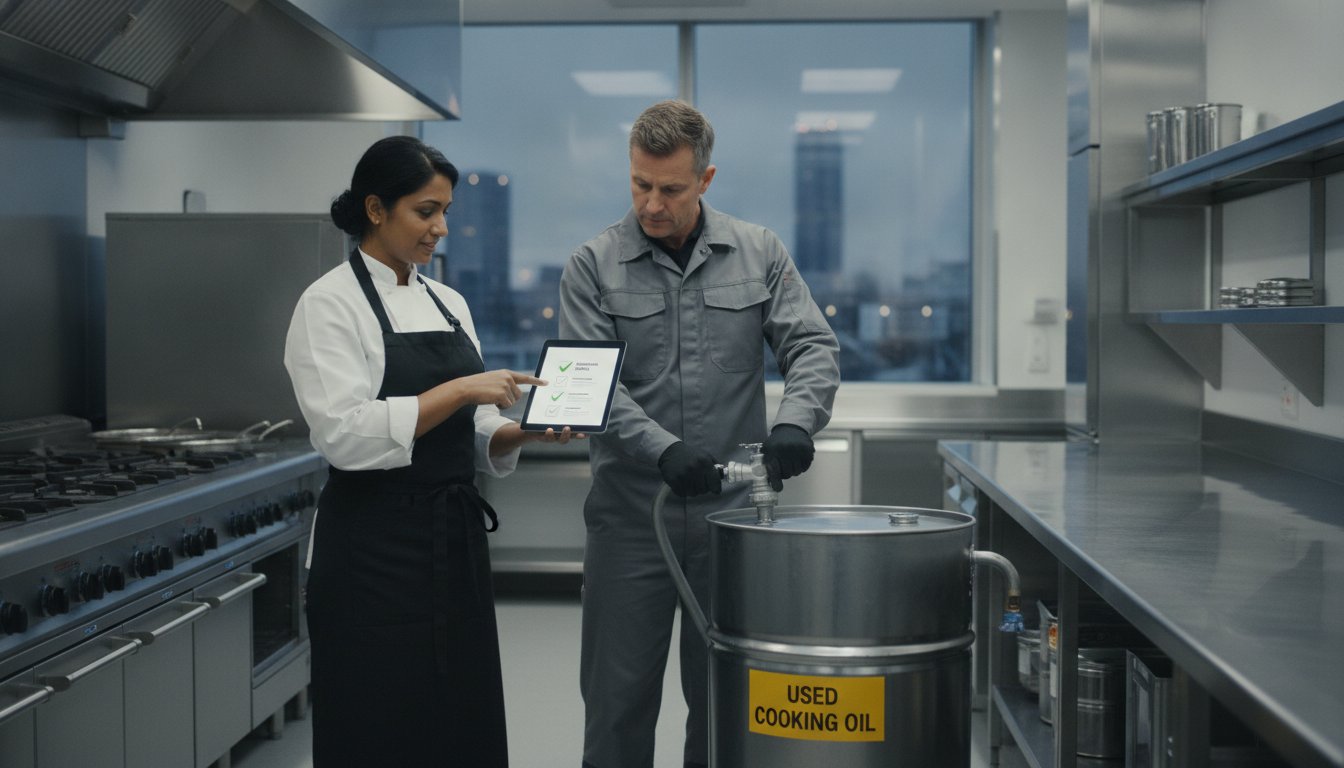
What if the messy sludge taking up space in your kitchen wasn't a legal liability, but a hidden revenue stream? Managing used cooking oil is often a greasy, stressful chore that leads to blocked drains and cluttered storage areas. You likely already know that the best way to dispose of commercial fryer oil isn't down the drain; however, keeping up with shifting regulations whilst running a fast-paced service is a constant challenge.
It's true that the pressure is mounting. With the new digital waste tracking mandate arriving in October 2026 and potential fines of up to £5,000 for non-compliance, you can't afford to get it wrong. This guide promises to help you organise your disposal routine by showing you how to transform your waste into a hassle-free source of income. We'll explore the latest Environment Agency requirements, the transition from paper to digital tracking, and the most efficient way to keep your kitchen compliant and profitable.
Key Takeaways
- Understand your legal "Duty of Care" and how to avoid unlimited fines by using an Environment Agency registered collector.
- Discover why professional collection is the best way to dispose of commercial fryer oil compared to the risks of binning or council disposal.
- Learn practical steps to safely cool and filter your oil to prevent drain blockages and maintain a hygienic kitchen environment.
- Prepare for the October 2026 digital waste tracking mandate to ensure your business stays compliant with the latest DEFRA regulations.
- Find out how to transform messy waste into immediate revenue through free collections and on-the-spot cash payments.
Why Finding the Best Way to Dispose of Commercial Fryer Oil is Critical
Disposing of used cooking oil isn't a task you can delegate without oversight. Under UK environmental law, including the Environmental Protection Act 1990, every commercial kitchen has a "Duty of Care." This means you are legally responsible for your waste from the moment it leaves the fryer until its final disposal. Identifying the best way to dispose of commercial fryer oil is no longer just about kitchen hygiene; it's a matter of legal survival.
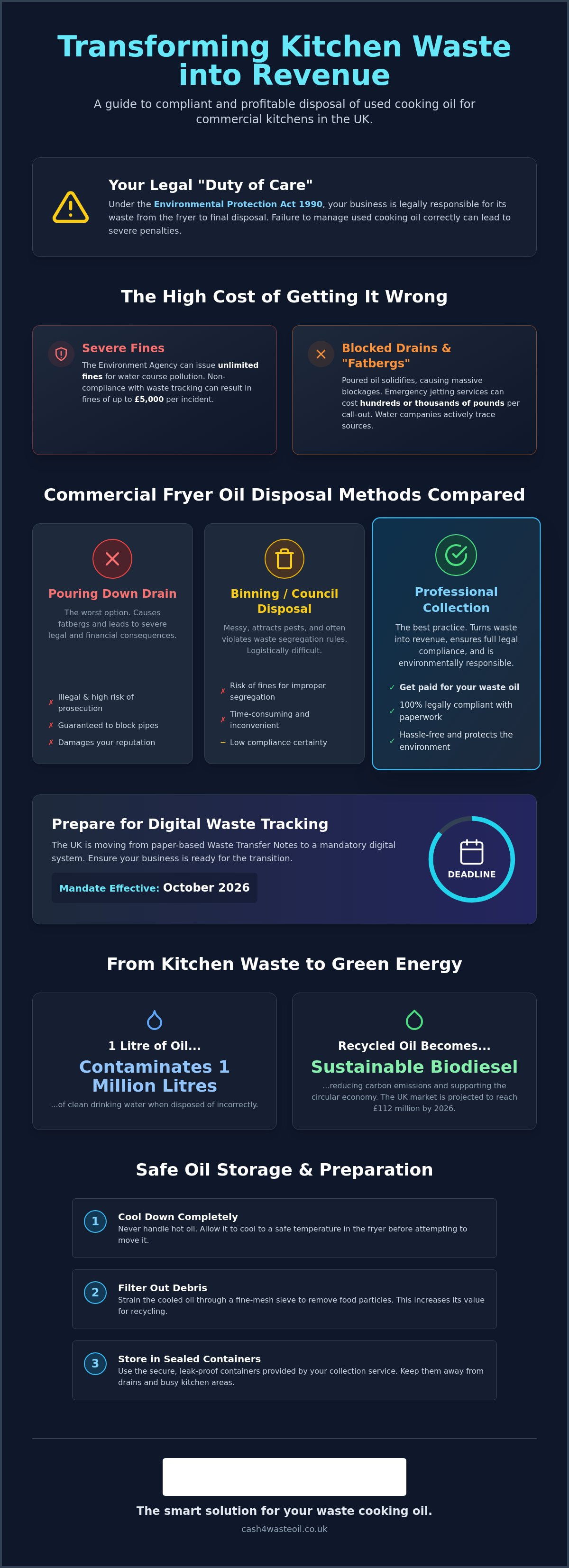
UK water companies are currently conducting aggressive crackdowns on hospitality businesses. They are using advanced CCTV to trace "fatbergs"—massive blockages of congealed fat and debris—directly back to the source. If the trail leads to your back door, the consequences are severe. Fines can be unlimited, and the Environment Agency is strengthening enforcement throughout 2026 to ensure liquid food waste stays out of the public sewer system. Failure to comply with the new digital waste tracking system alone can result in fines of up to £5,000 per incident.
The Hidden Costs of Improper Oil Disposal
The financial impact of poor oil management goes far beyond potential fines. If your drains seize up, emergency jetting services can cost hundreds, if not thousands, of pounds per visit. There is also the significant risk of reputational damage; a local authority environmental audit failure can lead to forced closures or a plummeting hygiene rating. It is vital to understand that fryer oil is classified as "Trade Effluent," which is defined as any liquid waste produced in the course of a business and is strictly prohibited from being discharged into public sewers.
Environmental Impact: From Kitchen Waste to Biofuel
The environmental stakes are equally high. A single litre of poured oil can contaminate up to one million litres of clean water. However, when handled correctly, this waste becomes a valuable commodity. In the industry, used cooking oil is often referred to as what is yellow grease, a vital feedstock for the circular economy. Finding the best way to dispose of commercial fryer oil involves more than just finding a bin; it requires a strategy that protects your bottom line and the planet.
By 2026, the UK's cooking oil recycling market is projected to reach £112 million as more kitchens transition from waste producers to green partners. Converting your used oil into sustainable biodiesel significantly reduces carbon emissions. This helps your business meet national sustainability goals whilst turning a logistical headache into an environmental win.
Comparing Methods: What is the Best Way to Dispose of Commercial Fryer Oil?
Choosing a disposal method is about balancing cost, effort, and legal safety. Many kitchens start by "binning" their oil in sealed containers within general waste. This is a mistake. Not only is it incredibly messy, but it also attracts pests and frequently leads to leaks that contaminate your bin store. For anything beyond domestic volumes, this method often violates UK government guidelines regarding commercial waste segregation. You risk heavy fines if a waste contractor discovers liquid oil in your general bins.
Council disposal is another option, yet it remains a logistical nightmare for busy chefs. Transporting large drums of used oil to a municipal site in a private vehicle is dangerous and time-consuming. You are a business owner, not a waste courier. The best way to dispose of commercial fryer oil is to use a professional collection service. Unlike traditional waste management contracts that charge you for every pickup, the modern "Cash for Oil" model turns your waste into a revenue stream. You receive on-the-spot payments whilst ensuring your kitchen stays 100% compliant.
Why Pouring Oil Down the Drain is Never an Option
As oil cools, it undergoes a chemical change, solidifying into a waxy substance that clings to Victorian-era pipework. Even if you flush it with hot water, it eventually hardens further down the line, contributing to fatbergs. Under the Environmental Protection Act 1990, you have a legal "Duty of Care" to prevent this. Modern grease traps are excellent for catching incidental runoff from washing up, but they are not a total disposal solution for bulk fryer oil. Using them as a primary disposal point will lead to frequent, expensive blockages and potential prosecution.
The Pros and Cons of Scheduled vs. On-Call Collection
Efficiency depends on how you organise your pickups. A fixed schedule works well for high-volume kitchens with a predictable oil turnover, ensuring your storage space never becomes overwhelmed by leaking drums. Conversely, on-call services offer essential flexibility during fluctuating periods, such as the Christmas rush or summer holidays. You can learn more about the long-term benefits of this approach in our guide to Sustainable Waste Oil Disposal. If you want to simplify your back-of-house operations immediately, you can book a collection online to see how the process works.
Legal Compliance: Waste Transfer Notes and the Environment Agency
Compliance is your business's safety net. In the eyes of the law, ignorance is never a valid defence. If your used oil is found fly-tipped in a local hedgerow or poured into a public drain, the Environment Agency (EA) will trace it back to your kitchen. To prevent this, using an EA-registered collector is non-negotiable. It's the only way to prove you've met your legal "Duty of Care" obligations. The best way to dispose of commercial fryer oil whilst protecting your business is to ensure every drop is accounted for with a valid Waste Transfer Note (WTN).
A WTN is a legal document that tracks the movement of waste from your premises to its final destination. You must receive one for every single collection, regardless of whether you are being paid cash or using a free service. Under UK government regulations, you are required to keep these records for a minimum of two years. During a council hygiene visit or an environmental audit, these notes are often the first thing an inspector will ask to see. If you cannot produce them, you face the risk of unlimited fines or criminal prosecution.
What Must Be Included on Your Waste Transfer Note?
A valid WTN isn't just a simple receipt. It must contain specific technical data to be legally binding. Ensure your documentation includes your business's Standard Industrial Classification (SIC) code and the correct European Waste Catalogue (EWC) code for used cooking oil, which is 20 01 25. It should also feature the names and addresses of both the producer and the carrier, along with their registration numbers and signatures.
By October 2026, the UK is transitioning to a mandatory digital waste tracking system. This move replaces traditional paper-based notes with a more transparent, real-time database managed by DEFRA. You can find a detailed breakdown of these upcoming changes in our DEFRA Cooking Oil Waste Guidance. Staying ahead of this digital shift is essential for maintaining a seamless, compliant kitchen operation.
Verifying Your Collector's Licence
Don't take a collector's word for it. You can easily verify a carrier's legitimacy by checking the Environment Agency's public register for a waste carrier licence. "Cowboy" collectors often offer free pickups but lack the necessary insurance or licensing to handle commercial waste. If they dump your oil illegally, the liability rests on your shoulders. Professional services like ours provide full legal documentation and on-the-spot cash payments, ensuring the best way to dispose of commercial fryer oil is also the safest for your reputation.
Practical Steps for Efficient Oil Storage and Preparation
Establishing a solid back-of-house routine is the best way to dispose of commercial fryer oil without disrupting your service. Effective storage isn't just about finding a corner for a drum; it's about maintaining oil quality and kitchen safety. If your oil is prepared correctly, the collection process becomes a seamless, five-minute task rather than a messy ordeal. Follow these four steps to streamline your storage:
- Step 1: Cool the oil. Never transfer oil whilst it's hot. Allow the temperature to drop below 40°C to prevent burns and ensure storage drums don't melt or warp.
- Step 2: Filter the waste. Use a fine mesh to remove large food particles and breadcrumbs. Removing these solids prevents the oil from going rancid and stops pests from being attracted to your storage area.
- Step 3: Use the right containers. Store your waste in high-quality, leak-proof blue drums or the original oil containers. Ensure the lids are tightly sealed to prevent rainwater from entering, which can degrade the oil.
- Step 4: Designate an 'oil centre'. Organise a specific area in your yard or loading bay for storage. This spot must be easily accessible for collection vehicles to ensure a fast, hassle-free pickup.
Health and Safety: Handling Hot Fryer Oil
Safety is paramount during an oil change. Slips and burns are amongst the most common kitchen injuries, so always use appropriate PPE, including heavy-duty heat-resistant gloves and aprons. Ensure the floor is dry and clear of obstacles before moving any containers. Never store your oil drums near fire exits, high-traffic corridors, or heat sources. A cluttered yard is a safety hazard and can lead to expensive insurance claims if an accident occurs.
Maximising Your Oil Rebate
The value of your waste oil depends heavily on its purity. Clean oil is a favourite feedstock for biodiesel production, whereas contaminated oil is far less valuable. Keep your drums under cover to prevent water ingress, as even a small amount of moisture can complicate the recycling process. Most importantly, never mix mineral oil, such as engine oil or hydraulic fluid, with your vegetable oil. Doing so makes the entire batch worthless and legally hazardous to transport. For more storage hacks, check out our Used Fryer Oil Collection Tips.
Ready to turn your waste into profit? You can book your free oil collection today and get paid cash on the spot.
The Cash 4 Waste Oil Solution: Turning Waste into Profit
Stop viewing your used oil as a burden. At Cash 4 Waste Oil, we specialise in transforming your kitchen waste into a cash-generating asset. We've established that the best way to dispose of commercial fryer oil involves balancing legal compliance with financial return. Our service is designed to do exactly that, providing a free collection service that pays you on the spot. We take the stress out of waste management so you can focus on running your service.
Our process is built for speed and transparency. You call us, we arrive at your premises, and we handle the heavy lifting. We weigh your oil, pay you cash immediately, and issue a mandatory Waste Transfer Note before we leave. This ensures your kitchen remains 100% compliant with Environment Agency standards without any administrative headache. Every litre we collect is diverted away from sewers and into the circular economy, where it's refined into sustainable biodiesel to power the UK's green future.
Why London and Midlands Kitchens Choose Us
We act as a local partner for kitchens across the UK. Whether you operate a busy bistro in Soho or Camden, or a large-scale takeaway in Birmingham or Leicester, our teams understand your specific logistical needs. In a tough economy, every pound counts. We help pubs, hotels, and independent eateries stay profitable by turning a traditional cost centre into a reliable revenue stream. Our no-nonsense approach to paperwork means you spend less time on compliance and more time on your customers.
Get Started Today: Your First Collection
Booking your first collection is straightforward. You can reach out via phone or use our online form for a rapid response. We handle all volumes, from a few blue drums to massive bulk storage tanks. Don't let leaking drums take up valuable floor space or risk expensive drain blockages. Join the hundreds of UK businesses already benefiting from our reliable, professional, and profitable disposal service.
Contact Cash 4 Waste Oil for your free collection and cash rebate.
Future-Proof Your Kitchen with Smarter Oil Management
Managing your used cooking oil doesn't have to be a logistical headache or a legal risk. By moving away from outdated "binning" methods and embracing professional collection, you protect your business from hefty fines and expensive drain repairs. It's about more than just compliance; it's a smart business move that supports the UK's circular economy whilst putting money back into your pocket.
Partnering with a licensed expert is the best way to dispose of commercial fryer oil without disrupting your daily service. As an Environment Agency Registered Carrier, we take the burden of paperwork off your shoulders. We provide instant Waste Transfer Notes and pay cash on the spot for every litre collected, ensuring your kitchen stays 100% compliant and profitable in 2026 and beyond.
Turn your waste oil into cash today – Book your free collection with Cash 4 Waste Oil
Take control of your waste today and turn a messy liability into a stress-free revenue stream for your business.
Frequently Asked Questions
Is it illegal to put cooking oil in the bin in the UK?
Yes, it is illegal for commercial businesses to dispose of liquid cooking oil in general waste bins. UK waste regulations require businesses to segregate their waste, and pouring liquid oil into a bin can lead to leaks, pest infestations, and contamination. Using a licensed carrier is the best way to dispose of commercial fryer oil whilst ensuring you stay compliant with the Environmental Protection Act 1990.
Can I pour small amounts of fryer oil down the sink if I use hot water?
No, you must never pour any amount of oil down the sink, even with hot water and detergent. Whilst the oil may seem liquid at the point of entry, it quickly cools and solidifies further down the pipework. This process creates fatbergs and blockages that water companies can trace back to your kitchen using CCTV, often resulting in unlimited fines and repair costs.
How much cash can I get for my used commercial fryer oil?
The cash rebate you receive is determined by the current market value of used cooking oil and the total volume collected. Market rates fluctuate based on the demand for biodiesel feedstock. Our model ensures that instead of paying a waste contractor for disposal, you receive a prompt payment on the spot, turning a messy waste product into a predictable revenue stream.
What happens if I don't have a Waste Transfer Note for my oil?
Failure to produce a valid Waste Transfer Note (WTN) during a local authority or Environment Agency audit can lead to unlimited fines and criminal prosecution. A WTN is your only legal proof that you've fulfilled your "Duty of Care." You are legally required to keep these records for at least two years to demonstrate that your waste was handled by a registered carrier.
Does Cash 4 Waste Oil collect from residential homes?
No, we do not offer residential oil collection services. Our business is strictly focused on the commercial sector, providing tailored collection solutions for pubs, restaurants, takeaways, and hotels. Domestic users should contact their local council to find the nearest household waste recycling centre that is equipped to handle used cooking oil from residential kitchens.
How often should a commercial kitchen have its waste oil collected?
Most high-volume kitchens benefit from a collection every two to four weeks. The exact frequency depends on your fryer capacity and oil change routine. We recommend organising a regular schedule to ensure your storage area remains clear and to prevent drums from becoming overfilled, which can lead to spills and safety hazards in your loading bay.
What is the best container for storing waste fryer oil before collection?
The best way to dispose of commercial fryer oil safely is to store it in 60-litre or 120-litre blue plastic drums designed for liquid waste. If these aren't available, using the original containers the oil was delivered in is an acceptable alternative. Always ensure lids are tightly secured to prevent water ingress and store them on a level surface away from drains.
Is used vegetable oil actually used for biodiesel?
Yes, the vast majority of the used cooking oil we collect is processed and refined into sustainable biodiesel. This renewable fuel is a vital component in the UK's move towards a circular economy, significantly reducing carbon emissions in the transport sector. By recycling your oil, your business directly contributes to a greener energy grid whilst clearing a waste product from your premises.